


Key Takeaways:
- Smoke shops can generate anywhere from $300,000 to over $800,000 in annual revenue, but profit margins vary widely depending on the product mix: cigarettes can run as low as 4%, while accessories and vape products can exceed 50%.
- Startup costs typically range from $50,000 to $150,000, and ongoing compliance costs vary widely by state and can materially affect net margins.
- The most profitable smoke shops are not the ones with the highest revenue; they are the ones with the best product mix, the tightest inventory management, and the strongest repeat-customer base.
Smoke shops can be genuinely profitable businesses, but the numbers vary more than most people realize before they open one. A shop in a high-traffic urban location selling a diverse mix of vape products, accessories, and premium tobacco can look very different financially from a small-town shop running mostly on cigarette sales. Revenue figures alone do not tell the full story.
This post breaks down what smoke shops actually make, where the margins come from, what it costs to get started, and what the most profitable shop owners do differently from those who struggle to break even.
If you’re researching whether to open a smoke shop, the next two sections on revenue and startup costs are the most relevant. And if you already run one, jump down to the section on how to improve smoke shop profitability.
How Much Does a Smoke Shop Make?
Revenue for smoke shops varies widely. A small or newly opened shop might bring in $150,000 to $300,000 in its first year. A well-established mid-size shop in a decent location typically lands between $300,000 and $500,000 annually. High-performing shops in strong locations with diversified product offerings can reach $800,000 or more per year.
On a monthly basis, a mid-size shop averaging $400,000 in annual revenue is generating roughly $33,000 a month before expenses. How much of that becomes actual profit depends almost entirely on product mix and operating costs, which is why two shops with similar revenue can have very different bottom lines.
What Are Typical Smoke Shop Profit Margins?
Smoke shop profit margins range from about 20% to 80% depending on what you sell and how well you manage your costs. That is an unusually wide range, and it is almost entirely explained by product mix. A shop that leans heavily on cigarettes will sit at the low end. A shop that prioritizes vape products, accessories, and glassware will sit much higher.
To calculate your margin, subtract your cost of goods sold from your revenue, divide by your revenue, and multiply by 100.
Smoke Shop profit margin example:
A shop doing $500,000 in annual sales with $315,000 in cost of goods is running at a 37% gross margin, meaning 37 cents of every dollar goes toward covering overhead and profit before other expenses.
Profit Margins by Product Category
Not all smoke shop products are created equal, and understanding the margin profile of each category is one of the most important things a shop owner can know (the right smoke shop POS system is the key):
- Cigarettes: 4 to 6% net margin. Low margin, high volume, and a traffic driver that brings customers in regularly. Necessary but not profitable on its own.
- Cigars and premium tobacco: 15 to 30% depending on brand and format. Premium cigars in particular carry stronger margins and attract a higher-spending customer.
- Vape products and e-cigarettes: 20 to 40% margin on devices and liquids, with some proprietary or boutique products running higher.
- Glassware and smoking accessories: Often 50% or more. Pipes, grinders, rolling papers, and related accessories are among the highest-margin items a smoke shop can carry.
- CBD and alternative products: Variable, but generally strong. Demand has grown steadily and margins on CBD products often sit between 40% and 60% for specialty retailers.
Smoke Shop Profit Margins in Practice
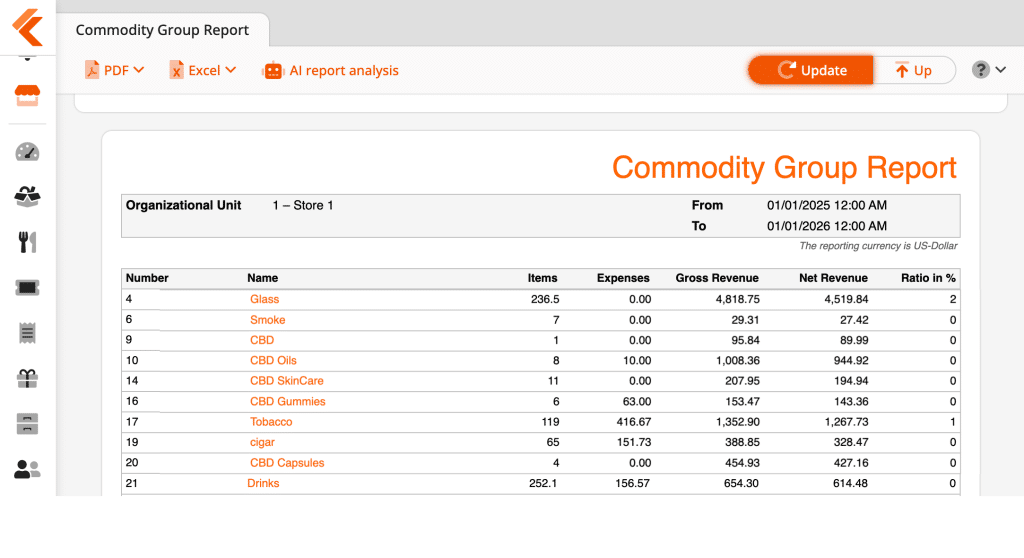
Take Derek, a smoke shop owner in Las Vegas, Nevada using KORONA POS. He pulled his Commodity Group Report in KORONA Studio for the prior year and was surprised by what he found:
- Glass: 236.5 items sold, $4,818 gross revenue (his top category by a wide margin)
- Tobacco: $1,352 across 119 items
- Drinks: $654
- Cigar: $388 on 65 items
- Smoke: $29 across just 7 items for the entire year (the category he considered his core business)
His customers were coming in for glass and accessories, not the cigars and cigarettes he had been prioritizing in his reorder budget. He shifted his floor plan, expanded glass and CBD oils, and stopped chasing cigar volume that was not there. Two quarters later, his blended margin had improved because his buying finally matched his data.
How Much Does It Cost to Open a Smoke Shop?
Opening a smoke shop typically costs $50,000 to $150,000 depending on location, size, and buildout scope. Here is where that money goes:
| Cost category | Estimated range |
|---|---|
| Store buildout and fixtures | $10,000 to $50,000 |
| Opening inventory | $20,000 to $40,000 |
| Licensing and permits | $1,000 to $5,000+ |
| POS system and equipment | $1,500 to $5,000 |
| Signage and branding | $2,000 to $8,000 |
These are estimates. Your specific market will move the needle significantly in either direction.
Ongoing Operating Costs to Plan For
Beyond startup, the main ongoing costs to budget for are:
- Rent: Anywhere from a few thousand dollars a month in a secondary market to $10,000 or more in a high-traffic metro area.
- Staffing: A single-location shop typically needs two to four employees depending on hours.
- Inventory replenishment: Your largest recurring expense, and the one most directly tied to your margin decisions.
- Compliance: Tobacco excise taxes, FDA regulations, age verification requirements, and local vape ordinances all add overhead that is easy to underestimate until you are already open.
Compliance in particular catches new owners off guard. These costs vary significantly by state and sit on top of your cost of goods, so they compress your margin in ways that do not show up in a basic revenue projection.
Key Factors That Determine Smoke Shop Profitability
Revenue and margins do not happen in a vacuum. The shops that perform consistently well share a few common characteristics that have less to do with luck and more to do with decisions made before and shortly after opening.
Location and Foot Traffic
Location affects both your revenue ceiling and your cost structure: a busy street brings more foot traffic but higher rent, while a lower-traffic area cuts overhead but requires more active marketing to compensate. Before signing a lease, research foot traffic patterns, nearby competition, and local demographics, because a neighborhood that skews toward budget cigarette buyers will never support a premium accessories business regardless of how well the shop is run.
Product Mix and Inventory Management
Product mix is the single biggest lever a smoke shop owner controls, and shops leaning heavily on cigarettes cap their own margins at 4 to 6%, while a strong vape, accessory, and CBD section can run margins two to ten times higher on a meaningful share of sales. Tracking sales velocity and turnover by category turns buying into a system and keeps slow-moving inventory from crowding out the higher-margin products that should be taking that shelf space.
Compliance and Regulatory Costs
Tobacco retail carries real regulatory overhead: state excise taxes on cigarettes range from under $1 to over $4 per pack, those taxes come directly out of your margin, and vape products are increasingly subject to their own excise tax structures as well. None of this makes a smoke shop unprofitable, but underestimating these costs when projecting margins is one of the most common ways new owners end up surprised by their first-year numbers.
Competition and Market Saturation
Lower barriers to entry mean competitive saturation is a real concern in some markets, and a trade area already served by three or four established shops may not have room for another general-purpose one. A shop that specializes in premium cigars, a curated vape wall, or a CBD-forward assortment has a clearer reason to exist than one trying to carry a little of everything.

Free printable templates and checklists to help you manage retail operations with ease
How to Improve Smoke Shop Profitability
For shops already open, profitability improvement is usually a combination of margin optimization and customer retention, not just chasing higher revenue.
Expand Into High-Margin Products
Vape products, glassware, rolling accessories, and CBD all carry significantly better margins than cigarettes, and adding a dedicated section does not require overhauling your whole store. Start with what customers are already asking for: if you are sending people elsewhere for accessories, that is money walking out the door.
Build a Loyalty Program
Smoke shop customers are creatures of habit, which makes loyalty programs unusually effective here. Nina, a mid-Atlantic shop owner, set up a simple points program through KORONA’s CRM and saw her loyalty members spending about 22% more per visit than non-members within six months.
Tighten Inventory Management
KORONA Studio’s Stock Return Rates report (under Evaluations) flags any SKU with returns running high relative to sales, which is usually the first sign that a product is worth dropping before you reorder it. Pair that with the ABC Analysis and you have a clear view of what is making you money, what is sitting, and what is causing problems.
Inventory management a headache?
KORONA POS makes stock control easy. Automate tasks, generate custom reports, and learn how you can start improving your business.
Negotiate Better With Suppliers
Most distributors will offer bulk discounts or better payment terms if you ask, especially once you have a consistent order history behind you. Every point you cut from your cost of goods goes directly to your bottom line, making supplier negotiation one of the highest-ROI habits a shop owner can build.
PRO TIP!
Every percentage point you shave off your cost of goods goes directly to your bottom line. A shop doing $400,000 in annual revenue that negotiates its COGS down by 3% gains $12,000 in additional profit without changing anything else. Supplier negotiation is one of the highest-ROI activities a smoke shop owner can focus on.
Is Opening a Smoke Shop Worth It?
For the right operator in the right market, yes. Startup costs are relatively low, customers come back regularly, and the margin opportunity is real if you build the right product mix.
The caveat is that the regulatory environment has gotten more complex, especially around vape and flavored nicotine products. The shops that struggle are usually not the ones that failed to attract customers; they are the ones that underestimated compliance costs going in.
Smoke Shop Profitability Comes Down to Margin, Not Just Revenue
A smoke shop that does $800,000 in annual revenue but sells mostly cigarettes is not necessarily more profitable than one doing $400,000 with a strong vape and accessories mix.
What you sell, how efficiently you manage your inventory, and how well you retain customers matter more than your top-line number. The retailers who build consistently profitable smoke shops treat margin as the metric that matters, track their product-level data closely, and make buying decisions based on the numbers.
FAQs: Smoke Shop Profitability
Do smoke shops make more money in certain seasons?
Yes, though the pattern varies by product mix. Shops with a strong selection of outdoor or festival-oriented accessories often see a summer lift. Cigar and premium tobacco sales tend to spike around the holidays. Vape products sell more consistently year-round, which is another reason a diversified product mix helps stabilize revenue across seasons.
How does an online presence affect smoke shop revenue?
Tobacco and nicotine products face significant restrictions on online sales and shipping, so e-commerce is not a realistic revenue channel for most smoke shop owners. However, a strong local SEO presence, an active Google Business Profile, and social media can meaningfully drive in-store foot traffic. Many customers search for smoke shops near them before visiting, so showing up well in local search is one of the highest-ROI marketing moves an owner can make.