

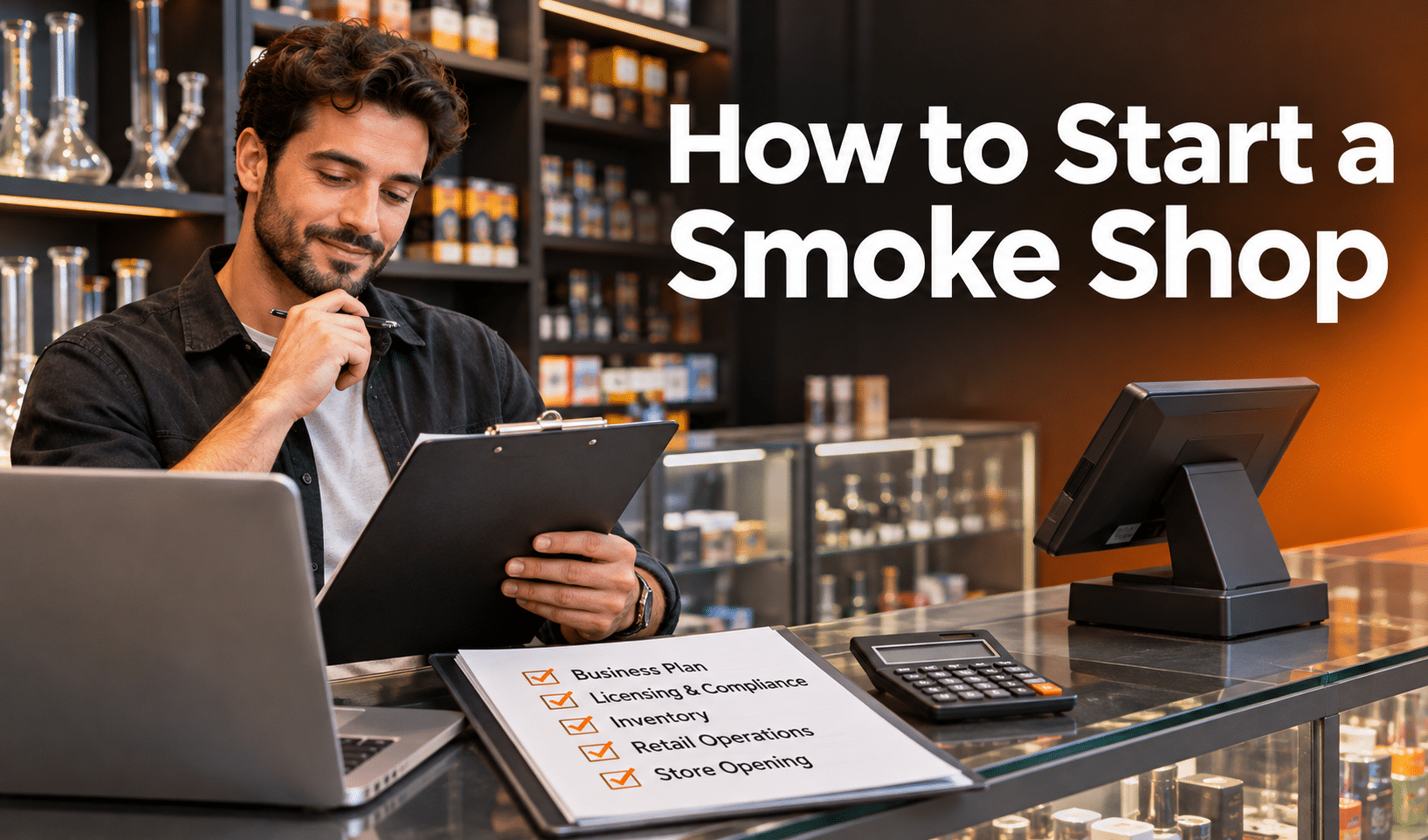
Learning how to start a smoke shop takes more than a lease and a stock order. Expect to budget $50,000 to $150,000, secure the licenses your state and city require, and prepare for federal age rules, vape directories, and hemp laws that keep changing.
Below, you'll find ten steps in order: market research, legal setup, startup costs, licensing, taxes, location, insurance, inventory, POS, and hiring. The steps include fee examples and compliance checks, so you can budget accurately and open without legal surprises.
Key Takeaways:
- Budget $50,000 to $150,000 to open. Inventory, rent, and fixtures take the biggest share.
- Start license applications as soon as you pick a location, and make your lease contingent on license and zoning approval. Federal age rules, state licensing, and local zoning all apply.
- Your product mix sets your compliance workload. Vape and hemp rules differ by state and are changing fast.
- Plan for 6 to 12 months before the shop turns a profit, and keep 3 to 6 months of operating cash in reserve.
- Set up a POS with age verification and carton and pack tracking before opening day.
Smoke Shop Profitability in 2026
Smoke shop profitability can be healthy, but it varies widely, so location, product mix, and expenses decide the outcome.
Competition is heavy as well: the CDC estimates at least 380,000 tobacco retailers nationwide, a count that includes every type of store selling tobacco.
Owner Income And Earnings
Smoke shops sold on BizBuySell between 2021 and 2025 reported median owner earnings of $100,000 on $420,000 in revenue, about 24% of revenue, according to BizBuySell's smoke shop benchmarks.
Those earnings include the owner's own pay, so the profit left after paying yourself a salary is lower. Half of the shops sold reported earnings between roughly $60,000 and $170,000, and the figures describe businesses whose owners chose to sell, not every operator.
Which Products Earn The Most?
Cigarettes bring in frequent shoppers but earn little margin. NACS category data for convenience stores shows a 13.76% average margin on cigarettes in 2024, compared with 29.50% on other tobacco products. Vendors such as DISPLAYARAMA describe vapes, glass, accessories, and hemp products as the higher-markup lines, though hemp and CBD carry the most regulatory risk right now.
How Long Until a Smoke Shop Turns a Profit?
Plan for 6 to 12 months. DISPLAYARAMA's 2026 startup cost guide says most new smoke shops do not turn a net profit during that stretch, so hold enough cash to cover three to six months of operating expenses.
Step 1: Research Your Market And Write a Business Plan
Start with local market research, then write a business plan that covers your products, customers, operations, and cash flow.
Study Local Demand And Competitors
Visit competing shops in your area and note what they sell, what they charge, and how they treat customers. Review neighborhood demographics and foot traffic too.
Gaps show up fast: a missing loyalty program, a thin premium accessory selection, or no CBD lineup. Each gap is a way to stand out.
Choose Your Product Focus
Decide which categories you will carry before you apply for any license: tobacco and cigars, vapes, glass and accessories, or hemp and CBD. Each category brings its own permits and compliance rules, covered in Step 4.
Write Your Business Plan
A thorough business plan is the best way to start. There are several key areas to cover when writing a great smoke shop business plan:
- Explain who you are
- Describe what you plan to sell
- Identify your target audience
- Exhibit what makes you stand out
- Describe your operational plan
- Show how you’ll market
- Track future cash flow
Starting with a business plan will keep you and your team organized and provide more opportunities for business loans or other outside investments.
Step 2: Choose a Legal Structure And Register Your Business
Many smoke shop owners register an LLC because it limits personal liability and keeps taxes straightforward.
Pick an Entity Type
Smoke shops usually choose from four legal structures:
- Sole Proprietorship: one owner, with no legal separation between the owner and the business
- Partnership: two or more owners who share profits, losses, and liability
- Limited Liability Company (LLC): protects personal assets, with profits taxed on the owners' personal returns by default
- Corporation: a separate legal entity owned by shareholders and taxed at the corporate level unless it elects S corporation status
If you have a team or outside investors, settle the structure early. A tax professional or attorney can recommend which option fits your situation.
Register With State And Federal Agencies
After you pick a structure, file your formation documents with the state and apply for a free Employer Identification Number (EIN) from the IRS.
Most businesses need an EIN to hire employees, open a business bank account, and register for state taxes, including the sales tax permit that some states require before they issue a tobacco license.
Open a Business Bank Account
Keep business and personal money separate by opening an account in the business's name. Bring your formation documents, EIN, and photo ID.
Register Your Business Name
Start by checking your local government's registry to make sure the name is available.
Most small businesses file a "doing business as" (DBA) name. Your business can be registered under your own name while the DBA is what customers see on the storefront.
A DBA does not stop another business from using the same name. If you want that protection, register a trademark with the USPTO.
Step 3: Estimate Startup Costs And Secure Funding
Most guides put the cost to open a smoke shop between $50,000 and $150,000, with inventory, rent, and fixtures making up the bulk.
Lightspeed and DISPLAYARAMA both land on that range, though DISPLAYARAMA notes that premium metro builds can run past $150,000.
Startup Cost Breakdown
The table below lists the main expense categories. Like other retail startup costs, each one carries a wide range depending on your market and shop size.
| Expense | Estimated range |
|---|---|
| Licenses, permits, and business formation | $700 to $6,150 |
| First month’s rent and security deposit | $3,600 to $18,000 |
| Buildout and leasehold improvements | $5,000 to $20,000 |
| Opening inventory | $14,500 to $51,000 |
| Fixtures and store setup | $4,600 to $24,000 |
| Technology and operations, year one | $9,200 to $32,400 |
| Working capital reserve | $10,000 to $30,000 |
| Total | $47,600 to $181,550 |
Line items come from DISPLAYARAMA's May 2026 cost guide for smoke shops. Lightspeed's September 2025 guide cites $500 to $2,000 for licenses and $10,000 to $50,000 for inventory, which overlaps these ranges.
The technology and operations line covers first-year costs for a POS, ID scanner, website, insurance, utilities, marketing, and staff training, not software alone.
Few shops hit the top of every category, which is why most totals land below the sum of the maximums.
Three Budget Scenarios
DISPLAYARAMA's guide frames startup costs in three sizes:
| Shop type | Estimated startup cost | What drives the cost |
|---|---|---|
| Lean shop in a small market | About $50,000 | Focused inventory, lower rent |
| Mid-size shop in a strip mall | About $85,000 | Full product mix, solid location |
| Full-scale shop in a metro area | $150,000 or more | Premium location, glass collection, full buildout |
Funding Options
Bank and credit union loans work well if you have solid credit and a written business plan with financial projections. Personal savings, investors, and crowdfunding are other routes. Some suppliers also offer payment terms on inventory and equipment, so negotiate vendor terms early to reduce the cash you need at opening.
Working Capital And Time to Profit
Keep a reserve that covers three to six months of rent, payroll, and inventory reorders. Because DISPLAYARAMA advises planning for 6 to 12 months before a net profit, that cushion helps a business get through its first year.
Step 4: Get Your Licenses And Permits
Most states require a tobacco retail license, and you also need local business approvals and a seller's permit before you open, while federal law sets 21 as the minimum age to buy any tobacco product. In such a heavily regulated industry, every license and permit must be in place before the first sale.
Federal Age And Product Rules
Federal law has banned tobacco sales to anyone under 21 since December 20, 2019, and the rule covers e-cigarettes along with every other tobacco product.
Since September 30, 2024, retailers must also check photo ID for any buyer under 30. FDA's Tobacco 21 guidance explains both requirements.
Vapes face a second federal hurdle. Manufacturers cannot market e-cigarettes without FDA authorization, and the agency's authorized e-cigarette list holds only a few dozen products.
State Tobacco Retail Licenses
Each state sets its own license fee, term, and issuing agency, and every location needs its own license. These four states show how much the details differ:
| State | Issuing agency | Retail license fee | Term | Also required |
|---|---|---|---|---|
| Florida | Department of Business and Professional Regulation | $50 per location | Annual | Ask the agency about vape and local requirements |
| New York | Department of Taxation and Finance | $300 per location | Annual | Separate $300 vapor products dealer registration, plus a separate New York City license in the city |
| Oregon | Department of Revenue with Oregon Health Authority | $984 per location | Annual | License also covers vape (inhalant delivery system) sales |
| Texas | Comptroller of Public Accounts | $180 per location | Two years | Active sales tax permit, plus an e-cigarette retailer permit for vape sales |
Texas also adds a $90 fee for the e-cigarette retailer permit when you already hold the tobacco permit, and $180 when you do not.
New York's $300 retail registration is charged per location and renewed each calendar year, and vape sales need a separate $300 registration.
Florida's $50 permit is the lowest of the four. Oregon's $984 license is the highest.
Verify every fee on your state agency's site, then build it into your budget. The American Heart Association's tobacco retail licensure map links to the agency for each state.
Licenses usually cannot be transferred to a new owner or location. If your smoke shop business has multiple locations, each shop needs its own license, and some states let you list several locations on one application. Oregon, for example, charges its fee for each location on the application.
Display each license where customers can see it, and keep invoices and receipts for the tobacco you buy. State retention periods differ, so ask your state revenue agency for yours. Missing licenses or records can bring fines.
Two situations call for extra permits. Selling tobacco wholesale to other businesses requires a separate wholesaler or distributor license.
Shipping tobacco or e-cigarettes to customers triggers the federal PACT Act, which requires registration with the ATF, payment of the destination state's excise taxes, and age verification on delivery.
Vape, Hemp, And CBD Product Rules
More than a dozen states have enacted laws that limit nicotine vape sales to products on an approved state directory, and effective dates differ. Pennsylvania offers a current example: its Act 57 became enforceable on October 19, 2026, and vapes missing from Pennsylvania's ENDS directory can be seized.
Alabama, Oklahoma, and Louisiana were the first to adopt directory laws, and states including North Carolina and Wisconsin have followed. Some of these laws face court challenges, so read a state's current rules on its attorney general or revenue department site ahead of your first inventory order, especially if you are opening a vape shop alongside your tobacco range.
Flavor rules add another layer. California, Massachusetts, New Jersey, New York, Rhode Island, and Utah restrict flavored vapes to varying degrees, and dozens of cities and counties add their own flavor bans.
Hemp-derived THC products face a federal change. A law signed in November 2025 narrows the federal definition of hemp and caps finished products at 0.4 milligrams of total THC per container.
Congress approved a one-month delay for most of the new limits, moving the date from November 12 to December 11, 2026, while cannabinoids the cannabis plant cannot naturally produce keep the November 12 date.
Congress could still change those dates, and many states have their own hemp laws, so verify the current rules before you stock delta-8, THCA, or similar products. If you plan to carry CBD, check how the new definition applies to each product and review the CBD license requirements in your state.
Local Zoning And Business Licenses
Cities and counties add their own requirements: a general business license, zoning approval, an occupancy permit, a fire inspection, and sometimes a minimum distance from schools, parks, or other tobacco retailers.
You will also need a seller's permit for sales tax. Texas and New York both require an active sales tax registration before they issue a tobacco permit.
Processing times vary by state. New York lists an average of 5 to 10 days for its retail tobacco registration, while DISPLAYARAMA notes that applications elsewhere can take weeks.
Apply as soon as you have an address, settle zoning before you sign, and make your lease contingent on approval.
Step 5: Understand Tobacco Taxes And Reporting
Tobacco products carry three layers of tax: federal excise tax, state and local tobacco taxes, and sales tax. Knowing who pays which layer keeps your pricing and filings accurate.
Federal Excise Tax
Federal excise taxes on tobacco are collected from manufacturers and importers, so they arrive built into your wholesale price. The Alcohol and Tobacco Tax and Trade Bureau states that you do not need a TTB permit to sell tobacco, though TTB's retail sales guidance notes federal recordkeeping rules if you sell more than 10,000 cigarettes in a month.
State Tobacco Taxes And Sales Tax
States add their own tobacco excise taxes, and rates differ widely by product. Texas, for example, taxes a pack of 20 cigarettes at $1.41, according to the Texas Comptroller.
New York applies a 20% supplemental sales tax to vapor products, collected by the dealer and listed separately on the receipt. Sales tax applies on top, and who collects and files each tax depends on the product and the state.
Filing And Record Keeping
Some states require periodic tobacco returns even for months with no taxable sales. Late or missed filings can bring penalties and put your license at risk, so ask your state revenue department for each deadline. A POS that supports product-level tax rates and sales reports makes those filings easier.
Step 6: Find a Compliant Location
Choose a spot with steady foot traffic that also passes your city's zoning rules, because a zoning problem can rule out a space before you ever discuss rent.
Zoning And Distance Rules
Numerous cities limit how close a tobacco or vape retailer can sit to schools, parks, places of worship, and other tobacco retailers. Rules differ by city, so verify them with the local zoning office ahead of any commitment. Ask your landlord for a lease contingency that lets you delay or exit if your license or zoning approval is denied.
Rent, Size, And Foot Traffic
Some markets already have plenty of smoke shops, so avoid an area that is already saturated. You still want a convenient spot with plenty of retail foot traffic, and it is worth the time and effort to find one. Look beyond strip malls, which hold numerous smoke shops, to other storefronts and shopping centers.
DISPLAYARAMA puts a typical smoke shop at 600 to 1,500 square feet and estimates monthly rent at:
- $1,200 to $3,000 for 600 to 800 square feet in a small or suburban market
- $2,500 to $5,500 for 800 to 1,200 square feet in a mid-size city strip mall
- $5,000 to $12,000 or more for 1,200 to 1,500 square feet in a major metro
Lightspeed puts retail rent at $25 to $50 per square foot annually. Landlords commonly ask for one to three months of rent as a deposit plus the first month up front, and buildout for flooring, lighting, and electrical work adds $5,000 to $20,000 in many spaces.
Step 7: Get Insurance For Your Smoke Shop
A smoke shop should carry general liability, commercial property, and product liability coverage, plus workers' compensation, which most states require once you hire employees. Business insurance is a must from day one, and a new tobacco store carries real risks, so make sure you are protected if anything goes wrong.
Core Coverage Types
- General liability: covers customer injuries and property damage claims
- Commercial property: covers your building contents, inventory, and equipment
- Product liability: covers claims that a product you sold caused harm
- Workers' compensation: covers medical costs and lost wages if an employee is hurt on the job
- Crime and business interruption: covers theft, burglary, and income lost during a covered shutdown
A business owner's policy (BOP) bundles several of these into one package.
Fire And Product Risks
Lighters and butane stock raise the fire risk in a tobacco shop, which makes strong property coverage worthwhile. Some carriers also exclude vape or hemp products from standard commercial policies, so work with a broker who understands tobacco retail. DISPLAYARAMA estimates annual insurance at $2,000 to $8,000.
Step 8: Source Inventory And Build Your Product Mix
Guides put opening inventory at roughly $10,000 to $50,000, and the product mix you choose sets both your margins and your compliance workload. Buy only from licensed distributors and wholesalers, and keep every invoice.
Tobacco And Cigars
Cigarettes, cigars, pipe tobacco, and hookah supplies form the baseline and bring repeat visits. DISPLAYARAMA budgets $3,000 to $8,000 for a solid opening selection of tobacco products.
Vapes And E-Cigarettes
Vapes turn over quickly, with a budget of $5,000 to $15,000 for a strong opening section. Compare every product against your state's directory and flavor rules before you order, since unlisted devices can be seized.
Glass, Accessories, And Hemp Products
Glass pipes and water pipes anchor your display cases and carry strong margins. DISPLAYARAMA budgets $3,000 to $10,000 for glass and $1,000 to $5,000 for lighters, papers, grinders, and similar accessories. Hemp and CBD products add $2,000 to $10,000, but review the federal and state rules covered in Step 4 first.
Start with a curated range focused on the categories you can verify as legal and profitable, then expand based on what customers ask for.
Good smoke shop inventory management shows you which products move and which sit on the shelf, so each reorder follows real demand.
Manufacturer scan data programs pay retailers rebates for submitting sales data, so ask your POS provider whether it supports them.
Step 9: Set Up Your POS And Inventory System
Install a POS built for tobacco retail before opening day, because accurate inventory is the most critical part of getting started.
You can't afford to be out of products that customers want, and you never want to carry items that aren't popular.
What a Smoke Shop POS Should Include
- Age verification prompts that match federal and state rules
- Carton and pack inventory tracking
- Tax rates set by product category
- Low-stock alerts and reorder reports
- Loyalty rewards for repeat customers
The best smoke shop POS systems combine those features with fast checkout.
KORONA POS includes smoke shop features such as age verification prompts, ID scanning for age verification, carton and pack inventory counting, and a point-based loyalty program. Its inventory tools add automated ordering and stock reorder notifications, and the Plus plan includes a top and slow sellers report.
KORONA POS subscriptions cost $59 (Core), $79 (Retail), or $99 (Plus) per terminal per month, with no setup fees and no forced contracts. Inventory counts, real-time stock tracking, and supplier ordering begin on the Retail plan, and hardware is priced separately. KORONA POS is processing agnostic, so you can keep your current payment processor.
Speak with a product specialist and learn how KORONA POS can power your business.
Step 10: Hire And Train Staff, Then Plan Your Grand Opening
Hire staff who can verify age correctly and answer product questions, then train them before opening day. Your team will be the face of your store and your brand.
Hire And Train For Compliance
Look for motivated people who are comfortable with a large inventory and a wide selection. Shoppers often arrive with questions and need direction, so your staff should be able to guide each customer through the shopping experience. Start interviewing early and offer competitive pay to attract the best candidates.
Build your cashier training guide around age checks: every employee should verify photo ID for buyers under 30 and refuse a sale when the ID is missing or invalid. FDA offers free retailer training materials, including an age calculator app.
Plan Your Grand Opening
Your retail marketing strategy is an ongoing effort, but a few items belong in place from the start:
- Set up all social media accounts before opening
- Build a website and blog
- Claim your Google Business Profile and get listed on Yelp and other applicable sites
- Reach out to local media that might announce your opening
- Come up with a grand opening deal or event
Federal rules prohibit giving away free samples of most tobacco products, and states set their own limits on tobacco discounts and advertising. Review those rules before you build an opening promotion, and consider offers on accessories or loyalty rewards.
Smoke Shop Startup Checklist
- Research local demand and competitors
- Write your business plan and choose a product focus
- Choose a legal structure, get an EIN, and register your business name
- Open a business bank account
- Estimate startup costs and secure funding
- Apply for state and local licenses and permits
- Confirm zoning, then sign a lease with a license contingency
- Buy insurance
- Source inventory from licensed distributors and check vape and hemp rules
- Set up your POS, hire and train staff, and launch your grand opening
Conclusion
Opening a smoke shop comes down to three decisions: how much cash you can commit, which products you can sell legally in your state, and where you can locate without zoning problems. Settle those first, and the rest of the checklist falls into place.
A POS built for tobacco retail supports daily operations after opening day. Explore KORONA's smoke shop POS software, start the free trial (no credit card required), or request a walkthrough from our team.
Frequently Asked Questions
How Much Does it Cost to Open a Smoke Shop?
Opening a smoke shop costs $50,000 to $150,000 in most estimates. Lean shops in small markets can open for about $50,000, while premium metro locations can run past $150,000. Inventory, rent, fixtures, and a 3 to 6 month cash reserve make up most of the budget.
What Licenses Do You Need to Open a Smoke Shop?
A majority of states require a tobacco retail license, and you will also need a general business license and a sales tax permit. Vape sales may require a separate permit, and hemp or CBD products can add more. Federal law sets the minimum sales age at 21, but no federal permit is required to sell tobacco at retail.
How Much Does a Smoke Shop Owner Make a Year?
Smoke shops sold on BizBuySell from 2021 to 2025 reported median owner earnings of $100,000 a year, and half reported between about $60,000 and $170,000. Those figures include the owner's own pay and describe businesses that sold, so your result depends on location, product mix, and rent. Plan for 6 to 12 months before the shop turns a profit.
What Sells The Most in a Smoke Shop?
Cigarettes remain a traffic driver, but other tobacco products earn more margin. NACS data for convenience stores shows 13.76% on cigarettes and 29.50% on other tobacco products in 2024. Vendor guides describe vapes, glass, and accessories as higher-markup lines.
Are Smoke Shops Still Profitable?
They can be. BizBuySell reports median owner earnings of $100,000 on $420,000 in revenue for shops sold from 2021 to 2025, though that figure includes the owner's pay. Rent, inventory, and compliance costs decide how much remains, and fast-changing vape and hemp laws make a tight budget and a curated product mix important.
What Are The Requirements to Open a Vape Shop?
Federal law allows only FDA-authorized e-cigarettes to be sold, and retailers need a state license or permit, a minimum buyer age of 21, and photo ID checks for anyone under 30. More than a dozen states also require products to appear on a state directory. Review your state's vapor permit rules, flavor restrictions, and excise taxes before inventory arrives.
How Long Does it Take to Open a Smoke Shop?
License processing varies by state. New York lists an average of 5 to 10 days, while DISPLAYARAMA notes that applications elsewhere can take weeks. Buildout, fixtures, and inventory orders add time after you have a location, so apply as soon as you have an address and make your lease contingent on approval.