

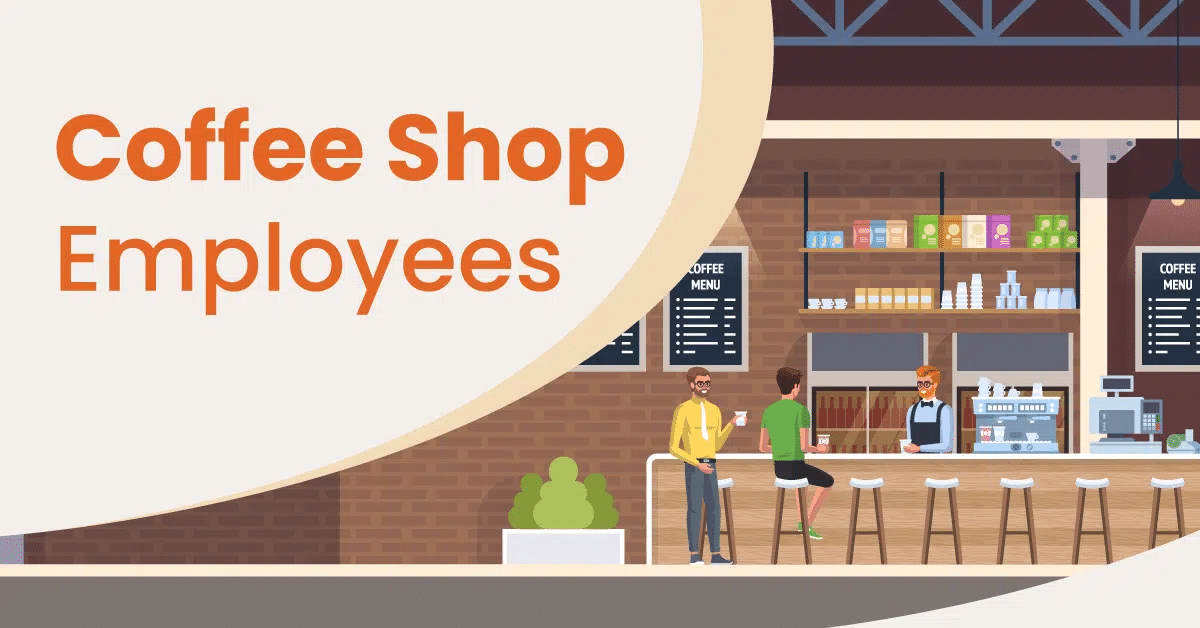
Coffee shop employees fall into six roles, though few independent cafes need all of them. Your format, your volume, and your opening hours decide the mix.
Below you’ll find what each position actually does, how many staff a shop needs per shift, what to pay them, and where your labor cost should land as a share of sales. You’ll also get a hiring sequence that works, job descriptions you can copy, interview questions that reveal something real, an onboarding plan, and the retention tactics that keep good people behind your bar.
Key Takeaways:
- Six roles exist on paper, but your format and opening hours decide how many you actually staff.
- Most independent shops staff two to three per shift, with six to twelve on the roster.
- Barista pay clusters between $13.32 and $17.34 per hour, against a $15.00 national median.
- Losing one hourly employee costs $2,305 to replace. Losing a manager costs $10,518.
Roles And Responsibilities of Coffee Shop Employees
Most coffee shops run on six positions: barista, cashier, shift supervisor, store manager, kitchen or pastry staff, and the owner-operator. Smaller shops combine several of them into one job. Larger cafes with food service and extended hours separate them out. Account for all of this labor when you calculate the costs of opening your shop, because payroll is the largest controllable line item you will carry.
Barista
The barista builds each drink on your menu, from drip coffee to multi-step espresso beverages. Daily duties include dialing in the grinder, pulling and timing shots, steaming milk to temperature, pouring latte art, and resetting the bar between rushes. Baristas also keep the station clean, rotate milk and syrups, and flag equipment faults before they turn into closures.
Who needs this role: every coffee shop, no exceptions.
Cashier or Counter Server
The cashier takes orders, rings up sales, handles payments, and manages the customer-facing side of the counter. Strong product knowledge matters here, since the cashier fields questions about menu items, allergens, and substitutions. Closing duties usually include counting the drawer and reconciling it against the day’s sales report.
Who needs this role: shops where the line regularly outpaces what one person can build and ring. Below that, a single employee can work the register and the bar together.
Shift Supervisor or Lead Barista
The shift supervisor runs the floor while the shift is live, and the two titles are not identical. A lead barista owns bar quality, trains new hires on drink standards, and holds the recipe book.
A shift supervisor carries keys, opens or closes the store, handles cash drops, resolves customer complaints, and decides when to pull someone off bar to restock or clean.
Complaint handling is the piece that separates a supervisor from a senior barista, so train yours on difficult customers instead of hoping instinct covers it.
Supervisors also manage restocking supplies and track stock discrepancies against what the POS recorded.
Who needs this role: any shop where the owner is not present for every shift.
Store Manager
The store manager owns the numbers, not the shift. Responsibilities cover scheduling, hiring, payroll approval, vendor orders, cost control, local marketing, and health inspections. A manager reviews sales per labor hour weekly, adjusts the schedule against traffic patterns, and keeps the labor percentage inside target.
The work belongs closer to retail personnel management than to shift work, which is why promoting your fastest barista into the role rarely succeeds on its own.
Who needs this role: multi-location operators, and single-site owners who want to step out of daily operations. Many first-location owners hold this role themselves for the first year or two.
Kitchen or Pastry Staff
Kitchen staff handle food prep, baking, plating, and food safety compliance. Even shops that buy pastries wholesale need someone responsible for receiving, dating, storing, and rotating product, along with holding a valid food handler certification where the state requires one. Certification sits alongside the other licenses a cafe needs, so check the full list for your state before the first food order lands.
Who needs this role: any shop serving prepared food, sandwiches, or in-house baked goods.
Owner-Operator
The owner-operator works the bar and carries the business at once. Nearly all independent cafes start here. Anyone still opening a coffee shop should decide which of the roles above they intend to hold personally, because the answer shapes the schedule from day one.
The trap to name: owners who schedule themselves into all the peak shifts have no hours left for ordering, hiring, or reviewing reports, and the business stalls at the size one person can personally cover.
Who needs this role: nearly every independent shop in year one.
Train every employee on their duties before their first solo shift. Untrained staff create mistakes, waste, and liability. A well-configured POS also cuts training time and improves efficiency in completing orders.
How Many Employees Does a Coffee Shop Need
Most independent coffee shops run two to three people per shift and employ six to twelve staff in total across a full week. The floor is one barista and one cashier during business hours, though a low-traffic shop can open with one person covering both.
Three factors move the number: transaction volume at peak, whether you serve food, and how many hours per day you open. A shop open 6 a.m. to 6 p.m. needs at least two shift blocks, which roughly doubles headcount versus a 6 a.m. to 1 p.m. operation. Weekend coverage usually requires one extra body per shift.
Coffee Shop Staff Wages And Labor Costs
Baristas earn a national median of $15.00 per hour, and the middle 50% falls between $13.32 and $17.34. Supervisors generally earn $2.00 to $4.00 above barista base, and managers land between $18.00 and $26.00 per hour.
What Each Coffee Shop Role Pays
| Role | Typical Hourly Range | Pay Structure |
|---|---|---|
| Barista | $13.32 to $17.34 | Hourly plus tips |
| Cashier or counter server | $13.00 to $17.00 | Hourly plus tips |
| Shift supervisor or lead barista | $16.00 to $21.00 | Hourly plus tips, occasional bonus |
| Store manager | $18.00 to $26.00 | Hourly or salaried, often with bonus |
| Kitchen or pastry staff | $15.00 to $22.00 | Hourly, tipped in some shops |
Ranges describe base pay and reflect published figures current as of September 2026. Tips sit on top. 7shifts puts typical barista tip income at $2.00 to $5.00 per hour, citing Indeed data showing around $20.00 per day, and the number swings hard by foot traffic and shop type. How you pool and distribute tips shapes take-home pay as much as the base rate does, so settle the policy before you quote anyone a number. Supervisor and manager ranges reflect market rules of thumb, not a federal series, since no government dataset breaks out either title.
Why Published Wage Averages Disagree
Salary sites measure different things, which is why the same job shows a $2.50 spread across sources. As of September 2026, ZipRecruiter puts barista pay at $15.55 per hour, PayScale at $14.22, and Salary.com at $13.00.
Federal data lands in the middle, with one caveat attached. The Bureau of Labor Statistics publishes no standalone barista series and counts baristas inside occupation 35-3023, fast food and counter workers, which covers 3.85 million people. That occupation showed a $15.00 median and a $15.46 mean in the May 2025 wage release, as compiled by Barista Life. Treat it as the envelope around barista pay, with the true barista average somewhere inside it.
Geography explains the bulk of the gap. State medians in that federal dataset run from $10.87 in Mississippi to $20.33 in California. Note also that the federal figures fold in employer-reported tips, which are widely thought to be underreported, so real take-home in a busy shop runs above the published rate.
Benchmark against live postings in your own market. National averages describe nobody’s labor market in particular, least of all yours.
What Your Labor Cost Should Be
Labor should land between 18% and 35% of sales, and the right target depends entirely on your service format.
| Shop Format | Target Labor Share of Sales | Typical Staff Per Peak Shift |
|---|---|---|
| Drive-thru | 18% to 25% | 2 to 3 |
| Kiosk or espresso bar | 25% to 30% | 1 to 2 |
| Counter-service cafe | 28% to 32% | 2 to 4 |
| Full cafe with food service | 30% to 35% | 3 to 6 |
Benchmarks follow guidance published by Brewspace and Barista Life. Drive-thrus sit lowest because revenue per labor hour is far higher. Full cafes sit highest because seating, table service, and food prep all consume hours that do not directly ring a sale.
One honest note on the numbers. No federal agency publishes cafe cost benchmarks the way the National Restaurant Association reports them for restaurants, so the ranges above come from trade sources, never a measured survey. Treat them as the going industry view, not a statistic.
Read the number in both directions. Sustained figures above 35% signal overstaffing, weak pricing, or low volume per hour. Sustained figures under 25% in a full-service format usually mean the opposite problem: slow service, skipped cleaning, and burnout that shows up later as turnover.
Calculate it monthly. Divide total labor cost, including payroll taxes and benefits, by total sales for the period, then multiply by 100. Leave tips out of the calculation, since customers fund those and they never hit your P&L the way wages do.
How to Hire Coffee Shop Employees
Hiring works best as a fixed sequence, not a set of instincts. Define the role, write a posting that filters, source deliberately, screen for attitude, test on bar, then check references before you make the offer.
Define The Role And The Schedule Before You Post
Write down the exact shifts you need covered before you write anything else. Candidates self-select out on schedule more than on any other factor, so a posting that says “weekends required, 5:30 a.m. opens” saves you a round of interviews with people who were never available.
Settle a second question now: are you hiring for experience, or for attitude? Both are defensible. Experience shortens ramp time, while attitude produces better long-term hires in a trade where technique is teachable. When you build your ideal candidate profile, weigh values such as integrity, reliability, and honesty, since those cannot be trained on a bar.
Write a Job Posting That Filters
A good posting states qualifications, duties, hours, pay range, and the vibe of your shop. Roughly a dozen states plus Washington, D.C. now require a pay range in the posting itself, and trackers disagree on the exact count because effective dates keep moving.
Most of those laws carry an employer-size threshold that exempts a single cafe, though Colorado and D.C. cover employers with even one in-state worker and New York starts at four. Check your own state through a current tracker such as Teamed before you post. Listing the range helps everywhere else regardless, because candidates stop applying blind.
Be transparent about hours during the posting and again during interviews. Opening shifts, weekend coverage, and holiday expectations should all be on the table before anyone accepts.
Where to Find Coffee Shop Candidates
The best applicants come from four channels: a sign in your own window, referrals from your current staff, local barista and hospitality groups on social platforms, and general job boards. In-window signs skew toward people who already like your shop, and staff referrals tend to produce steadier hires, since your team is vouching with their own working conditions.
For recruitment agencies and freelance recruiters helping coffee shops fill these positions, tools such as Jarvi ATS can make the hiring process easier to manage. An applicant tracking system can help organize candidates, keep track of applications, and manage interviews and follow-ups, especially when recruiters are handling multiple openings or clients at the same time.
Screen For Attitude Over Experience
Screen on a 10-minute phone call before you book anyone in person. Confirm availability, ask why they applied to your shop specifically, and listen for whether they ask questions back. Candidates without cafe backgrounds often bring transferable strengths worth weighing: retail service history, kitchen speed, or a long-held hobby that demonstrates follow-through.
Run a Paid Working Interview
A paid two-hour shift on bar tells you more than any interview question. Pay the candidate their prospective hourly rate, put them on a real shift alongside a lead, and watch three things: how they move when the line builds, whether they clean without being asked, and how your existing team reacts to them.
Working interviews also let the candidate evaluate you, which cuts first-month departures. Pay for the time, always. Under the federal Fair Labor Standards Act, a candidate doing productive work that benefits your business counts as an employee for those hours and is owed at least minimum wage.
The Department of Labor has pursued employers over exactly that practice, as HR Dive reported. A brief skills demonstration that produces nothing you sell is a different matter.
Check References And Make The Offer
Call two references and ask one question that gets honest answers: would you rehire this person, yes or no. Then move fast. Strong hospitality candidates hold multiple offers, and a week of internal deliberation loses them.
Put the offer in writing with pay rate, scheduled hours, start date, and tip policy spelled out.
Coffee Shop Job Description Templates
Use these as starting blocks and edit the bracketed fields. Each one is built to paste directly into a job board listing.
Barista Job Description Template
Position: Barista Reports to: Shift Supervisor Pay: $[X] per hour plus tips Schedule: [Days and hours, note opening or closing shifts]
Responsibilities:
- Prepare espresso drinks, drip coffee, tea, and cold beverages to shop recipe standards
- Take customer orders and process payments accurately
- Keep the bar, seating area, and restrooms clean throughout the shift
- Restock milk, syrups, cups, and pastry cases
- Follow food safety and sanitation procedures
- Open or close the store as scheduled
Requirements:
- Availability for [specify shifts]
- Ability to stand for [X]-hour shifts and lift 30 pounds
- Clear communication and a calm manner during busy periods
- Prior cafe experience preferred, not required. Training provided.
Shift Supervisor Job Description Template
Position: Shift Supervisor Reports to: Store Manager or Owner Pay: $[X] per hour plus tips Schedule: [Days and hours]
Responsibilities:
- Run the floor during assigned shifts and direct barista and cashier coverage
- Open or close the store, including cash handling and drawer reconciliation
- Resolve customer complaints and service recovery on the spot
- Monitor stock levels and place or flag reorders
- Coach baristas on drink standards and speed
- Record waste, voids, and discrepancies
Requirements:
- One or more years of cafe or food service experience
- Demonstrated ability to lead a shift and make decisions without a manager present
- Comfort with POS reporting and cash handling
- Food handler certification, or willingness to obtain within 30 days
Store Manager Job Description Template
Position: Store Manager Reports to: Owner Pay: $[X] per hour or $[X] annually, plus [bonus structure] Schedule: [Days and hours, note on-call expectations]
Responsibilities:
- Build weekly schedules against forecast traffic and hold labor cost at [X]% of sales
- Recruit, hire, onboard, and develop staff
- Manage vendor relationships, ordering, and inventory counts
- Review sales, waste, and labor reports weekly and act on them
- Maintain health, safety, and licensing compliance
- Handle escalated customer issues and local community relationships
Requirements:
- Two or more years of food service management experience
- Working knowledge of P&L, labor percentage, and cost of goods
- Experience with scheduling and POS reporting tools
- Availability across opening, closing, and weekend shifts
Interview Questions For Coffee Shop Candidates
Ask nine to ten questions across four areas, and listen for specifics over sentiment. Vague answers about loving coffee tell you nothing. Concrete stories tell you how someone behaves on a floor when it gets loud.
Customer Recovery
- Tell me about a customer who was genuinely angry with you. What happened? A good answer names the mistake plainly and describes a fix, without blaming the customer or a coworker.
- A regular says their latte has tasted wrong all week. What do you do? Strong candidates check the drink, remake it, then investigate the cause. Weak candidates only apologize.
Speed And Pressure
- Eight people are in line, the espresso machine loses pressure, and a delivery just arrived. Walk me through your next five minutes. Look for triage and for someone who communicates with the line instead of freezing.
- What does a bad rush look like when you are on bar? Candidates who have worked real volume describe it vividly. Those who have not tend to answer in generalities.
Coffee Knowledge
- How would you describe the difference between a flat white and a latte to a customer who has never ordered either? Tests knowledge and the ability to explain without condescension.
- What would make you adjust a grinder mid-shift? Experienced candidates mention taste, shot timing, or a change in humidity. Newer candidates can be trained here, so weigh it lightly for entry roles.
Reliability And Fit
- What shifts can you commit to over the next six months? Ask directly and write down the answer.
- Tell me about a time you covered for a teammate. Reveals whether someone thinks in terms of the team or the task.
- What would make you leave a job after two months? The honest answers are useful, and evasion here is worth noting.
Onboarding And Training New Coffee Shop Employees
Plan roughly three to four weeks from first shift to solo bar coverage. Rushing a new hire onto an unsupervised shift produces waste, remakes, and the kind of first-month exit that costs you the whole hiring cycle again.
The First Shift
Cover the non-negotiables before anything else: opening and closing procedures, POS login and permissions, cash handling rules, allergen protocol, and where the cleaning supplies live. Pair the new hire with a lead for the entire shift and keep them off the register during peak. Register work comes next, and a structured cashier training routine keeps the first fumbled transactions from happening in front of a line.
The First Week
Move through the menu in order of volume. Drip and americano first, then milk drinks, then the long tail of seasonal and specialty items. Set a measurable standard, such as a correctly built cappuccino within 90 seconds. Subjective standards leave a new hire guessing at what good looks like. Book food handler certification now if your state requires it.
Staff with some knowledge of POS systems ramp faster here, and the skill is quick to teach anyway.
Weeks Two Through Four
Build independence deliberately. Hand over one closing duty per shift until the new hire can close alone. Book a 30-minute check-in at the two-week mark and ask what is still confusing, because problems surface then, long before the 90-day review.
Keep everyone current on brew methods, techniques, and essential shop equipment through periodic refreshers. Consistent knowledge across the team means consistent drinks across every shift.
Qualities to Look For in Coffee Shop Employees
Hire for reliability, speed, service instinct, coachability, and adaptability. Coffee knowledge ranks below all five, because it is the only one you can teach in a month.
- Reliability: shows up on time, shift after shift, and finishes what they start
- Customer service skills: reads the room, handles complaints without escalating, remembers regulars
- Speed under pressure: stays accurate when the line stretches to the door
- Teamwork: steps into gaps without being assigned, communicates across the bar
- Leadership instinct: takes initiative and sets an example, the trait that identifies your future supervisors
- Adaptability: absorbs equipment failures, no-shows, and menu changes without stalling
- Passion for coffee: genuine interest in origin, roast, and method, which translates directly into better customer experience
How to Keep Coffee Shop Employees
Replacing one hourly employee costs $2,305 in separation, replacement, and training, and the figure for a manager climbs to $10,518, per Black Box Intelligence figures cited by HighMatch. Estimates that also count lost productivity push the hourly figure toward $5,000.
At the turnover rates common in food service, retention is usually worth more to your margin than any pricing change you could make this year.
Give Regular Freebies
Small, visible appreciation works. A staff meal, a bag of beans to take home, or a pizza after a brutal Saturday signals that the effort registered. Shops that never do this find their teams quietly stop going beyond the minimum.
Offer Rewards Programs
Build something staff can accumulate: merchandise discounts, points redeemable for gift cards, or a paid barista competition entry. Anything that saves employees money or advances their craft tends to land.
Keep an Open-Door Policy
Make it easy for staff to raise problems before they become resignations. An open door tells the team that their input carries weight, and it surfaces operational issues you would otherwise learn about from a review.
Be Transparent
Share where the business is heading and what you expect. Name the goals, praise the wins, and help when a shift goes badly. Employees who understand the plan make better decisions when nobody is watching.
Give Predictable Schedules
Unpredictable scheduling ranks high among the reasons hourly staff leave hospitality jobs. Post schedules at least two weeks out, honor time-off requests you approved, and stop changing shifts after posting. Predictability costs nothing and buys loyalty.
Load Up on Technology
Take administrative weight off your team. Automated payroll, attendance tracking, and current shift schedules free your staff for customer interaction, which is the part of the job they tend to enjoy.
Managing Your Team With a Coffee Shop POS System
A POS system turns staffing from guesswork into measured decisions by recording who worked, what they sold, and what it cost you per hour. KORONA POS, a processor-agnostic platform built for coffee shops and specialty retail, costs from $59.00 per terminal per month on month-to-month billing, with KORONA POS pricing published by tier.
Clock-In And Clock-Out Data
Employees clock in and out at the terminal, and the time summary report exports into payroll. As a coffee shop owner, you need that record to verify hours, pay correctly, and see who is drifting into overtime. Accurate employee time tracking is the foundation everything else sits on.
Worth knowing before you buy: KORONA POS records worked time but does not build schedules, so shops that want the plan and the actual hours side by side pair it with a scheduling tool.
Sales Per Labor Hour
Divide sales by hours worked for any window and you can see exactly which shifts are overstaffed. A common pattern is that the labor problem hides in the mid-afternoon lull rather than the morning rush, with two people scheduled where one would do.
Permissions And Void Tracking
Assign each employee their own login and restrict who can process refunds, apply discounts, or open the drawer without a sale.
Void and discount reports by employee are the single most useful loss prevention tool a small cafe has. They also cover one slice of retail shrink, since employee error, register manipulation, and unrecorded waste all surface in the same gap between what the POS says you sold and what the shelf says you have.
Per-Employee Sales Data
Pull sales, voids, and refunds by cashier login to see who is performing and where cash goes missing. Employee and commission reports point you toward who deserves a raise and who needs coaching, though no POS measures floor performance on its own, so read the reports next to what you observe.
Inventory That Matches The Schedule
Strong coffee shop POS systems tie sales to stock levels so ordering stops being a guess. Accurate counts reduce both stockouts and the cost of holding too much product that will not move.
Building Your Coffee Shop Staffing Plan
A workable staffing plan comes down to four decisions: which of the six roles your format demands, how many people cover each shift, what you pay against your local market, and which labor target you hold inside the 18% to 35% band.
Settle those and the rest follows. Write a posting that screens on schedule, run a paid working interview so nobody is guessing from a resume, and allow three to four weeks before a new hire covers the bar alone. Then protect the hire you made, because turnover costs $2,305 per hourly departure and $10,518 when a manager walks out.
If you want the reporting to check your work, KORONA POS for cafes records worked hours, sales, and per-cashier activity in one back office.
Frequently Asked Questions
How Much Do Coffee Shop Employees Make?
Median barista pay is $15.00 per hour, with the middle half of the occupation landing between $13.32 and $17.34. Shift supervisors typically earn $2.00 to $4.00 more, and managers range from $18.00 to $26.00 per hour. State minimum wage drives the variation.
How Many Employees Does a Small Coffee Shop Need?
A small shop generally needs six to twelve employees total, with two to three working each shift. Very low-volume locations get by with a lone employee handling bar and register. Weekend and extended hours coverage is what pushes total headcount upward.
What Is a Good Labor Cost Percentage For a Coffee Shop?
Between 25% and 35% of sales for most formats. Drive-thrus operate leaner at 18% to 25% because revenue per labor hour is higher. Figures above 35% usually point to overstaffing or underpricing, and sustained figures below 25% suggest understaffing.
Do You Need Experience to Hire a Barista?
No. Most cafes hire for attitude and train the technical work, since drink-building is learnable within a few weeks. Prior experience gets someone up to speed faster, but reliability, speed, and service instinct predict long-term performance far better than a resume does.
What Is a Working Interview?
A paid trial shift where a candidate works alongside your team while you observe. Two hours is typical. Pay their prospective hourly rate, because the federal Fair Labor Standards Act treats productive work as compensable, and the shift reveals more than any conversation.