


A coffee shop equipment list tells you what to buy, what it costs, and what can wait. New owners often forget sinks, ventilation, and water filtration.
Below, every item is sorted into Opening Day, Add Later, or Optional. You will also find current price ranges, utility and health code checks, advice on buying new, used, or leased gear, and the POS hardware your counter needs.
Key Takeaways:
- Let your menu decide which equipment you buy.
- Buy the espresso machine and grinder first, because they set drink quality.
- Plan for sinks, ventilation, and water filtration, since new owners skip them most.
- Used or leased gear can lower upfront cost on big-ticket items.
Coffee Shop Equipment Checklist at a Glance
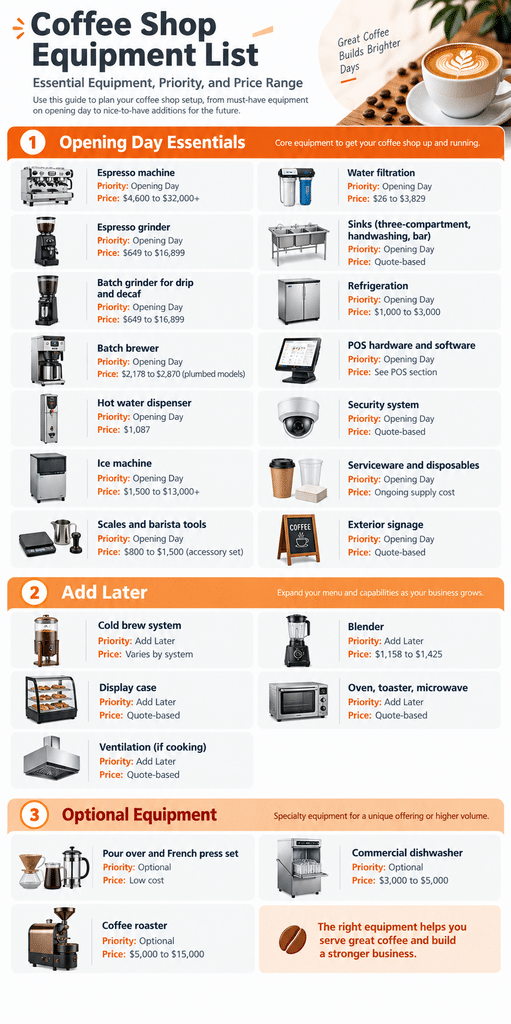
A coffee shop equipment list covers five groups: beverage equipment, water and sinks, cold storage and food prep, serviceware and supplies, and technology and security.
The table ranks each item by purchase priority and shows price ranges where public pricing exists.
Opening Day marks equipment required to serve the first customer. Add Later covers purchases that pay off as volume or menu scope grows, and Optional depends entirely on your concept.
A Quote-based price varies with size, configuration, and installation. Collect bids from at least two suppliers.
| Equipment | Priority | Price range |
|---|---|---|
| Espresso machine | Opening day | $4,600 to $32,000+ |
| Espresso grinder | Opening day | $649 to $16,899 |
| Batch grinder for drip and decaf | Opening day | $649 to $16,899 |
| Batch brewer | Opening day | $2,178 to $2,870 (plumbed models) |
| Hot water dispenser | Opening day | $1,087 |
| Ice machine | Opening day | $1,500 to $13,000+ |
| Scales and barista tools | Opening day | $800 to $1,500 (accessory set) |
| Water filtration | Opening day | $26 to $3,829 |
| Sinks (three-compartment, handwashing, bar) | Opening day | Quote-based |
| Refrigeration | Opening day | $1,000 to $3,000 |
| POS hardware and software | Opening day | See POS section |
| Security system | Opening day | Quote-based |
| Serviceware and disposables | Opening day | Ongoing supply cost |
| Exterior signage | Opening day | Quote-based |
| Cold brew system | Add later | Varies by system |
| Blender | Add later | $1,158 to $1,425 |
| Display case | Add later | Quote-based |
| Oven, toaster, microwave | Add later | Quote-based |
| Ventilation (if cooking) | Add later | Quote-based |
| Pour over and French press set | Optional | Low cost |
| Commercial dishwasher | Optional | $3,000 to $5,000 |
| Coffee roaster | Optional | $5,000 to $15,000 |
Sources for each range appear in the sections below. Treat each figure as a starting point, and verify current pricing ahead of budgeting.
How Your Menu And Space Shape The Equipment List
The menu dictates which coffee shop equipment you buy, while available space, utilities, and health-code rules decide what fits. Lock down all three before comparing models.
Match Equipment to Your Menu
A drip-and-pastry counter runs on a batch brewer, a grinder, a toaster, and a display case. An espresso bar calls for a machine, two grinders, milk refrigeration, and an ice machine.
A drive-thru window layers a speed requirement over either setup. Square’s equipment guide agrees that menu and concept largely shape what a cafe must buy.
Toast’s article makes the same point through the owner of Fresh Cup magazine, who observes that a downtown espresso bar and a Texas drive-thru need very different gear.
Check Utilities And Counter Space Before Buying
ProCoffeeGear says commercial espresso machines typically require 220-volt power, a dedicated 30 to 50 amp circuit, and direct plumbing. Confirm those requirements with your landlord, an electrician, and a plumber at the planning stage.
Smaller equipment draws power too: a 5-gallon Bunn H5X hot water dispenser pulls 15.4 amps at 120 volts on KaTom’s listing, and the 208 to 240 volt version uses 19.5 amps on a second listing.
PRO TIP!
Certain three-group espresso machines depend on three-phase power for full output, and EKUEP warns that such service is not always available. Request the spec sheet from each supplier and pass it to your contractors.
Look For NSF Listings
Local health codes frequently mandate that food service equipment meet NSF or ANSI sanitation standards. The Southern Nevada Health District specifies that equipment in permitted establishments must satisfy ANSI, BISSC, or NSF standards, and the City of Everett demands NSF or equivalent listing for new and used equipment alike.
Because rules differ by jurisdiction, phone your local health department ahead of any purchase. That same call is a good moment to confirm the licenses needed for a coffee shop in your area.
Coffee And Beverage Equipment
Beverage equipment forms the core of the list: an espresso machine, grinders, a batch brewer, a hot water dispenser, and cold options such as ice and cold brew.
Espresso Machine
New commercial espresso machines run from $4,600 to more than $32,000 in ProCoffeeGear’s 2026 pricing guide. Bean & Brew Tech reports that most established shops spend $10,000 to $20,000 on their primary machine. Group head count and boiler design drive the price: each added group brings extra boiler capacity, plumbing, and heavier construction.
Match the machine to the busiest hour rather than the daily total. Zanduco assigns a one-group machine to peak hours under 40 drinks, a two-group machine to 40 to 80, and three groups or paired two-group machines to anything beyond 80.
Bean & Brew Tech’s sizing guide draws its lower line at 30 drinks and also treats 30 to 80 as two-group territory. Too few groups creates a morning-rush bottleneck, and an oversized machine sits underused for years.
Espresso Grinder And Batch Grinder
Plan on two grinders: one dedicated to espresso and a separate batch grinder for drip and decaf. WebstaurantStore points out that a shop likely needs just one batch grinder, because drip sees lower demand than espresso drinks.
ProCoffeeGear stocks commercial grinders from $649 to $16,899. Bean & Brew Tech budgets $1,500 to $3,500 for a quality unit and advises setting aside 15 to 25 percent of the espresso machine budget for it. Toast favors conical burr models over blade grinders for consistent grounds and stresses regular cleaning of built-up grounds and oils to extend grinder life.
Drip Brewer, Airpots, And Satellite Servers
A plumbed commercial batch brewer handles high-volume drip service. Fetco and Curtis single and twin station models sell for $2,178 to $2,870 at Black Rabbit Service Co.. Toast calls drip coffee a profit leader for many shops.
Airpots and satellite servers hold brewed coffee at a temperature away from the brewer base and support self-serve stations, according to WebstaurantStore. Poster POS observes that hot plates can leave coffee tasting burnt, whereas metal carafes retain heat on their own.
Cold Brew System
A cold brew setup starts with a steeping vessel, fine filtration, and storage. The alternative is a keg and tap system filled from a roaster’s kegged supply. Toast outlines both routes, and Poster mentions that cold brew service may also require line cleaner.
Demand justifies the space. Starbucks told investors in January 2026 that roughly two-thirds of the beverages sold in its U.S. company-operated stores are cold.
CNBC reported that Americans spent an estimated $17.7 billion on out-of-home cold coffee in 2023, more than double the 2016 total.
Pour Over And French Press Setup
A pour over station comes down to four items:
- A gooseneck kettle for controlled pouring
- A dripper that holds the filter and grounds
- Filters sized to the dripper
- A scale for coffee and water
A French press station asks for press pots and a timer. Either method suits shops that serve specialty coffee to customers who linger, and each costs far less than an automated brewer. Ceramic and glass drippers are inexpensive yet fragile, and spares are cheap insurance.
Hot Water Dispenser
The Bunn H5X, a plumbed 5-gallon hot water dispenser, costs $1,087 at both WebstaurantStore and KaTom. It holds temperatures from 60 to 212 degrees Fahrenheit and delivers 3.7 to 8.1 gallons per hour. WebstaurantStore notes that a standalone unit shortens lines versus relying on the espresso machine’s built-in tap, since tea, Americano, and pour over orders no longer queue behind espresso.
Blenders And Ice Machine
Blenders and an ice machine make iced and frozen drinks possible. A premium front-of-house blender such as the Vitamix Quiet One sells for $1,158 at KaTom and $1,425 at Prima Coffee, and its sound enclosure keeps frappe orders from disturbing the room.
KaTom’s 2026 pricing guide sets commercial ice machines at $1,500 to $13,000 or more, and Culligan quotes $1,500 to $2,500 for small undercounter units. With good maintenance, a machine lasts 7 to 10 years. An iced tea brewer is a low-cost add-on for shops that sell batch-brewed tea.
Scales And Barista Tools
Digital scales, tampers, knock boxes, frothing pitchers, thermometers, and syrup pumps determine drink consistency at a modest price.
Bean & Brew Tech puts the full accessory set at $800 to $1,500. Within it, knock boxes run $50 to $150, tampers $50 to $200, and shot glasses and measuring tools $100 to $200. Accurate scales keep each shot and brew ratio repeatable and protect flavor and ingredient cost.
PRO TIP!
Keep a spare of each small tool on hand. The Fresh Cup owner quoted by Toast cautions that a forgotten knock box on opening day becomes a headache.
Coffee Roaster (Optional)
In-house roasting belongs in a later phase. Coffee Pro Direct prices small shop roasters from $5,000 to $15,000 and commercial machines from around $25,000.
The same source tells buyers to include installation, ventilation, maintenance, and fuel or electricity in the total cost of ownership.
Water Filtration, Plumbing, And Sinks
Put commercial water filtration in place ahead of the espresso machine, since Barista Magazine states that water makes up nearly 99 percent of brewed coffee and more than 90 percent of espresso.
Water Quality Targets
The Specialty Coffee Association (SCA) recommends clean, odor-free water with no chlorine, a pH of 6.5 to 7.5, and total dissolved solids around 150 ppm, as Barista Magazine summarizes.
Vixxo adds that the SCA table accepts 75 to 250 mg/L and that water feeding espresso boilers should carry at least 40 ppm of alkalinity to limit corrosion.
Pure reverse osmosis (RO) water can taste flat and attack metal parts, which is why coffee-focused RO systems include a remineralization stage, Coffee Machine Depot explains.
Filtration System Costs
Commercial water filtration at ProCoffeeGear starts at $26 for a basic sediment filter and reaches $3,829 for a full reverse osmosis system, while a typical cartridge filter and head setup costs $180 to $390.
Cartridges are a recurring expense, and Coffee Machine Depot recommends swapping filters every 6 to 12 months. Size the system for peak demand, and find out whether the ice machine needs its own filter.
Sinks And Dishwashing
Health departments commonly insist on a three-compartment sink wherever utensils are washed by hand, along with a separate handwashing sink wherever open food is handled.
The Southern Nevada district’s rules include both. KaTom clarifies that the three-compartment sink handles the wash, rinse, and sanitize steps and cannot double as a handwashing or mop sink.
Toast points to two coffee bar extras: a bar sink to catch waste liquid and a rinser that cleans pitchers and shot glasses quickly. Verify the exact sink count with the health department that will inspect you.
A commercial dishwasher is optional. Undercounter models run $3,000 to $5,000 at Shop at Stop, and TheHoReCaStore gives their lifespan as 7 to 12 years.
Low-temperature units cost less upfront but depend on sanitizing chemicals, and KaTom suggests keeping a three-compartment sink as a backup even with a dishwasher.
Refrigeration, Food Prep, And Display Equipment
Refrigeration is the one purchase in the group that all coffee shops make. Undercounter units start near $1,000, one-door reach-ins cost $1,200 to $1,800, and two-door models run $2,500 to $3,000, according to The Restaurant Warehouse.
Refrigeration
Dairy and plant-based milks demand generous cold storage. Toast sees a walk-in cooler as an option for larger operations, and some small shops get by with several large coolers.
Coffee grinding also fills the air with dust that clogs refrigerator intake and exhaust vents, so put vent cleaning on the maintenance schedule.
Ovens, Toasters, And Microwaves
Light cooking equipment handles the majority of coffee shop menus: a countertop convection or high-speed oven, a toaster, and a microwave.
Square includes all three, and Toast throws in grills for finishing sandwiches and burritos. Size the oven to the menu: a pastry reheat program asks for far less than a baking program.
Ventilation
Cooking produces steam and smoke, so settle ventilation first. Toast recommends matching the system’s power to the kitchen’s size, and the Southern Nevada district expects exhaust hoods with ANSI/NSF certification that also comply with building and fire codes.
Display Cases And Shelving
A display case sells pastries before customers reach the register. Toast describes refrigerated, non-refrigerated, glass, and countertop styles, and WebstaurantStore suggests a combination dry and refrigerated case for shops with both kinds of baked goods. Shelving keeps ingredients off the floor, a food-safety basic Poster POS stresses as well.
Serviceware, Disposables, And Core Ingredients
Serviceware divides into in-house vessels and to-go supplies, and each category deserves a safety stock because mugs break and sleeves go missing.
Mugs, Cups, And Teapots
Stock ceramic mugs, tea cups, and teapots for guests who stay. Espresso cups hold 1 ounce for a shot and 2 ounces for a double, WebstaurantStore specifies, and small glasses suit cortados. Sugar pourers and creamers let customers adjust drinks at the condiment station.
Takeout Supplies
Paper hot cups, lids, plastic cups for cold drinks, sleeves, straws, stirrers, and cup carriers handle the bulk of takeout orders. Custom sleeves double as branding, and coffee to-go boxes become useful for shops that cater events, WebstaurantStore adds.
Core Ingredients
Ingredients fall under supplies, yet they belong in the opening order. Stock coffee and espresso beans, milk, plant-based alternatives, tea, chai, hot chocolate, syrups, and sweeteners. WebstaurantStore encourages tailoring the list to the customer base, such as vegan or specialty coffee drinkers.
Cleaning And Maintenance Supplies
Clean commercial brewers nightly, and WebstaurantStore calls for backflushing espresso machines with a dedicated cleaner at the close of each day. Skip those steps and coffee oils build up and alter the flavor in the cup.
Cleaning Supplies to Stock
Stock espresso machine cleaner, coffee equipment cleaner, steam wand and milk frother cleaner, cleaning brushes, and a simple maintenance kit with a screwdriver and spare gaskets. Poster POS also lists scale remover, sanitizer, and line cleaner for cold brew service.
Routine Schedule
| Task | Frequency |
|---|---|
| Clean commercial brewers | Nightly |
| Backflush espresso machine | Nightly |
| Soak portafilters and baskets in cleaner | Weekly |
| Clear dust from refrigerator vents | Regularly |
Train the whole team on the schedule and post it beside the machine.
Safety, Security, And Signage
Toast and Square name the same food-safety basics for a coffee shop: gloves, aprons, bar rags, date labels, sanitizer buckets, and a first-aid kit. Toast also includes chemical safety data sheets.
Security
Put cameras inside and outside, a locking cash drawer, an alarm system, and motion-sensor lighting in place. Bank cash on a regular schedule to keep it from piling up in the register.
Poster POS points out that a security system can deter break-ins and assist law enforcement afterward. Those measures shield the largest purchases on the list, and a primer on retail asset security fills in the wider picture.
Signage
An A-frame sign and exterior signage pull in foot traffic and announce specials. Clear lettering for the logo, menu highlights, and promotions nudges passersby toward the door, and an attractive window display backs up the pitch.
POS Hardware And Software For Coffee Shops
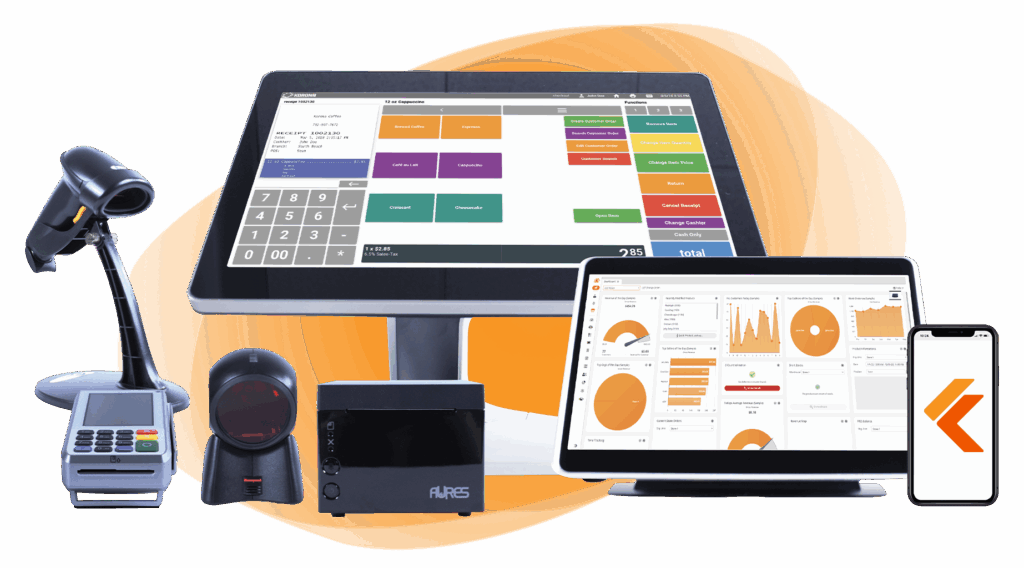
A coffee shop POS system is built from a terminal, receipt printer, cash drawer, card reader, and a kitchen or bar ticket printer or display.
KORONA POS sells POS hardware bundles that combine a terminal, cash drawer, receipt printer, and barcode scanner, and a separate kitchen printer produces tickets for the kitchen and bar.
Match Hardware to Peak Hour
Plan one order-taking point for each active lane during the busiest hour. A countertop terminal with a customer-facing display fits a standard counter, and a tablet terminal handles mobile checkout. Add a barcode scanner if the shop sells bagged beans or merchandise.
Build Your Own POS
Whether you run a retail store, café, or admissions booth, we have the point of sale hardware designed for your specific needs. Start building your ideal POS system now.
Software And Payments
KORONA POS is processor-agnostic: a shop picks its own payment processor. The card reader is the other half of that decision, and an explainer on choosing a payment terminal lays out the options.
KORONA POS plans cost $59 (Core), $79 (Retail), or $99 (Plus) per terminal per month, with no setup or sign-up fees and no forced contracts.
Cafés that rely on modifiers and kitchen printers can add the KORONA Food module for $10 per register per month, and payment plans are available for hardware.
Pick the POS while the counter layout is still open, because terminal and printer placement shapes workflow. A comparison of the best POS system for coffee shops helps narrow the software choice.
How Much Does Coffee Shop Equipment Cost?
A drinks-only coffee shop can be equipped from about $11,200 at entry-level prices, and the espresso machine alone ranges from $4,600 to more than $32,000. Bean & Brew Tech sets a mid-range professional espresso setup, with the machine, grinder, and accessories, at $15,000 to $25,000.
Entry-Level Budget by Shop Format
The table totals the lowest sourced price for each listed piece. Read the figures as a floor, not a forecast.
| Shop format | Equipment included | Entry-level total (approximate) |
|---|---|---|
| Kiosk or drive-thru window | Espresso machine, espresso grinder, batch brewer, hot water dispenser, undercounter ice machine, undercounter refrigerator, filtration kit | $11,200 |
| Small café | Kiosk equipment plus batch grinder and two-door reach-in refrigerator | $14,300 |
| Full café with food | Small café equipment plus undercounter dishwasher and blender | $18,500 |
Ovens, display cases, ventilation, prep tables, sinks, signage, security, and POS hardware sit outside the totals because they are priced by quote. Installation and permits raise the bill further.
What The Totals Leave Out
Lease, build-out, licenses, inventory, and payroll fall outside equipment spending. A separate breakdown of the cost to open a coffee shop addresses those line items. Reserve a contingency for installation surprises such as electrical upgrades or extra plumbing.
Buying New, Used, or Leased Equipment
Used equipment works for expensive, durable pieces such as ovens and freezers when it is well maintained and NSF-listed, and leasing or financing can lower upfront cost.
When Used Equipment Makes Sense
Toast’s checklist supports buying used for costly essentials, as long as previous owners maintained the units well. Inspect units in person at purchase. The City of Everett subjects used equipment to onsite inspection and expects clean, working, well-repaired units. Request service records on any used espresso machine or ice machine.
Leasing And Financing
Leasing or renting equipment lowers risk until the business model proves itself, Toast says, and lease payments can be tax-deductible. Check the treatment with an accountant. Square points to small-business loans and names three features to compare: a quick application, fast funding, and simple repayment that fits cash flow.
Where to Buy
Poster POS names restaurant supply retailers such as WebstaurantStore, Whole Latte Love, and McDonald Paper as online sources, and many cities also have a local restaurant depot or wholesaler.
Toast suggests choosing suppliers that handle installation, maintenance, and repairs. Buying direct from a manufacturer does not guarantee better repair support, Poster cautions.
Equipment Maintenance And Replacement Planning
Plan maintenance and replacement piece by piece. Culligan places ice machine life at 7 to 10 years, TheHoReCaStore gives undercounter dishwashers 7 to 12 years, and Coffee Machine Depot advises changing water filters every 6 to 12 months.
Service Intervals And Technicians
Follow each manufacturer’s service schedule, and get to know an espresso machine technician before the first breakdown, a step Toast endorses. Log cleaning dates, filter changes, and service visits for each machine.
Warranty Questions to Ask
Before buying, ask who processes warranty claims, what the coverage includes, whether labor is part of it, and whether a local technician services the brand. Even a strong warranty falls short without a nearby service provider.
Replacement Planning
Record each high-cost piece with its install date and expected lifespan, then add an annual replacement line to the budget. Swap out ice machines and dishwashers on schedule, and monitor espresso machines and grinders for climbing repair frequency.
Next Steps For Equipping Your Coffee Shop
Begin with the menu, then sort each item into Opening Day, Add Later, or Optional with the checklist above. Collect quotes on the big-ticket pieces, verify utilities and NSF listings, and match the budget table to your shop format. The equipment list is one step in a larger plan, and the guide on how to open a coffee shop walks through the rest.
Once the equipment list is final, test the checkout side of the counter. A free KORONA POS trial, with no credit card required, shows how the terminal, printers, and cash drawer fit your workflow, and a product specialist can run a demo on request.
Speak with a product specialist and learn how KORONA POS can power your business.
Frequently Asked Questions
Which Equipment Does a Coffee Shop Need on Opening Day?
Day one means a batch brewer, an espresso machine with grinders, water filtration, refrigeration, ice production, hot water service, barista tools, code-required sinks, and a POS system. Ovens, blenders, and display cases come later, once the menu justifies them.
How Much Does Coffee Shop Equipment Cost?
Budget at least $11,200 for a drinks-only shop built from entry-level gear. On its own, the espresso machine runs from $4,600 past $32,000, and food service or higher-capacity equipment pushes totals higher. Collect quotes on each significant purchase.
Does a Coffee Shop Need a Commercial Espresso Machine?
Yes. Commercial units are built for continuous back-to-back extraction, and numerous local health departments expect NSF-listed commercial machines. A consumer machine falls behind during peak-hour demand and usually lacks the NSF listing that inspectors check for.
Can You Buy Used Coffee Shop Equipment Safely?
Yes, for sturdy items like ovens, freezers, and refrigeration units, provided they carry NSF listing and pass inspection. A few health departments inspect used equipment as a condition of approval. Buy used espresso machines and ice machines only with full service records.
Does a Coffee Shop Need a Dishwasher Beyond a Three-Compartment Sink?
No. A three-compartment sink already covers hand warewashing, and plenty of jurisdictions require one anyway. A dishwasher is optional, speeds cleanup, and costs $3,000 to $5,000 for undercounter models. Check your local rules first, as requirements vary.
Which Coffee Shop Equipment Matters Most?
The espresso machine paired with a quality grinder carries the most weight on espresso-based menus, as the two together set drink quality and speed. Drip-focused menus lean harder on a reliable batch brewer and good water filtration. Rank priorities by what the menu sells.