

The best QuickBooks POS alternatives in 2026 are KORONA POS, MicroBiz Cloud, Square, Shopify POS, Clover, Magestore, and Toast, each of which syncs with QuickBooks Online so you keep your accounting. Intuit shut down QuickBooks POS on October 3, 2023, with no further security patches, payment processing, or support, so any replacement should protect your books and fit your vertical. We compared all seven on cost, QuickBooks Online sync, hardware reuse, and data migration to help you choose.
Key Takeaways:
- QuickBooks POS ended on October 3, 2023, with no more security patches or payment processing.
- Your best replacement should sync with QuickBooks Online so your accounting stays intact.
- KORONA POS is the strongest all-around retail pick, since it works with any payment processor.
- Products, customers, and stock counts transfer to a new system, but sales history usually does not.
- Most scanners, printers, and cash drawers carry over, while payment terminals rarely do.
Is QuickBooks POS Really Discontinued?
Yes. Intuit discontinued QuickBooks Desktop Point of Sale 19.0 on October 3, 2023. The software still opens and runs on your computer, but it stopped receiving security patches and lost every Intuit-connected service on that date, including built-in payment processing. Running it today means operating a working register on unsupported, unpatched software that handles credit card data.
What Stopped Working on October 3, 2023
Intuit named version 19.0 the final release in late 2022, stopped selling new licenses on February 8, 2023, and let existing users add licenses until the October 3, 2023 cliff. On that date, the following ended:
- Security patches and updates: none since that date, so any vulnerability discovered afterward stays open.
- QuickBooks Payments (Intuit Merchant Services): card processing through the POS ended, and the Tetra Lane 5000 PIN Pad no longer works.
- Gift Card Service: existing balances have to be tracked by hand.
- eCommerce integration and multi-store sync: the Webgility connection and the Intuit Store Exchange method shut off.
- Technical support: phone and chat support closed.
Why “It Still Works” Is the Trap
The local software keeps running, which lulls owners into staying put. The risk is not that QuickBooks POS stops one day. The risk is that it keeps running while unprotected. Because it is a desktop POS, it lives on a local Windows machine that processes credit cards, connects to the internet, and never receives another patch, which is exactly the target attackers hunt for.
The Security and PCI Compliance Reality
PCI DSS requires merchants to run supported software with current security patches. Software that has had no patches since October 2023 cannot meet that standard, which breaks the PCI compliance every retail store has to maintain and can expose you to penalties and liability after an incident.
The cost when an incident happens is not minor. IBM’s 2025 Cost of a Data Breach Report put the United States average breach cost at a record $10.22 million, with customer personal information the most commonly exposed data. A small retailer will not face that full figure, but even PCI fines and the cost of a card-data exposure dwarf the price of switching systems.
There Is No Native QuickBooks Online POS
Worth clearing up for anyone searching: Intuit did not replace QuickBooks POS with a QuickBooks Online version. What people call “QuickBooks Online POS” is one of two things, either the GoPayment app, which accepts card payments but has no full register workflow, or a third-party POS that integrates with QuickBooks Online. If you want a real point of sale, you are choosing from the alternatives covered in this guide, not waiting for an Intuit product that is not coming.
Your Deadline Reality: The Cliff Already Passed
There is no second deadline on the way, because the cliff is behind you. Every month on QuickBooks POS adds security and compliance exposure, and clean data exports get harder over time as the unsupported software ages. The practical move is to choose a replacement that syncs to QuickBooks Online and migrate before an incident or a failed export forces the decision on a worse timeline.
How to Choose a QuickBooks POS Replacement (the 6-Point Checklist)
The right replacement is the one that keeps your QuickBooks Online accounting, moves your existing data, reuses the hardware you can, gives you control over payment processing, fits your retail vertical, and comes with support and contract terms you can live with. The six points below build on the broader rules for how to choose a POS, narrowed to what a QuickBooks POS migrant needs, so score every system you shortlist against them before you look at price, because a cheap system that fails on migration or processing costs more in the long run.
1. QuickBooks Online Integration
Confirm the system syncs with QuickBooks Online, since that is how you keep your books after QuickBooks POS. Ask two questions: is the sync built in or does it require a paid third-party connector, and how much detail transfers (summary totals only, or itemized sales, tax, and payment fees you can reconcile). Direct QuickBooks Desktop sync is effectively gone, so if you still run Desktop for accounting, confirm the exact path or plan to move your books to QuickBooks Online as part of the switch.
2. Data Migration
Check what the system can import and who does the work. Master records (products, customers, vendors, and current stock counts) should move over. Sales history, purchase orders, loyalty points, and store credit usually do not, so plan to keep your QuickBooks POS backup as the record of past sales. For a small, clean catalog, a self-service CSV import is workable. For a large catalog or a compliance-driven store, favor a system with a dedicated migration team so field mapping does not become your problem.
3. Hardware Reuse
Decide what you can keep before you budget. Barcode scanners, receipt printers, and printer-driven cash drawers often carry over when the new system supports the model and connection type. Payment terminals and PIN pads almost never transfer, because they are tied to a processor. Locked, all-in-one systems force their own hardware, which turns a software switch into a full hardware repurchase, so weigh that cost into the comparison.
4. Processing Flexibility
Look closely at whether you control your payment processing or the POS controls it for you. Systems like Square, Clover, and Toast lock you into their processing at non-negotiable rates, so you cannot shop for a better deal without replacing the system. A processor-agnostic system lets you keep or change processors and negotiate your own rate, which matters most for high-volume stores where a fraction of a percent is real money. If your margins are tight, the freedom to shop around for lower processing rates can outweigh a lower sticker price.
Payment processors giving you trouble?
We won’t. KORONA POS is not a payment processor. That means we’ll always find the best payment provider for your business’s needs.
5. Vertical Fit and Required Features
Match the system to how your store actually operates. A liquor, vape, or smoke shop needs age verification. A multi-location or franchise operation needs centralized control with per-location reporting. An inventory-heavy retailer needs matrix products, purchasing, and receiving, while a restaurant needs menu and kitchen tools. A generic POS that handles the basics but misses your one critical workflow is the most expensive mistake on this list, so list the must-have POS features for your business first and disqualify anything that cannot do them.
6. Support Quality and Contract Terms
Read the contract and test the support before you sign. Some systems run month-to-month with no commitment, while others require 36-month or two-year contracts with early-termination fees that can reach into the thousands. Confirm the support hours overlap your business hours, ask how support is delivered (phone, chat, email), and check whether quality support costs extra. Poor support during a busy shift costs you sales, so weigh it as heavily as features.
Best QuickBooks POS Alternatives Compared (at-a-glance)
Here is how the seven alternatives compare on the factors that matter most to a QuickBooks POS migrant: who each is built for, how it connects to QuickBooks Online, whether you control payment processing, what it costs to start, and whether you can try it first.
Best QuickBooks POS Alternatives Compared
| POS | Best For | QuickBooks Online Sync | Processing Model | Starting Price | Free Trial |
|---|---|---|---|---|---|
| KORONA POS | Retail and multi-location | Built-in | Processor-agnostic | $59/mo | Yes |
| MicroBiz Cloud | Inventory-heavy specialty retail | Built-in (Enterprise plan) | Multiple processors | $65/mo | Yes, 21 days |
| Square | Small budgets and simple retail | Built-in (Intuit app) | Locked to Square | $0/mo | Free plan |
| Shopify POS | Ecommerce-first retailers | Connector app | Shopify Payments or third-party | $39/mo | Yes, 3-day |
| Clover | Service-based and counter businesses | Connector app | Locked to Fiserv | $0/mo | No |
| Magestore | Magento and Adobe Commerce merchants | Built-in integration | Flexible (Magento gateways) | $69/mo | Yes, 7 days (Lite) |
| Toast | Restaurants | Connector | Locked to Toast | $0/mo | No |
The 7 Best QuickBooks POS Alternatives in 2026
Every system below syncs with QuickBooks Online, so the merchant keeps their accounting after leaving QuickBooks POS. They are ordered by how closely they replace a QuickBooks POS retail setup, starting with the strongest retail fit. Pricing and rates are current as of 2026 and pulled from each vendor’s official site.
1. KORONA POS: Best for retail and multi-location
KORONA POS is a cloud retail system built for inventory-heavy and compliance-driven stores, and it connects to QuickBooks Online for accounting. The features that set KORONA POS apart line up closely with what QuickBooks POS users are losing.
Key Features
- Inventory management: ABC grading classifies products by performance, automated reorder points hold stock at target levels, and inventory tracks across multiple locations. Included in the Retail plan.
- Loss prevention: Built-in tools track inventory discrepancies, flag unusual transaction patterns, and give managers visibility into employee-level activity. Native tooling that is rare at this price point.
- Reporting and KPI dashboards: KORONA.studio surfaces conversion rates, sales by hour, product performance, employee activity, and multi-location comparisons through custom dashboards you build without opening a spreadsheet.
- QuickBooks Online integration: Direct sync, so former QuickBooks POS users keep their existing accounting workflow.
Where KORONA POS Shines
- Processor independence: Use any processor you want, so you can move off QuickBooks POS without changing your credit card processing. A 0.3% difference in processing rates on $1M in card volume is $3,000 a year back in your pocket.
- Niche industry depth: age verification for liquor and vape, ticketing and membership for museums and parks, franchise royalty calculation, and winery tasting room management. Most POS systems do not cover these.
- Customer support: Across hundreds of reviews, responsive US-based support is the most consistently praised aspect. Most users report reaching a real person in under a minute.
Where KORONA POS Falls Short
- Learning curve: The backend is feature-dense and can feel heavy during setup. Budget time for onboarding.
- Per-terminal pricing adds up: At $59 to $79 a month per terminal on the lower tiers, a five-terminal store pays $295 to $395 a month before add-ons. Run the math for large multi-terminal setups.
Customer Reviews
KORONA POS holds a 4.8/5 on G2. Reviewers consistently praise inventory depth, reporting, and processor independence, particularly multi-location retailers who centralize all store data in one dashboard. The most common criticism is an interface some describe as functional but dated.
“Korona is a flexible POS software with all of the features that I need in order to track inventory, sell products easily, and keep track of my business. It’s not built for book sales, but the support team helped me to get everything up and running and customized for my particular needs. It’s far more affordable than the book-specific POS systems, and especially for a small store starting out, it has been a great fit. I’ve been able to figure out how to do most things on the platform on my own, new employees catch on to how to do things easily, and when I don’t know how to do something, the support team is amazing and always helpful. I’ve never experienced any downtime on the platform, which is super helpful for running an in-person retail business.”
Small-Business (50 or fewer emp.)
That said, some users have noted limitations in reporting customization, particularly when specific use cases require combining data from multiple reports to get the insights they need.
“There are a couple of reports that I have to merge together in a spreadsheet in order to get the information I need for weekly reporting. just based on my specific use case. I wish there was a little more flexibility in bringing the fields I wanted into a report. It would also be amazing to someday have an integration with Edelweiss so that we don’t have to input every book manually. (though the process for that is pretty simple and efficient)”
Small-Business (50 or fewer emp.)
Who KORONA POS Is Best For
- Specialty retailers with compliance requirements (liquor, vape, cannabis-adjacent).
- Multi-location and franchise operations needing centralized control with per-location visibility.
- High-volume retailers who want to negotiate their own payment processing rates.
KORONA POS Pricing
| Plan | Price | What’s Included |
|---|---|---|
| Core | $59/month | 24/7 support, payment processor choice, customizable dashboard, unlimited users and sales, gift cards, eCommerce integration, API access |
| Retail | $79/month | Everything in Core plus inventory counts, stock management, barcode automations, supplier interface integration, customer management |
| Plus | $99/month | Everything in Retail plus advanced stock management, assortment cleanup, KPI reports, custom ABC analysis, order-level optimization |
| Add-ons | $10 to $50/month | KORONA Food (+$10), KORONA Franchise (+$30), KORONA Ticketing (+$50/gate) |
Unlimited free trial, no credit card required.
2. MicroBiz Cloud: Best feature-for-feature retail replacement
MicroBiz Cloud is the closest match to old QuickBooks POS for inventory-driven specialty retail, and it publishes register data straight into QuickBooks Online.
Key Features
- Deep retail inventory: matrix and configurable products, kits and bundles, serialized inventory, purchasing and receiving, and multi-store stock with a centralized view.
- Order and service tools: order management for layaways and phone orders, work orders for repair and service departments, and credit accounts with AR.
- One-touch QuickBooks Online sync: publish register batch data to QuickBooks Online with a single action, with no file uploads or manual reconciliation.
Where MicroBiz Cloud Shines
- QuickBooks POS parity: the advanced inventory and back-office features that QuickBooks POS users relied on are present here, more so than in Square or Shopify.
- Per-register pricing: back-office users are not charged, only registers, which keeps cost predictable for small teams.
- Support reputation: reviewers repeatedly cite patient, knowledgeable support.
Where MicroBiz Cloud Falls Short
- Smaller ecosystem: fewer third-party integrations and no public API, and the eCommerce sync setup draws some complaints.
- Retail-only focus: little for restaurants or hospitality, and employee management is basic (no time clock).
Customer Reviews
MicroBiz Cloud has won over retailers who previously struggled with inventory discrepancies across physical and online storefronts, with users noting its dependable real-time sync as a standout advantage over competing solutions.
“After using many POS solutions for a physical/virtual store hybrid business model (including WooCommerce POS, Shopify, and more) I was always frustrated with the discrepancies in inventory from one system to the other. Now, with microbiz, I never have to worry. Moneris and others have solutions too, but they are always throwing errors and out of date with the fast pace that WooCommerce iterates… but not MicroBiz. Highly recommend we keep supporting this product.”
Computer Software
On the other hand, some users have expressed frustration with limited invoice layout customization and the absence of a mobile app, which can be a drawback for businesses that need flexibility on the go.
“I wish that you could customize the layout of the invoices. There are a few settings to tweak it – but this is somewhat limited. Does not have an iPhone app so has to be used on a laptop or tablet.”
Small-Business
Who MicroBiz Cloud Is Best For
- Independent, inventory-driven retailers (appliance, firearms, hardware, garden, furniture) leaving QuickBooks POS.
- Retailers who want to keep QuickBooks Online and need true purchasing, receiving, and matrix inventory.
MicroBiz Cloud Pricing
| Plan | Price | What’s Included |
|---|---|---|
| Standard | $65/month ($650/year) | Store plus one register, inventory, order and work-order management, unlimited back-office users, up to 25K product records. No QuickBooks Online or WooCommerce sync. |
| Enterprise | $95/month ($950/year) | Everything in Standard plus QuickBooks Online integration, WooCommerce and WordPress sync, and up to 150K product records. |
| Extra register license | $32.50/month ($300/year) | Each additional register. |
| Additional stores | $65/month ($600/year) | Each additional store. |
Free 21-day trial, no credit card. QuickBooks Online integration requires the Enterprise plan. For more than five stores, contact MicroBiz.
3. Square: Best for small budgets and simple retail
Square is a free-to-start POS with flat-rate processing, and Intuit’s official Square app imports daily sales into QuickBooks Online. Our full Square POS review digs into where that flat rate stops paying off.
Key Features
- Free POS software: full app on phone, tablet, or Square hardware, with next-day deposits.
- Square for Retail: barcode and SKU tools, vendor and purchase-order management, and inventory reporting on paid tiers.
- QuickBooks Online sync: the official Square app in the QuickBooks App Store, built by Intuit, auto-imports sales into QuickBooks Online.
Where Square Shines
- Lowest barrier to entry: free plan, no contract, and setup in minutes.
- Connected ecosystem: Payroll, Banking, Loyalty, and Online all tie into the POS.
Where Square Falls Short
- Locked, non-negotiable processing: you cannot bring your own processor below $250K a year, and the flat rate gets costly at volume.
- Account stability: some sellers report sudden fund holds or account terminations.
- Inventory depth: trails specialty retail systems for complex catalogs and multi-location transfers.
Customer Reviews
Square users have appreciated the moments when its support team comes through, with some reviewers noting that knowledgeable representatives can effectively resolve issues when they are finally reached.
“The chat was not helpful. I spent too much time off my job to fix the problem. Upon speaking to the last rep, he was able provide clearly and directed me the right person to resolve the problem. Note: I had been call and dealing with char from May 21. The rep was very held and could response and follow his direction. Please make more reps available. He was great. You need more intuitive individuals.”
However, Square has drawn significant criticism for abrupt account freezes and fund holds that leave sellers unable to access their earnings, with some reporting repeated verification demands and little recourse through customer service channels.
“Square is the absolute worst is no doubt part of a Ponzi scheme of sorts in freezing thousands of accounts weekly and forcing 90 day holds and account closures to keep the scheme going giving it a never ending cycle. They made me verify 4 times in a span of 10 days, 3 times in 3 days and 2 times within 24 hours. On the last day after several chats and emails I told them let me have my money then close account so at 2:08 I received email stating verification good and account normal, at 2:15 I went to withdraw funds and they blocked it again for “verification” purposes. They have taken food off my table, made my heart monitor go off more than ever sending me to hospital bc of BP while they sit back and laugh at damage they do. DO NOT USE THIS COMPANY, will be pursuing legal action”
Who Square Is Best For
- Small and simple retail, cafes, mobile sellers, and service businesses on a tight budget that prioritize zero monthly software cost.
Square Pricing
| Plan | Monthly | In-Person Rate | What’s Included |
|---|---|---|---|
| Square Free | $0/month per location | 2.6% + $0.15 (3.3% + $0.30 online) | POS app and payments, website builder with SEO tools, and item library. |
| Square Plus | $49/month per location | 2.5% + $0.15 (2.9% + $0.30 online) | Everything in Free plus staff management, expanded site customization, and a loyalty rewards program. |
| Square Premium | $149/month per location | 2.4% + $0.15 (2.9% + $0.30 online) | Everything in Plus plus advanced reporting, no gift card load fee, and 24/7 phone support. |
| Square Pro | Custom | Custom | Custom pricing and processing for businesses over $250,000 a year, plus hardware discounts, onboarding and implementation support, technical specialists, and account management. |
Custom rates for businesses processing more than $250,000 a year. Hardware from $59 (reader) to about $799 (Register).
4. Shopify POS: Best for ecommerce-first retailers
Shopify POS unifies online and in-store selling for brands on Shopify, and it reaches QuickBooks Online through connector apps. The cost builds in layers, and our Shopify POS pricing breakdown shows how the base plan, POS Pro, and processing fees stack up.
Key Features
- Unified commerce: one back office for online and retail catalog, inventory, and customer data.
- POS Pro tools: demand-forecast inventory, buy-online-pickup-in-store, ship-from-store, and cross-location returns.
- QuickBooks Online sync: through connector apps such as Webgility or QuickBooks Connector, not a native link.
Where Shopify POS Shines
- Best omnichannel fit: for brands already on Shopify, one system runs web and physical retail.
- Fast setup: an interface staff learn quickly.
Where Shopify POS Falls Short
- Tied to the ecosystem: offline-only stores with no online presence get little value.
- Layered cost: base Shopify plan plus POS Pro per location plus processing, with 0.5% to 2% added for third-party processors.
- QuickBooks sync needs a paid connector: Accounting Continuity costs extra and adds a moving part.
Customer Reviews
Shopify POS has been commended for its reliability as a scalable commerce platform, particularly by brands that convert online traffic into in-store purchases and need a backend that holds up under growing demand.
“Overall, it’s been a reliable and scalable platform for our business. We’re able to turn YouTube traffic into purchases without friction, and that’s been huge. While it takes some initial setup to make it work for digital products and content funnels, once it’s dialed in, it runs smoothly. It gives us the confidence that when we send traffic — especially from YouTube — the backend will hold up and convert. For a growing brand, that reliability matters more than anything.”
Some merchants have reported serious concerns about unresponsive support and account-level actions that disrupt business operations, leaving sellers feeling powerless when urgent issues arise.
“Shopify’s unresponsiveness is holding my business hostage and causing severe financial damage. I have already filed a formal complaint with the Better Business Bureau (BBB Complaint ID: 24980532). It is unacceptable to treat sellers this way. I need an urgent manual review and the immediate restoration of my store!.”
Who Shopify POS Is Best For
- eCommerce-first retailers already on Shopify who also sell in-store and want a single catalog across channels.
Shopify POS Pricing (2026)
| Plan | Monthly | In-Person Rate | What’s Included |
|---|---|---|---|
| Basic | $39/month | 2.6% + $0.10 (2.9% + $0.30 online) | For solo entrepreneurs. Casual in-person selling with limited staff POS access, simple customer profiles, and returns at the original purchase location. |
| Grow | $105/month | 2.5% + $0.10 (2.7% + $0.30 online) | For small teams. Casual in-person selling with unlimited POS logins, simple customer profiles, and returns at the original purchase location. |
| Advanced | $399/month | 2.4% + $0.10 (2.5% + $0.30 online) | For global reach. Unlimited POS logins, with the lowest standard card rates of the paid tiers. |
| Plus | $2,300/month (3-year term) | Best rates for high-volume merchants | For complex businesses. Includes POS Pro features: unlimited staff POS access, rich customer profiles, returns at any location, staff roles and permissions, customer loyalty insights, inventory management, professional retail reports, and omnichannel selling. |
| POS Pro (add-on) | $89/month per location | Same as your plan | Optional upgrade on any paid plan. Adds unlimited staff POS access, staff roles and permissions, rich customer profiles, customer loyalty insights, returns and exchanges at any location, inventory management, professional retail reports, and omnichannel selling. |
5. Clover: Best for service-based and counter businesses
Clover is an all-in-one hardware-and-software system owned by Fiserv, and it syncs to QuickBooks Online through App Market connectors. Because rates and terms vary by reseller, our Clover pricing breakdown is worth a read before you sign anything.
Key Features
- Bundled hardware and software: polished terminals with a large app market for add-ons.
- Retail tiers: inventory, item-level reporting, and order management.
- QuickBooks Online sync: through apps such as Commerce Sync on the Clover App Market.
Where Clover Shines
- Hardware quality: durable, well-built terminals and a simple in-person setup.
- App ecosystem and offline mode: broad add-on options and offline transaction capability.
Where Clover Falls Short
- Processor lock-in: tied to Fiserv or the reseller that sold the system, so you cannot shop rates without replacing hardware.
- Contracts and opaque pricing: 36-month terms with early-termination fees are common, and rates vary widely by reseller.
- Paid add-ons: advanced inventory, loyalty, and accounting features often require extra monthly apps.
Customer Reviews
Clover has received recognition for delivering a functional device with adequate service during the initial onboarding period, giving new users a smooth enough start with the system.
“The clover device works ok. Service is also ok at the beginning. But subscription fee is so high (they gave me free of charge for the first a couple of months). I used their service for 4 years. It’s ok overall until 2 months ago I couldn’t stand their ridiculously high subscription fee and moved to another provider. ”
Clover’s reseller-driven sales model has been a recurring pain point, with users reporting experiences of unresponsive representatives, opaque account setup processes, and unexpected charges for devices that were never fully activated.
“So we own a small restaurant, one day a guy walked in asked if we want pos system with flat rate, we said yes, and couple days later he came with the device and told us the processing fee will be charged to our customers, we could not accept it, and he left said he will figure out something. Now its been weeks and he didn’t come or answer our call or reply email. When i call clover customer service, they asked for account numbers and stuff which the guy never gave us, i told them i can provide address, business name or phone numbers for them, they can’t find the account, i provided the serial number of the device, they still can’t find it, and hung up. By the way even if the guy didn’t activate the device, clover has charged us for the device, now there is no way for me to contact them. The funny part is their customer service rep cant even spell simple words, i have to use phonetic alphabet, come on guys.”
Who Clover Is Best For
- Service-based and simple in-person businesses that want all-in-one hardware and are not sensitive to processing rates or contract terms.
Clover Pricing
Card-present 2.3% to 2.6% + 10¢; keyed or online 3.5% + 10¢. Hardware costs roughly $349 to $1,799 and up, depending on the device. Rates and contract terms vary by reseller. Keyed-in payments are 3.5% + $0.10 on every plan. Hardware can be financed over 36 months or bought outright. Prices shown are Clover.com direct pricing; reseller pricing and contract terms vary.
| Plan | Price | What’s Included |
|---|---|---|
| Starter (professional services) | $0/month | Accept payments and manage your business through the Clover dashboard and Clover Go app. Keyed payments 3.5% + $0.10. |
| Essentials (professional services) | $29.95/month | Everything in Starter plus estimates, time and attendance, bill pay, and bookkeeping sync. |
| Services Growth (professional services) | $84.95/month | Everything in Essentials plus advanced scheduling, appointment management, and online booking. |
| Basic terminal (personal services) | $16/month for 36 months, or $349 | Compact 3.6-inch countertop terminal with built-in receipt printer, on the Starter plan. Card-present 2.6% + $0.10. |
| Standard POS (personal services) | $130/month for 36 months, or $849 plus $84.95/month software | Mini 8-inch touchscreen POS with built-in receipt printer, on the Services Growth plan. Card-present 2.3% + $0.10. |
| Advanced station (personal services) | $180/month for 36 months, or $1,899 plus $84.95/month software | Station Duo, a 14-inch merchant-facing POS with an 8-inch customer screen, on the Services Growth plan. Card-present 2.3% + $0.10. |
6. Magestore: Best for Magento and Adobe Commerce merchants
Magestore is a Magento-native POS that owns the omnichannel sync for Adobe Commerce stores, and it connects to QuickBooks for accounting.
Key Features
- Magento-native sync: inventory, orders, and customers sync to the Magento or Adobe Commerce store with no middleware connector.
- Omnichannel fulfillment: in-store pickup, ship-from-store, and unified online and offline loyalty.
- Accounting integrations: QuickBooks Online and Xero.
Where Magestore Shines
- One-time license option: POS Commerce and POS Customization are one-time purchases you own forever, with no per-terminal monthly fee.
- Customization: source-code access on owned plans for deep retail workflows.
Where Magestore Falls Short
- Magento prerequisite: only relevant if you run Magento or Adobe Commerce, which carries its own hosting, development, and maintenance cost.
- Support consistency: multiple reviewers report slow or hard-to-reach support.
Customer Reviews
Magestore has garnered positive feedback for delivering a comprehensive, all-in-one solution that ties together online sales, in-store POS, and inventory management, with users praising its powerful automation capabilities across key workflows.
“Magestore software provides a complete solution for operating and managing an entire business across online sales, POS, and inventory management. It also includes powerful automation features that streamline workflows such as order processing, picking, packing, and checkout, helping businesses improve efficiency and operational control.”
Computer Software (Used the software for: 1-2 years)
Still, some users have noted that unlocking Magestore’s full potential often requires dedicated development time to properly configure and customize the system for specific business operations, which can increase the initial investment.
“There are essentially no major limitations, as one of the key advantages of the system is its flexibility and ability to be customized around your specific business operations. This opens the door to a wide range of solutions that can be tailored to support and optimize overall workflows across the business. However, achieving this level of customization may require development time to properly configure and program the system according to your operational needs and objectives.”
Computer Software (Used the software for: 1-2 years)
Who Magestore Is Best For
- Retailers running Magento or Adobe Commerce who want a native POS and accounting sync to QuickBooks.
Magestore Pricing (2026)
| Plan | Price | What’s Included |
|---|---|---|
| POS Lite | $69/month | Native Magento Open Source POS for fast in-store checkout, with unlimited users, devices, and locations. Includes offline mode, order management, multi-location management, and staff management. Comes with a 7-day free trial. |
| POS Simple | One-time license (quote-based) | Everything in POS Lite, plus Adobe Commerce support, online payments through Stripe, Square, and Adyen, omnichannel loyalty, role-based access, barcode management, POS reporting, and popular third-party integrations including accounting tools such as QuickBooks. One-year warranty and 90-day money-back. |
| POS Commerce | One-time license (quote-based) | Everything in POS Simple, plus advanced order fulfillment with dropshipping, backorder, and click-and-collect, multi-location inventory, purchase order and supplier management, extensive omnichannel reporting, and custom development. One-year warranty and 90-day money-back. |
90-day money-back guarantee on licenses. Requires a Magento or Adobe Commerce store.
7. Toast: Best for restaurants
Toast is a restaurant-specific platform, included here for food-service operators leaving QuickBooks POS, and it syncs sales and labor data to QuickBooks Online.
Key Features
- Restaurant-built tools: menu management, kitchen display system, tableside handhelds, and online ordering.
- All-in-one platform: payroll, loyalty, and marketing modules on one system.
- QuickBooks Online sync: through Toast’s accounting integration and partner connectors.
Where Toast Shines
- Purpose-built for food service: menu, modifier, and KDS handling that generic retail systems cannot match.
- Durable hardware and 24/7 support: spill-resistant devices and round-the-clock help, even on the free Starter Kit.
Where Toast Falls Short
- Locked processing: you cannot bring your own processor, and rates can rise on 30 days’ notice, as they did in a past Toast processing rate increase.
- Proprietary hardware and contracts: two-year terms are standard on paid plans, with early-termination fees, and you cannot use your own tablets.
- Not a retail replacement: little fit for non-food retail leaving QuickBooks POS.
Customer Reviews
Toast has been praised by restaurant owners for its ability to drive high-quality, high-spending customers through the door, making it a valuable tool for establishments looking to fill seats and boost revenue.
“If you have empty seats you are paying rent for you are crazy not to use these guys. If your restaurant is busy and you are constantly full, this is not the solution, you will cut into your bottom line. These guys will drive quality customers to your door, no coupon clippers here, these people spend AND tip!”
However, long-term users have raised serious concerns about Toast’s support quality, citing costly software glitches and a frustrating cancellation process that can leave restaurant owners feeling trapped in the system.
“The software is about the same as others but their support is a joke. Due to some glitches, their support has cost my 2 restaurants literally thousands of dollars. I went to cancel today after 5 1/2 years because I couldn’t take it anymore and they told me I had to have the previous owner contact them because they never updated their system, though I have asked them to repeatedly over the years. They are always quick to offer an apology but to fix something is real hit and miss. Can’t wait to finally be free of them. ”
Who Toast Is Best For
- Full-service and quick-service restaurants, cafes, and food trucks, especially former QuickBooks POS users in food service.
Toast Pricing (2026)
| Plan | Price | What’s Included |
|---|---|---|
| Starter Kit | $0/month | Hardware kit with no upfront costs, ideal for single-location restaurants needing one to two terminals. Cloud-based point of sale with hardware configuration including one terminal. Additional add-ons available. |
| Point of Sale | $69/month | Monthly software subscription with flat-rate processing. Cloud-based point of sale with your choice of hardware. Additional add-ons available. |
| Build Your Own | Custom pricing | The full Toast platform with the features you choose, such as perpetual inventory management, integrated payroll and tips, automated inventory, employee benefits and scheduling, and guest marketing, loyalty, and gift cards, paired with hardware of your choosing. |
| POS and Toast Payroll bundle | $69/month plus $9 per employee/month | Special pricing for new restaurants, down from $90. Everything in Point of Sale plus payroll essentials, basic scheduling, and team management tools including Restaurant Insurance, Vestwell 401(k), and the Toast Pay Card. |
Online orders 3.50% + 15¢. Hardware starts around $799 per terminal, with starter kits roughly $950 and up. Two-year contract standard on paid plans.
How to Migrate from QuickBooks POS Without Losing Your Data
You migrate by exporting your data from QuickBooks POS into spreadsheet files, reformatting those files to match your new system’s import template, importing them, then reconnecting QuickBooks Online for accounting. Your master records (products, customers, vendors, and current stock levels) move over. Transaction and sales history generally does not, so keep a full QuickBooks POS backup as your record of past sales.
What QuickBooks POS Data You Can Move (and What You Can’t)
Knowing what transfers before you start prevents the most common migration regret, which is assuming sales history will follow you.
Data that moves cleanly with correct mapping:
- Inventory items: item name, description, cost, retail price, on-hand quantity, and department or category.
- Customer list: names and contact details.
- Vendor list and store locations.
Data that does not transfer cleanly:
- Sales and order history, purchase orders, and discounts.
- Product images, which you export and reupload separately.
- Store credit balances, which most systems reissue as gift cards.
- Customer loyalty points and history.
- Multiple barcodes per item, since most new systems allow only one barcode per product.
Keep your QuickBooks POS backup file. It stays the system of record for historical sales and tax reporting after you switch.
Step 1: Export Your Data from QuickBooks POS
Inside QuickBooks POS, go to File, then Utilities, then Export. Select one data file at a time (inventory, customers, vendors), choose the Default template, and save the output as Excel or CSV. Repeat the process for each file. The export caps at 65,000 rows per file, so large catalogs export in batches.
Make a complete backup before you export anything. Some export functions degrade on the now-unsupported software, so the longer you wait, the harder a clean export becomes.
Step 2: Clean and Map the Export Files
The raw export will not match your new system’s import template, and the cleanup step is where most do-it-yourself migrations fail. Budget time for it.
Common fixes before import:
- Format UPC and barcode columns as text so Excel does not strip leading zeros or convert long numbers to scientific notation.
- Convert the Taxable field from “Tax” or “Non” to the True or False format your new system expects.
- Generate a customer ID and a stock number if your new system requires fields that QuickBooks POS did not use.
- Fill empty Vendor or Department fields, which many systems require to create an item.
Step 3: Import into Your New POS
Upload the mapped files into the new system. Some vendors provide guided import tools, such as Shopify’s QuickBooks Desktop Connector, that handle part of the mapping for you. After import, verify item counts, on-hand quantities, and customer totals against your QuickBooks POS figures before you trust the data.
Step 4: Reconnect QuickBooks Online
Connect the new POS to QuickBooks Online and run a test transaction. Confirm the sale posts to the correct accounts in QuickBooks Online before you go live. The connection is what preserves your accounting workflow, so test it rather than assume it.
Who Should Handle the Migration: DIY vs Done-for-You
For a small, clean catalog, a careful do-it-yourself CSV import is workable. For larger catalogs, multi-location stores, or compliance-driven retail where errors are costly, use a migration team. KORONA POS provides in-house technicians who merge your QuickBooks POS database onto the new system and confirm the QuickBooks Online connection before handover, which removes the field-mapping risk that derails self-service migrations. You can read more on the mechanics of switching POS systems before you commit to a path.
How Long Does a QuickBooks POS Migration Take?
For a typical catalog, the import itself runs from about an hour to a few hours. Very large catalogs take longer, because guided import tools cap around 50,000 items per day, so a 150,000-item catalog can span roughly three days. The real bottleneck is data cleanup, not import speed, so a clean, well-mapped export is the fastest path to going live.
Will My Existing QuickBooks POS Hardware Work?
Often, yes for the basics. Most barcode scanners, receipt printers, and cash drawers carry over to a new POS if it supports the model and connection type. Payment terminals and PIN pads usually do not, because they are tied to a specific processor. Confirm every device by exact model number before you assume it works, and treat your accounting sync as a separate question from your hardware.
Hardware You Can Usually Keep
- Barcode scanners: reusable when they run in standard USB keyboard (HID) mode and read your barcode types (UPC, EAN, Code 39, Code 128). Most QuickBooks POS scanners qualify.
- Receipt printers: widely supported models such as the Star TSP100 and TSP143 lines and the Epson TM-T88 family often carry over, provided the new POS and your operating system support that model and connection. Tablet and cloud systems sometimes require a specific connection type, so check whether it’s USB, Ethernet, or Wi-Fi.
- Cash drawers: most connect through the receipt printer with an RJ12 drawer-kick cable, so a drawer is reusable when the new receipt printer supports the same kick voltage and cable.
Hardware You Will Usually Need to Replace
- Payment terminals, PIN pads, and card readers: tied to a processor and rarely portable. Intuit and QuickBooks Payments devices do not carry over, and locked systems such as Clover, Toast, and Square require their own readers.
- Pole displays and label or tag printers: often need replacement because drivers, label templates, and barcode formats change between systems.
- Older serial-only printers and anything unsupported on a tablet or cloud setup: verify driver availability before counting on these.
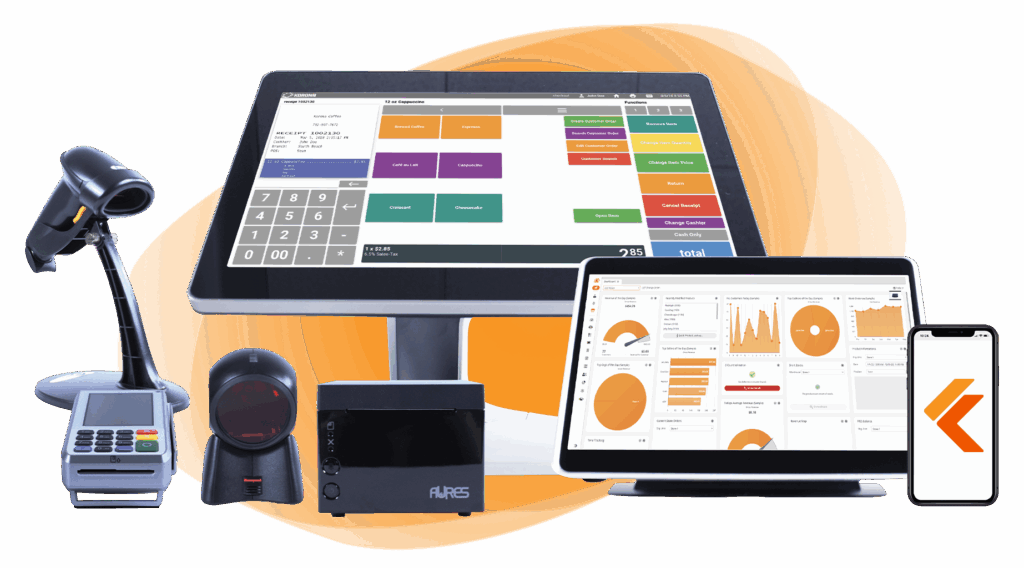
Build Your Own POS
Whether you run a retail store, café, or admissions booth, we have the point of sale hardware designed for your specific needs. Start building your ideal POS system now.
How to Check Hardware Compatibility Before You Switch
Run this checklist before migration day so nothing fails at the register:
- List every device by brand, model number, and connection type.
- Confirm the new POS officially supports each model.
- Verify operating system and driver availability.
- Check receipt paper width, label size, barcode format, and cash drawer cable type.
- Test scanning, receipt printing, and cash drawer opening before you go live.
Why Processor-Agnostic Systems Give You More Hardware Flexibility
Because KORONA POS is processor-agnostic, you are not locked into a single vendor’s terminal, so you can keep more of your existing peripherals and choose the payment hardware that best fits your store. Locked, all-in-one systems take the opposite path and mandate their own devices, which turns a software switch into a full hardware repurchase. Review which devices fit your setup on the POS hardware page before you buy anything new.
Keeping QuickBooks for Accounting After You Switch
You do not lose QuickBooks. Intuit discontinued QuickBooks POS, which is the in-store register software, not QuickBooks accounting. Your books stay in QuickBooks Online, the new POS takes over the register and inventory, and the two connect so sales flow into your accounting automatically. You are replacing the cash register, not your bookkeeping system.
QuickBooks POS vs QuickBooks Accounting: What Was Actually Discontinued
The two products share a name and get confused constantly, which is why some owners fear they are losing their books. They are not.
- QuickBooks POS is the register, checkout, and store-inventory software. Intuit ended it on October 3, 2023.
- QuickBooks Online and QuickBooks Desktop accounting are your bookkeeping tools. Both are still supported and sold.
Only the register software went away. Your accounting stays exactly where it is.
How a New POS Connects to QuickBooks Online
A modern POS pushes your sales totals, sales tax, payments, and processing fees into QuickBooks Online, and some systems also pass itemized sales and cost of goods sold. The connection runs one of two ways:
- Built-in sync: KORONA POS and MicroBiz publish data into QuickBooks Online directly, and Square uses the official “Sync with Square” app that Intuit built.
- Connector app: Shopify POS and Clover reach QuickBooks Online through a paid third-party connector such as Webgility or Commerce Sync.
Why Most Systems Sync to QuickBooks Online, Not Desktop
QuickBooks POS earned its loyalty through a deep link to QuickBooks Desktop accounting. Almost no modern cloud POS rebuilds that Desktop link. Instead, current systems sync to QuickBooks Online, and direct QuickBooks Desktop sync is effectively gone. If you still run QuickBooks Desktop for accounting, confirm the exact path before you commit, or plan to move your books to QuickBooks Online as part of the switch.
What to Confirm Before You Commit
- Which QuickBooks version the POS supports: Online or Desktop.
- Whether the sync is built in or needs a paid connector, and what that connector costs each month.
- How much detail transfers: summary totals only, or itemized sales, tax, and payment fees you can reconcile.
KORONA POS and QuickBooks Online
KORONA POS connects to QuickBooks Online so former QuickBooks POS users keep the same accounting tools they already trust, with no manual file shuffling between the register and the books. You can see how the register, inventory, and accounting fit together on the POS software page.
Frequently Asked Questions
Is QuickBooks POS still supported?
No. Intuit discontinued QuickBooks Desktop Point of Sale 19.0 on October 3, 2023. The software still opens and runs on your computer, but it no longer receives security patches, and connected services such as payment processing, gift cards, and eCommerce sync ended on that date.
What is the best replacement for QuickBooks POS?
For most retailers, the best replacement is a cloud POS that syncs with QuickBooks Online and fits your vertical. KORONA POS is the strongest all-around retail option, because it is processor-agnostic and supports compliance-driven stores. MicroBiz Cloud is the closest feature match for inventory-heavy retail, Square fits the smallest budgets, and Toast is the better choice for restaurants.
Do these POS systems integrate with QuickBooks Online?
Yes. All seven systems connect to QuickBooks Online so you keep your accounting. KORONA POS, MicroBiz, Square, and Magestore offer built-in sync, while Shopify POS, Clover, and Toast connect through a third-party connector app such as Webgility or Commerce Sync.
Can I transfer my data from QuickBooks POS?
Yes, for your master records. You can export products, customers, vendors, and current stock counts from QuickBooks POS and import them into a new system. Sales history, purchase orders, loyalty points, and store credit usually do not transfer, so keep your QuickBooks POS backup as the record of past sales.
Can I keep my QuickBooks POS hardware?
Often, for the basics. Most barcode scanners, receipt printers, and printer-driven cash drawers carry over when the new system supports the model and connection type. Payment terminals and PIN pads usually do not, because they are tied to a processor, and the Intuit Tetra Lane 5000 PIN Pad stopped working when QuickBooks Payments ended.
Does any POS still integrate with QuickBooks Desktop?
Rarely, and the direct link QuickBooks POS had is effectively gone. Most modern systems sync to QuickBooks Online instead, and a few connect to QuickBooks Desktop through a paid third-party connector. If you stay on QuickBooks Desktop for accounting, confirm the exact path before you commit, or plan to move your books to QuickBooks Online as part of the switch.