

Opening a retail store in 2026 requires serious upfront capital and careful financial planning. Most new retailers spend between $50,000 and $250,000 before opening their doors.
The biggest expenses include your lease deposit, initial inventory, store buildout, POS system, and working capital reserves.
We’ll break down each cost category with real numbers, show you where to save money, and help you avoid the cash flow mistakes that sink new stores.
Key Takeaways:
- Budget $50,000 to $250,000+ for total startup costs. Your actual number depends heavily on location, store size.
- Payment processing fees will quietly drain your profits every month. Choose a processing agnostic POS system so you can shop around for the best rates.
- Cash flow kills more retail stores than bad products do. Keep 3 to 6 months of operating expenses in reserve to cover slow seasons and unexpected gaps between when you pay suppliers and when customers pay you.
- Your store layout and signage directly impact sales from day one. Poor flow confuses customers and costs you money.
How Much Does It Cost To Open a Retail Store?
Opening a retail store typically costs $50,000–$250,000+, depending on size and location. Major costs include lease deposits, build-out and fixtures, inventory, licenses/permits, POS systems, insurance, staffing, and initial marketing. Urban locations and larger inventories significantly increase startup costs.
Free printable templates and checklists to help you manage retail operations with ease
Inventory Management Systems and Tools
Modern retail relies on SaaS (Cloud) or On-Premise systems. Cloud tools like Zoho Inventory or KORONA POS cost $30–$200/month, while on-premise licenses can exceed $30,000. These tools impact startup costs by adding hardware (scanners/printers) and onboarding fees.
Key Cost Factors To Consider When Opening a Retail Store
Cost Category | Typical Range | When You Pay | Critical Money-Saving Strategy |
Lease Deposit & First Month | $3,000-$15,000 | Before opening | Negotiate tenant improvement allowance; consider popup or shared retail space first |
Build-Out & Renovations | $50-$200 per sq ft | 2-3 months before opening | Get 3+ contractor bids; do cosmetic work yourself; buy used fixtures |
Inventory (Initial Stock) | $10,000-$100,000+ | 4-6 weeks before opening | Start with consignment or drop-shipping; negotiate net-30 or net-60 terms with suppliers |
POS System & Technology | $1,200-$5,000 | 1 month before opening | Use cloud-based systems (Square, KORONA POS) to avoid upfront hardware costs |
Licenses & Permits | $500-$2,000 | 2-4 months before opening | Research local requirements early; some can take 8-12 weeks to process |
Insurance | $2,000-$7,000/year | Before opening | Bundle policies (liability, property, workers' comp) for discounts |
Signage & Branding | $2,000-$10,000 | 1-2 months before opening | Order outdoor signs early (6-8 week lead time); use affordable online design services |
Marketing & Launch | $2,000-$10,000 | Ongoing from month 1 | Focus on Google Business Profile and local social media over paid ads initially |
Utilities Deposits | $500-$2,000 | Before opening | Ask landlord which utilities they cover; some commercial spaces include certain utilities |
Staffing (First 3 Months) | $15,000-$50,000 | Bi-weekly after opening | Start lean; work the floor yourself; hire part-time before full-time |
Working Capital Reserve | 3-6 months operating expenses | Keep liquid | This covers slow months and unexpected gaps; most retail failures happen from cash flow issues |
Security System | $1,000-$5,000 + monitoring | Before opening | Basic camera systems now under $500; avoid long monitoring contracts |
One-Time Costs to Open a Retail Store
Start with a business plan
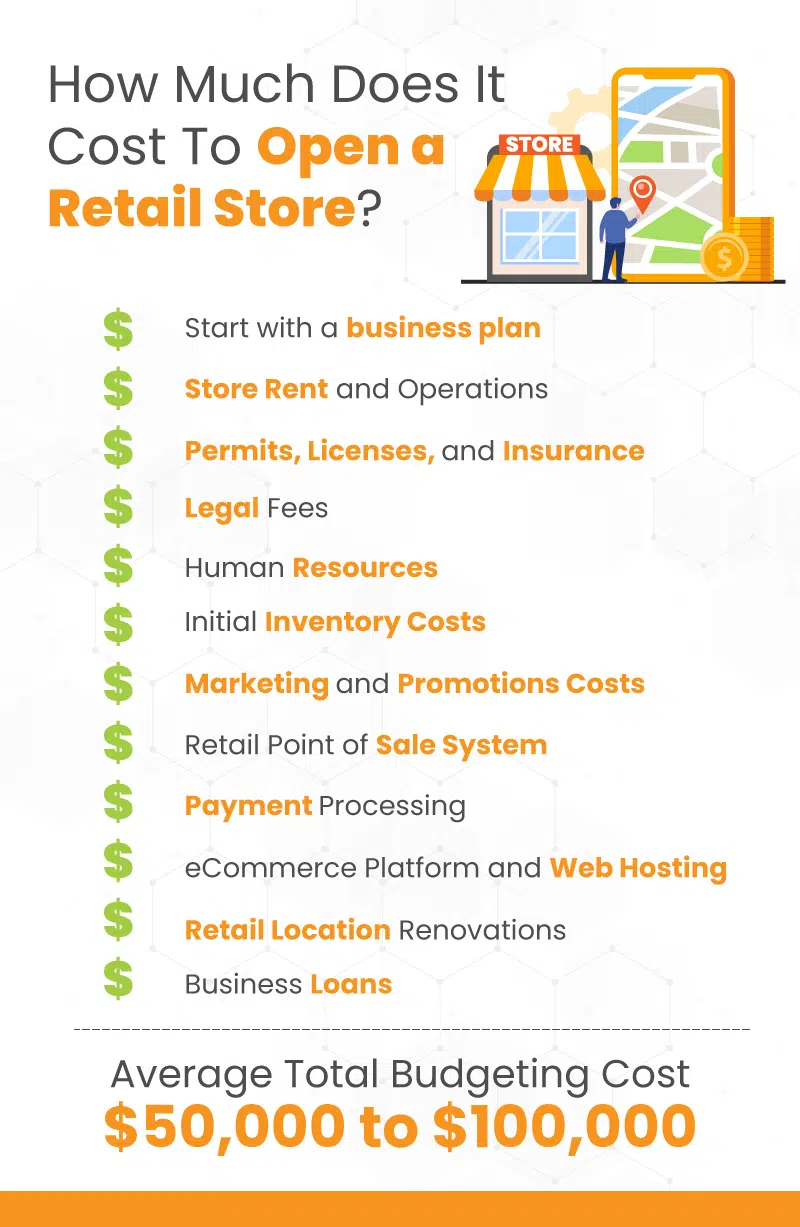
Knowing how much it costs to open a retail store first boils down to developing a business plan. The research you conduct in your plan is where you will record all calculations, as well as your store’s start-up costs and monthly operating expenses.
The business plan will also indicate how long it will take your business to break even. Not only does it give you a clear picture of your business’s expenses and funding needs, but lenders will also require it if you want to secure financing.
Permits, licenses, and insurance
All retail businesses must obtain licenses, permits, and insurance before operating.
Costs of creating an entity
But before the permits and licenses, there are the expenses associated with creating your business structure. A business entity is an organization formed by one or more people to conduct business activities.
GOOD TO KNOW
The way a business entity is organized and operates is crucial because it determines how it is taxed and who will be responsible for paying its debts and obligations.
Most businesses are organized as follows:
- Sole proprietorship
- Limited Liability Company
- Limited Liability Partnership
- Partnership
- S-Corporation
- C-Corporation
License and permit fees
You must obtain an appropriate license for your store, depending on your location and the items you will sell. For example, all liquor store owners must obtain a liquor license, which varies by state. Getting a liquor license in California is different than in NY.
Below are some common items that you’ll need before opening:
- Employer Identification Number (EIN) for tax purposes
- State and local licenses as specified by the SBA
- Resale certificate (if you do not sell exclusively independent products),
- Wholesaler licenses
- Resale certificate (for those who do not sell exclusively independent products)
- Vendor’s license
- Certificate of occupancy for your retail space.
These costs can range from $200 to $2,000, depending on your business and the state in which you operate.
PRO TIP
Check your state government website for more detailed information on the licenses you may need for your retail business.
Business insurance cost
Several types of insurance can help mitigate the risks for your new business.
- General liability insurance cost: General liability insurance can help cover medical expenses and attorney fees resulting from bodily injury and property damage for which your business may be legally responsible. The cost of general liability insurance differs depending on your business’s operations and policy limits, among other factors. Small businesses pay about $40-50 per month for this policy.
- Professional liability insurance: Professional liability insurance, also known as errors and omissions (E&O) insurance, protects your small business from the financial risks associated with professional mistakes. If you own a bar, for instance, this insurance will greatly benefit you because of the increased liability your business has. Notwithstanding the policy limits, a small business’s median cost of professional liability insurance is $60 per month ($720 per year).
- Workers’ Compensation Insurance: It is a legal requirement in many states. Workers’ compensation insurance policies protect workers who become ill or injured on the job.
- Cyber insurance: It protects your online store against losses incurred from cybercrime, such as hacking into your card payment system.
- Business interruption insurance: Business interruption insurance helps you replace lost income and pay operating expenses during a period in which you’re unable to operate. According to Insureon, business interruption insurance costs an average $67 per month.
- Commercial property insurance: Commercial property insurance protects your business against loss in the event of a fire, natural disaster, theft, or other problems. The median cost of commercial property insurance is $63 per month or $755 per year, with a $60,000 limit and a median deductible of $1,000, according to Insureon.
Although you won’t know how much you’ll have to pay until you get a quote from a local insurance company, most small retail stores pay about $600 to $1,200 a year for a business owner’s comprehensive policy and an additional $1,070 a year for workers’ compensation coverage.
Key Takeaways:
Factors that affect insurance costs, in general, are the size of the building, location, size of payroll and annual revenue, claims history, policy details, and the number of people who have access to your systems and data.
Legal fees
You will need to factor in legal fees among the costs of opening a retail store. The average hourly rate for a business lawyer is between $100 and $400.
Human Resources
Again, the costs associated with managing your staff depend largely on the size of your business. One thing is for sure, though: running a retail store of any size is not a one-person operation.
Below are some of the crucial positions in a retail store and the average wages for each:
- Sales associates: A sales associate ensures that customers know someone is available to help them if they need anything, whether answering product questions or showing them a product that meets their needs. The average salary for a sales associate in the U.S. is $15.07 per hour.
- Cashiers: The average annual salary for a retail cashier in the United States is $31,678 per year. That works out to about $15.23 per hour.
- Store managers: According to a Payscale study, a retail store manager can earn an average total compensation (including tips, bonuses, and overtime pay) of $56,920.
- Inventory control specialists: The inventory control specialist is responsible for preventing losses, tracking, and maintaining inventory. Salaries for inventory control specialists in the United States in 2026 are on average $20.62 per hour.
The above list of positions is far from being exhaustive. Positions such as customer service representatives, visual merchandisers, buyers, and assistant store managers may be required, depending on your business needs.
PRO TIP
Once you’ve hired your first employee, it’s a good idea to track their work using the employee management tools in your POS system. You’ll be able to track employees’ arrival and departure times, as well as their sales performance.
Initial Inventory Costs
From an accounting perspective, inventory costs can help you determine how much profit your inventory can bring you. It will also tell you how much of your company’s capital will be tied up in inventory and for how long.
You need to have a full inventory on opening day and enough product to last at least four to six months. If you don’t know the exact prices of your products, use an estimated markup assumption based on the rates you are likely to see from your distributors.
Also, to get a reasonable estimate of your initial inventory, you may want to determine the product lines you will be stocking. Then, determine how many items you need for each product line and the manufacturer’s suggested retail price for each.
Marketing and promotions costs
While marketing is often seen as a side cost by many new store owners, it is critical in getting your retail store off the ground and should be factored into your start-up budget.
How much you spend on each strategy will depend on your store and product type, as well as the location and market saturation in the specific area.
Areas where new retail stores can consider spending their marketing budget include the following:
- Google advertising (both search and shopping streams)
- Social media advertising – the average hourly rate for a social media manager is $26/hour, not including the budget needed for paid advertising campaigns
- Flyers and posters in the local area
- Website design and SEO
- Branding and logo design
- Signage
- Business cards and flyers
Grand opening event expenses
Plan to spend $1,500 to $5,000 on your grand opening event. Costs include refreshments, entertainment, promotional giveaways, local advertising, and decorations. A well-executed launch builds buzz and brings in your first wave of customers.
PRO TIP
You can keep costs down by partnering with local vendors for food samples or coordinating with your chamber of commerce for free promotion. Many successful retailers spend around $3,000 to create a memorable first impression without breaking the bank.
Getting the fundamentals right matters more than throwing an expensive party, so review the complete steps for how to start a retail business before you finalize your budget.
Retail point of sale system
Not only will a retail point of sale allow you to process transactions with all major payment types (credit card, debit card, cash, NFC, etc.), but you’ll also have access to advanced reporting, inventory management tools, and employee management capabilities that can help you increase sales and run your business more efficiently.
A good retail point of sale system should be cloud-based, allowing you to access all operations in your store without necessarily being present.
PRO TIP
Remember that most systems require you to open an account and pay a monthly fee for the use of the payment processing equipment and software. Ensure your POS software supports any payment processing provider.
Purchasing a point of sale system for your store is essential to your start-up. With no hidden fees or contracts, KORONA POS is an all-in-one point of sale solution that makes running a business easy.
All plans include free 24/7 customer support and the option to choose your credit card processor. You can start with KORONA POS for $59/month. KORONA POS offers several affordable leasing options for businesses looking to finance their POS equipment.
eCommerce platform and web hosting
A brick-and-mortar retail store is no longer sufficient, given the rapid rise of online shopping. eCommerce platforms with native site builders and templates will save you money on site design.
You will need to consider domain hosting costs, however. Domain hosting typically starts at $36 per year and goes up for premium domains. Platforms such as GoDaddy and Bluehost are some of the best web hosting platforms.
Your inventory will be synchronized with online and in-store transactions by choosing an eCommerce POS integration platform.
Retail location renovations
Most of the time, stores or commercial premises require some renovation to meet your needs. And most of the time, it is your responsibility to pay for these renovations.
The most needed renovations are painting, flooring, lighting, retail shelving, cash wrap, locksmithing, etc. Once your renovations are complete, your city will likely require you to obtain a certificate of occupancy before opening. Check with your city’s building department.
Borrowing costs
Starting any type of business requires an influx of capital. Equity and debt financing are two ways to acquire capital for a business.
The most likely funding source for small business owners is debt, specifically a small business loan. Business owners can often obtain loans from banks, savings institutions, and the SBA.
PRO TIP
Like any other loan, business loans come with interest payments. These payments must be included in the business plan; the default cost is very high. Your financing can affect your expenses, including the repayment schedule and interest rate. Different loans have different costs, so do your research and talk to local startup capital lenders.
The most significant expenses in opening a retail store include rent, initial inventory, employee payroll, equipment, and marketing your products and brand.
Planning your retail store layout
Expect to spend $2,000 to $10,000 on professional layout planning and design services. If you hire a retail designer or architect, costs climb quickly based on your square footage and complexity. You can reduce expenses by creating your own floor plan using affordable software or templates.
The investment pays off when you maximize sales per square foot and create smooth customer flow. Different retail store floor plans work better for different types of businesses, so understanding your options before committing to fixtures is crucial. Strategic retail store layouts can increase conversion rates.
Security system hardware and installation
Budget between $1,500 and $8,000 for a complete security setup, including cameras, sensors, and monitoring equipment. Installation labor typically adds another $500 to $2,000 depending on your store size and the number of cameras.
Monthly monitoring fees range from $30 to $150. Basic systems now cost less than ever, but skimping on security leaves you vulnerable to theft and liability issues.
PRO TIP
Your POS security matters just as much as physical cameras since data breaches can be costly. Strong asset security in retail protects both merchandise and customer information. Smart retailers also focus on improving retail data security to prevent breaches that damage reputation.
Branding and logo design
Professional branding typically costs $1,000 to $7,500, depending on whether you hire a freelancer or an agency.
A logo alone might run $300 to $2,500, while a full brand identity package, including color schemes, fonts, and style guides, costs more.
You can use online design services for $100 to $500 if you’re on a tight budget. Your brand shows up everywhere from your storefront to your shopping bags, so getting it right from the start saves money on reprints and redesigns later. Good branding helps customers remember you and builds trust before they even walk through the door.
Signage
Outdoor signage runs $2,000 to $15,000 for fabrication and installation. Channel letters with LED lighting cost more than basic flat signs. Indoor signage adds another $500 to $3,000 for wayfinding, promotional displays, and department markers.
Many landlords require design approval, and permits can take six to eight weeks, so plan ahead. Poor signage means lost sales from customers who can’t find you or don’t understand what you sell. Learning how to design a store window display helps you attract foot traffic and showcase your best products effectively.
Ongoing Monthly Expenses
Rent and operations
The average asking rent for retail space in the U.S. in early 2026 is approximately $23 to $25.56 per square foot annually.
PRO TIP
You can also open a pop-up shop in a temporary location to test your market before committing to a long-term lease. You may find that, although a prime downtown location costs more to lease, the area attracts a lot of foot traffic and drives higher sales.
You can also open a pop-up shop in a temporary location to test your market before committing to a long-term lease. You may find that, although a prime downtown location costs more to lease, the area attracts a lot of foot traffic and drives higher sales.
PRO TIP
Instead of signing a ten-year lease, for example, it may be best to sign a five-year lease with a five-year option for greater flexibility. You can also negotiate free rent for the first few months and have the landlord deliver the store to you in a vanilla shell, ready to be painted and outfitted with dressing rooms and finishes. Most importantly, know and negotiate your landlord’s responsibilities.
In addition to rent, you must also pay utilities. The average cost per square foot for electricity is about $1.47, while gas is $0.29. Other costs include water and sewer charges, telephone and internet bills, and many others.
Payment processing
Before accepting credit card payments, you must register with a payment processor. Payment processors charge a small commission or percentage on each credit card sale. So it’s in your best interest to find a processor that will save you money in the long run.
Find out how much you’re spending.
Some fee systems, such as flat-rate or tiered pricing, are unpredictable and will likely end up costing you more money down the road. Your POS provider should be able to help you find the best payment processors. Find a solution that offers you choice and transparency, so you’ll always know what you’re paying for.
Payment processors
giving you trouble?
We won’t. KORONA POS is not a payment processor. That means we’ll always find the best payment provider for your business’s needs.
Save on Running Costs of Your Retail Store with KORONA POS
Payment processing fees eat into your profits with every swipe, tap, and chip read. Most POS systems lock you into their preferred processor, but KORONA POS takes a different approach.
You get complete freedom to choose any payment processor that offers you the best rates. When you can shop around and switch processors without changing your entire system, you keep more of what you earn.
GOOD TO KNOW
KORONA POS also includes dual-pricing functionality. You can offer different prices for cash and card payments, helping offset processing costs while staying compliant with card network rules.
The platform works especially well for liquor stores, smoke shops, vape retailers, tobacco outlets, and convenience stores.
Quick-service businesses like bakeries and coffee shops also benefit from features built specifically for fast-paced environments. The system handles age verification, complex inventory, and high transaction volumes without slowing you down.
Want to see how much you could save on processing fees? Click the button below to schedule your free demo, or call us at 833-200-0213.
Speak with a product specialist and learn how KORONA POS can power your business.
FAQs
How much does it cost to open a small shop?
You should budget between $50,000 and $100,000 to open a small retail store. Opening costs will vary depending on the size and location of your store. It will also depend largely on other factors, such as the number of employees, initial inventory, and administrative costs.
How do I start my own retail store?
You can start a retail business in a few steps. Start by finding your niche. Would you like to open a convenience store, vape shop, grocery store, or liquor store? Next, develop a business plan to better understand your initial expenses.
Register your business, then obtain licenses and permits and business insurance. Find a physical location, create an online store, and then invest in robust retail POS software.
How much does a retailer make?
The amount of money earned (net profit) at the end of the year is a function of the sales/revenues earned throughout the year. Some retailers make higher profits, while others earn lower profits, depending on the retail niche.
Is retail a profitable business?
Retailers generally have low-profit margins due to the nature of their business. Online retailers tend to have higher profit margins than brick-and-mortar retailers, thanks to higher online shopping volumes and lower overhead costs. A better way to increase your revenue is to have both types of stores to meet consumers’ needs and new trends.