

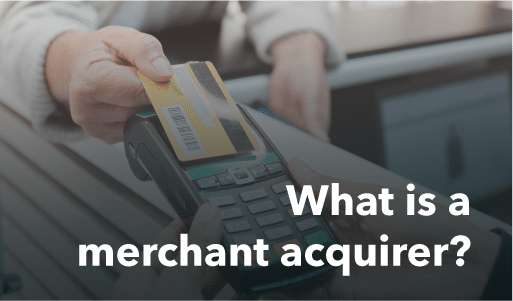
A merchant acquirer is a financial institution that holds your merchant account and is part of the network that processes card payments. Your payment processor handles the transfer of the data. The acquirer is responsible for the account and the risk.
Many retailers never signed directly with their acquirer, and could not say what company it was on demand.
In this article, you will learn about the role of acquirers, how they differ from other payment processors, and how to identify yours.
Key Takeaways:
- A merchant acquirer holds your merchant account and takes the financial risk on every card payment you accept.
- Most retailers signed with an ISO, a PayFac, or a POS vendor, so their acquirer’s name only shows up on the merchant statement.
- Acquirer risk appetite, not your POS system, decides whether a liquor, vape, or smoke shop gets approved.
- Interchange and network assessments are fixed, so the acquirer markup is the only part of your bill you can negotiate.
What Is a Merchant Acquirer?
A merchant acquirer is basically a financial institution that’s licensed to hold a business’s merchant account. They also maintain membership in the card networks and take on the financial liability for that store’s card transactions. All other parties involved in the payment process, such as processors, gateways, and point-of-sale (POS) vendors, link to the networks through an acquirer.
There are three things that make an acquirer different from anyone else who handles a card payment.
- Card network membership: Acquirers are registered members of Visa, Mastercard, and the other networks. No one else in the chain can handle card transactions unless they’ve got an acquirer’s sponsorship.
- Ownership of the merchant account: The account that receives the card funds before they go into your business checking account is the acquirer’s, not your POS company’s.
- Financial liability: If your business fails and chargebacks occur after closing, the acquirer absorbs the loss. This fact alone explains almost every underwriting decision an acquirer makes.
Payment processors giving you trouble?
We won’t. KORONA POS is not a payment processor. That means we’ll always find the best payment provider for your business’s needs.
Why They Are Called “Acquirers”?
The name comes from the acquirer’s position at the start of the payment journey. The acquirer acquires the transaction from the seller and sends it into the card network for authorization. The issuing bank sits at the other end and holds the cardholder’s money.
What Does a Merchant Acquirer Do?
A merchant acquirer vets the business, opens and maintains the merchant account, routes authorization requests to the card networks, settles funds into your bank account, and manages chargebacks and compliance. Those duties sit inside the wider chain covered in our guide to how credit card processing works, and the acquirer’s own share of the work splits into money movement and risk management.
Money Movement
- Receives authorization requests from the payment gateway or terminal
- Routes those requests to the card networks and returns the approval or decline
- Collects funds from the issuing bank through the settlement process
- Deposits net proceeds into your bank account after interchange, assessments, and its own markup
- Handles refunds, returns, and chargeback debits
Risk Management and Underwriting
Underwriting is the part most retailers never witness, yet it is the most crucial aspect. Before an acquirer opens an account, it runs checks to verify the customer’s identity and to determine whether the customer is involved in illegal activity. It also reviews business licenses and financial information, assigns a merchant category code, and sets exposure limits.
Monitoring continues after approval. Merchant acquirers track chargeback ratios, watch for sudden volume spikes, and enforce Payment Card Industry Data Security Standard (PCI DSS) compliance across the merchants they sponsor.
If a merchant’s ratios exceed network thresholds, the acquirer imposes a reserve, raises pricing, or closes the account. If you break a network rule, the card network fines your acquirer, who then bills you for it.
Merchant Acquirer vs. Payment Processor vs. Gateway vs. PayFac vs. ISO
A merchant acquirer holds the merchant account and bears the liability; a payment processor moves transaction data between parties; a payment gateway captures and encrypts card details at the point of entry; a payment facilitator resells acceptance to sub-merchants under its own master account; and an ISO sells acquirer accounts without ever holding one. Only the acquirer and the PayFac take on financial risk, and the split between them is the line that matters most.
| Entity | What it does | Holds the merchant account? | Carries the risk? |
|---|---|---|---|
| Acquirer (acquiring bank) | Underwrites merchants, settles funds, holds card network membership | Yes | Yes |
| Payment processor | Moves transaction data between terminal, networks, and acquirer | No | No |
| Payment gateway | Captures and encrypts card data at the point of entry, online or in store | No | No |
| Payment facilitator (PayFac) | Holds one master merchant account and onboards sub-merchants under it | Yes, as master merchant | Yes, for its sub-merchants |
| ISO or MSP | Sells and services merchant accounts on an acquirer’s behalf, earns residuals | No | No |
Can One Company Be Both an Acquirer and a Processor?
Yes, several of the largest payment companies hold acquiring licenses and run their own processing. In practice, the five roles constantly overlap. Here’s how the roles are combined:
- Fiserv and Global Payments act as both acquirers and processors.
- Adyen and Checkout.com have acquiring licenses and manage the entire process, from the gateway to settlement.
- Square and Stripe are payment facilitators that hold a master merchant account with a sponsoring acquirer and place thousands of businesses underneath it as sub-merchants. As a result, signup takes minutes instead of days.
- Stripe is moving up the stack. In 2025, Georgia granted Stripe a merchant acquirer limited-purpose bank charter, a step toward direct membership in Visa and Mastercard without a sponsor bank.
It is difficult to discern where one role ends and the next begins from the outside. Even for operators who have accepted cards for years, the payment gateway versus payment processor comparison remains useful.
Merchant Account vs. Sub-Merchant Account: What Changes for You?
Liability and control are what actually change. A traditional merchant account comes with your own merchant ID and a direct contractual relationship with the acquirer that approved you. A sub-merchant account under a PayFac gets you approved faster. However, the PayFac can freeze or drop you at its own discretion.
PRO TIP!
If you sell booze, e-cigarette merchandise, or cannabidiol, the distinction might determine whether you keep accepting credit cards next month. We cover payment facilitators and third-party processors in more depth. The POS system versus payment processor comparison clarifies the pairing that retailers often confuse, usually because one sales representative sold them both.
Acquiring Bank vs. Issuing Bank
The acquiring bank works for the merchant, and the issuing bank works for the cardholder. They never speak directly. The card network sits between them and relays every message.
The acquiring bank is responsible for:
- Opening and maintaining the merchant account
- Receiving authorization requests from your gateway or terminal
- Passing approvals and declines back to your point of sale
- Settling funds, net of fees, into your business bank account
- Underwriting and ongoing risk monitoring of your business
The issuing bank is responsible for:
- Issuing credit, debit, and prepaid cards to consumers
- Authenticating the cardholder during a transaction
- Confirming available funds or credit
- Approving or declining the authorization request
- Releasing funds to the acquirer during settlement
- Ruling on chargebacks, the cardholder files
One institution can play both roles for different customers. A bank that issues consumer credit cards and also runs a merchant services arm is an issuer to its cardholders and an acquirer to the retailers it signs.
How a Card Payment Moves Through the Acquirer?
The processing of a card payment occurs in two phases. The authorization phase confirms that the money exists and takes about two to three seconds. Settlement actually moves the money and takes one to three business days for most U.S. companies.
Phase 1: Authorization
- The customer taps, dips, or swipes their card at your point of sale (POS) payment terminal or enters their card details online.
- Your payment gateway encrypts the card data and sends it to the processor.
- The processor then forwards the approval request to the acquirer.
- The acquirer then sends the request to the card network.
- Visa, Mastercard, or the relevant network routes the request to the issuing bank.
- The issuing bank then checks the account and approves or declines the payment.
- The approval or decline then travels back through the network, the acquirer, and the gateway to your terminal.
- Finally, the issuing bank places a hold on the cardholder’s funds.
Phase 2: Clearing and Settlement
At the end of the day, your POS system groups the approved transactions and submits them for settlement. The acquirer presents the batch to the networks. Then, your customers’ card issuers release the funds. Finally, the acquirer deposits the net amount into your account.
How fast you get paid depends on who’s handling your account and how risky they think your business is. Standard funding takes one to three business days. Next-day and same-day deposits are available, but usually cost extra. New accounts and high-risk categories often experience longer initial delays until a track record has been established.
Who is Your Merchant Acquirer? How to Identify the Bank Behind Your Account
The name of your acquirer is printed on your monthly merchant statement, generally in fine print at the top or in the footer, listed as the sponsoring bank or member bank. Most retailers have never looked because the company that sold them the account is rarely the one holding it.
Three different names are often involved in a single processing relationship:
- The company on your POS invoice: Your point of sale vendor. This company is frequently not involved in acquiring at all.
- The company you call for support: They are usually an ISO or MSP that sold you the account and earns a residual on your volume. This is how most small-business merchant accounts in the US are sold. The name on your welcome email is rarely the same as the name on your statement.
- The acquirer actually holds the account: It is a registered member bank, such as Fiserv, Elavon, or J.P. Morgan Payments, and is named in the fine print of your merchant agreement.
Here is where to look:
- Your merchant statement. Scan for “member bank,” “sponsoring bank,” or “acquiring bank,” typically alongside a city and state. Our walkthrough on how to read a merchant processing statement shows where those lines sit on a real example.
- Your merchant agreement. The contract names the acquirer as a party. The ISO is usually named as agent or servicer.
- Your merchant ID. A traditional MID assigned to your business alone signals a direct merchant account. If you never received one and you signed up online in a few minutes, you are almost certainly a sub-merchant under a PayFac.
A handful of banks sponsor most of the market. In TSG’s 2026 Directory of U.S. Merchant Acquirers, more than 36% of the companies listed named Wells Fargo as a sponsor bank, making it the most common one in the industry. Knowing the answer matters for two reasons. It tells you who can actually reprice your account and who can close it.
What a Merchant Acquirer Actually Charges?
Your effective processing rate consists of three components, only one of which is negotiable. Interchange fees go to the issuing bank. Assessments go to the card networks. The markup goes to your acquirer or the ISO that sold your account.
Interchange
It is set by the card networks and paid to the bank that issued your customer’s card. Rates typically range from less than 1% for basic debit cards to over 2.4% for premium rewards credit cards, and interchange fees usually account for 70% to 80% of your total processing costs.
No provider can discount it. The rate depends on the card your customer pulls out of their wallet, and you have no say in that choice.
However, you can influence qualification. Transactions that fail data or approval requirements are categorized as non-qualified, which is far more expensive. Visa and Mastercard both have a standard non-qualified rate of 3.15% plus $0.10, the highest consumer credit rate published by either network. The categories and triggers for a downgrade are covered in our breakdown of how interchange fees are calculated.
Assessments
Assessments are network fees. Published rates sit around 0.14% for Visa credit and 0.1375% for Mastercard credit, with per-transaction network charges of roughly $0.0195 on top. Every provider in the country pays the same schedule.
The Acquirer Markup
The markup is the negotiable piece, and how visible it is depends entirely on your pricing model.
- Interchange-plus shows interchange, assessments, and markup as separate line items. Transparent, and generally the cheapest structure for any store doing real volume.
- Flat-rate bundles everything into one number and prices by channel. As of 2026 that lands near 2.6% plus $0.15 for a card tapped in store, around 2.9% to 3.3% plus $0.30 online, and about 3.5% plus $0.15 for keyed entry. Simple, predictable, and expensive as volume grows.
- Tiered sorts transactions into qualified, mid-qualified, and non-qualified buckets, and the provider decides where each one lands. The least transparent of the three.
High-risk categories carry higher markups on top of higher interchange, and effective rates of 3% to 5% or more are common. Judge every quote on effective rate rather than the headline number, and use our credit card processing rate comparison to see how the same volume prices out across providers. Run your own numbers with the KORONA POS processing rate calculator before you accept a quote.
Merchant Acquirer Examples
The largest U.S. merchant acquirers are Fiserv, J.P. Morgan Payments, Global Payments, Elavon, and Adyen. There are also bank-owned programs at institutions such as Bank of America and Wells Fargo. Rankings shift depending on whether transaction count or purchase volume is measured.
- Fiserv: It’s the parent of Clover, operates a large share of bank-branded merchant programs. In May 2026, Fiserv revealed that it had been recognized as the leading US merchant acquirer by the Nilson Report, securing the top spot in both purchase volume and transaction count in the 2025 data.
- J.P. Morgan Payments: The previous year told a different story. In April 2025, Nilson ranked J.P. Morgan Payments first in transactions for 2024 at 40.98 billion, with Fiserv second at 40.72 billion. Who gets the top spots changes from year to year and depends on the metric used.
- Global Payments: Completed its acquisition of Worldpay in January 2026 for $24.25 billion, in partnership with FIS and GTCR. The combined company serves over 6 million merchant locations, processing approximately $3.7 trillion in payment volume and 94 billion transactions annually across more than 175 countries.
- Elavon: It’s a wholly owned subsidiary of U.S. Bank. The 2025 Nilson Report ranked Elavon the fifth-largest U.S. acquirer by Visa and Mastercard purchase volume, up from seventh the previous year.
- Adyen: It holds its own acquiring license and operates as an acquirer, gateway, and processor in one stack, primarily serving larger eCommerce and omnichannel retailers.
- Bank of America and Wells Fargo: Both run merchant services programs, though the ownership structure behind them has changed.
Acquirer Mergers Keep Changing Who Holds Your Account
The biggest acquirers keep buying each other. The company named on an agreement you signed a few years ago may not be the one servicing your account today.
Three examples matter for anyone reading an older guide.
The Banc of America Merchant Services joint venture between Bank of America and First Data was dissolved effective July 1, 2020, and Bank of America has run its own merchant services since. Wells Fargo Merchant Services, a joint venture 40% owned by Fiserv, ended April 1, 2025. Wells Fargo bought out the remaining interest and now owns the business outright, with Fiserv staying on as processor under a separate multiyear agreement. Then in January 2026, Global Payments absorbed Worldpay while FIS took Global Payments’ Issuer Solutions business in the same three-way deal.
PRO TIP!
For retailers, consolidation shows up quietly. Statements change letterhead, support numbers get reassigned, and pricing comes up for review at renewal. A portfolio change is a reasonable moment to re-shop your rates, and our ranking of the best credit card processing companies is a practical place to start that comparison.
Acquirers and High-Risk Retail: Liquor, Vape, Smoke, and CBD
For high-risk retail categories, the acquirer’s risk appetite decides whether you get an account at all. Your merchant category code, not your sales volume or your POS system, is what triggers the extra scrutiny. Merchants in those categories usually end up on a high-risk merchant account with its own approval rules and pricing.
What Is a Merchant Category Code (MCC)?
A merchant category code, or MCC, is the four-digit number the card networks assign to your business to describe what you sell. Your acquirer reads that code to decide how much risk you carry and what to charge you for it. Mastercard publishes the full list in its Quick Reference Booklet.
Two codes come up most often in specialty retail:
- MCC 5921, package stores for beer, wine, and liquor
- MCC 5993, cigar stores and stands, a bucket that in practice absorbs smoke shops, most vape retailers, and many CBD sellers
Both codes carry age restrictions, regulatory exposure, and higher-than-average chargeback rates, so acquirers price them accordingly. A pure vape retailer with no tobacco line sometimes lands in MCC 5999 instead, and the classification varies from one acquirer to the next.
The wrong code hurts you in two directions. It can inflate what you pay in interchange, and it can void your agreement outright if an acquirer decides you misrepresented the business. Find the code on your statement and confirm it matches what you actually sell.
What Acquirers Do to High-Risk Accounts
- Decline the application outright. Risk appetite varies enormously between acquirers, and a decline from one is not a decline from all of them.
- Impose a rolling reserve. A percentage of your settlements gets held back for a set period against future chargebacks.
- Delay funding. Longer settlement windows on new accounts.
- Require documentation. Business licenses, age verification procedures, product catalogs, and processing history.
- Terminate mid-relationship. A sub-merchant account under a PayFac can be closed with little notice, and no argument against running a liquor store or smoke shop on a general-purpose aggregator carries more weight.
What Actually Helps
Be accurate about your full product mix during underwriting. Understating a CBD or kratom line to get approved faster is the fastest route to a frozen account later, and CBD payment processing carries documentation requirements worth satisfying upfront rather than explaining after the fact.
Keep chargeback ratios low with clear billing descriptors and documented age verification at the point of sale. And keep your POS decision separate from your acquiring decision, so a processor change does not mean replacing your hardware.
How to Choose a Merchant Acquirer?
Choose an acquirer based on six things:
- whether it can handle your volume and channels
- how transparent it is about pricing
- the risk level you’re comfortable with for your category
- the terms of the contract
- how well it integrates with your point-of-sale system
- the quality of the support it provides
1. Volume and Channel Fit
Calculate your monthly card volume and average ticket. Higher volume favors interchange-plus pricing. Sometimes, when the volume is very low, it’s better to keep things simple with a flat rate. Make sure the company you’re buying from supports every channel you sell through. That means in-store, online, and mobile.
2. Pricing Transparency
Ask for the pricing model by name and request a full fee schedule, including monthly minimums, PCI fees, batch fees, statement fees, and chargeback fees. If a provider will not put the markup in writing, that is your answer.
3. Risk Appetite for Your Vertical
Ask directly whether the acquirer boards MCC 5921 or 5993, and whether a reserve applies. Ask before you spend time on an application.
4. Contract Terms
Watch for multi-year terms, automatic renewal clauses, early termination fees, and equipment leases. Equipment leases in particular are where the worst long-term costs hide. Read the exit language before you sign, because early termination fees on a three-year agreement can run into four figures.
5. POS Integration
Confirm the acquirer works with the point of sale system you already run or intend to buy. An acquirer that requires proprietary hardware locks you in permanently.
6. Support Quality
Check who answers when a terminal goes down on a Saturday. Read recent reviews on Trustpilot, Capterra, and the BBB rather than relying on the sales rep’s account of service levels.
Negotiate the markup, and re-shop every two years. Rates drift, and providers rarely volunteer a reduction. Beyond the markup itself, there are other ways to lower your merchant fees that do not require changing acquirers at all.
How Your POS System Fits In
Your POS system and your acquirer are two separate decisions, though many vendors work hard to bundle them. When hardware is locked to a single processor, switching acquirers means replacing terminals, retraining staff, and rebuilding integrations. The cost of that switch is exactly what keeps merchants on uncompetitive rates. Retailers who want out of that trap look for a POS that keeps their processor.
A processor-agnostic POS breaks the dependency. The software connects to whichever merchant services provider you choose, and you keep the freedom to move when a better rate or a friendlier risk appetite comes along. For high-risk retail especially, keeping those two contracts separate is a form of insurance.
Payment processors giving you trouble?
We won’t. KORONA POS is not a payment processor. That means we’ll always find the best payment provider for your business’s needs.
Choose the Right Payment Setup for Your Retail Business With KORONA POS
KORONA POS is a processor-agnostic point of sale system built for specialty retail, including liquor stores, vape and smoke shops, CBD retailers, and convenience stores. KORONA POS is not a payment processor, so we have no incentive to steer you toward one acquiring relationship over another.
That independence matters most in the categories where acquirers get picky. When an underwriter tightens up or a portfolio changes hands, you can move your processing without replacing your point of sale. Retailers keep shopping for competitive rates while the software stays put.
Talk to a product specialist to match your business with the right merchant services provider, or start a free trial to see the system first.
Speak with a product specialist and learn how KORONA POS can power your business.
Frequently Asked Questions About Merchant Acquirers
Is a merchant acquirer the same as a bank?
Not always. Every acquirer is a licensed financial institution with card network membership, but not all are retail banks. Fiserv and Global Payments acquire without offering consumer accounts, while Elavon operates as a subsidiary of U.S. Bank, and Chase runs both sides.
Do I need a merchant acquirer if I use Square or Stripe?
Yes, indirectly. Square and Stripe are payment facilitators that hold a master merchant account with a sponsoring acquirer, and you sit underneath as a sub-merchant. Stripe received a Georgia limited-purpose bank charter in 2025 and is pursuing direct membership in a card network.
Who is my merchant acquirer?
Check your monthly statement for the sponsoring bank or member bank, usually printed in small type near the top or footer. Your merchant agreement names the acquirer as a party, and the ISO that sold you the account appears separately as agent.
Can a business have more than one acquirer?
Yes. Larger retailers frequently run multiple acquiring relationships for redundancy, for separate sales channels, or for different countries. Most single-location stores use one. A second acquirer means a second approval process and a second set of contract terms to track.
Is Visa an acquirer?
No. Visa is a card network. It sets the rules and the interchange schedule and routes messages between acquirers and issuers, but it does not hold merchant accounts or carry the risk. Acquirers pay Visa for membership and network access.
How much does a merchant acquirer charge?
Total card acceptance typically runs 1.5% to 3.5% per transaction for standard retail, and 3% to 5% or more for high-risk categories. Interchange makes up 70% to 80% of that, assessments add roughly 0.14%, and the rest is acquirer or ISO markup.
What happens if my acquirer closes my account?
Card acceptance stops immediately, and any reserve is held six months or longer against pending chargebacks. Closures follow high chargeback ratios, undisclosed product lines, or a policy shift. A listing on MATCH, Mastercard’s terminated merchant database, lasts five years and blocks most new applications.
Can I switch acquirers without changing my POS system?
Only if your point of sale software is processor-agnostic. Systems bundled with proprietary hardware or a locked processing agreement usually require replacing terminals too. Check your contract for early termination fees and equipment leases before you shop for a new acquirer.