



Most businesses that accept card payments use a third-party payment processor instead of opening their own merchant account. A third-party payment processor lets a business take credit cards, debit cards, and digital wallets within minutes of signing up, but the convenience comes with trade-offs in cost, control, and account stability. Below, we explain what a third-party payment processor is, how it works, and how it compares to a traditional merchant account. We also cover pricing, the risk of frozen accounts, the best providers, and what high-risk businesses should check before they commit.
Key Takeaways:
- A third-party payment processor lets a business accept cards and digital wallets without its own merchant account.
- Setup is fast and upfront costs are low, so it suits new, small, and seasonal businesses.
- Flat-rate pricing is simple but costs more than a merchant account once sales volume grows.
- Accounts can be frozen without warning, and the risk is highest for high-risk industries like liquor, vape, and CBD.
- A processor-agnostic POS lets a business switch processors without replacing its checkout system.
What Is a Third-Party Payment Processor?
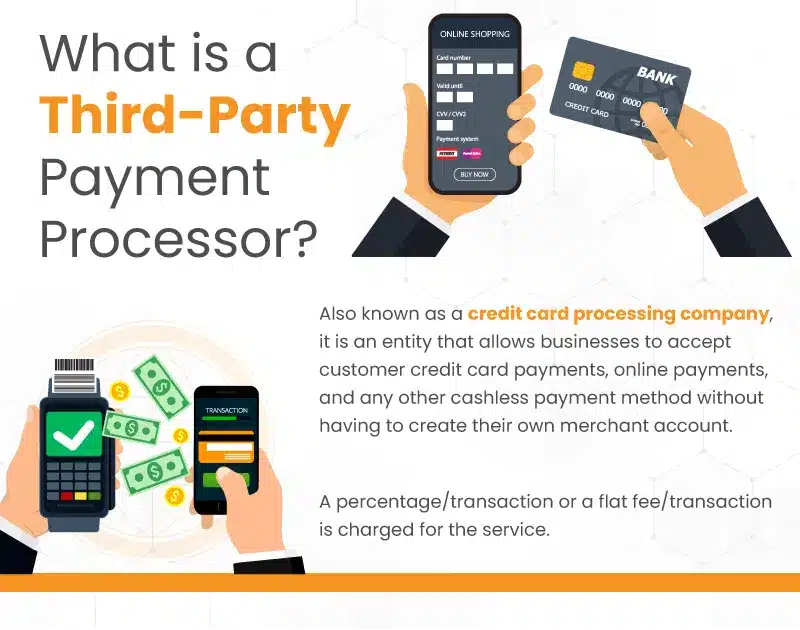
A third-party payment processor is a company that lets a business accept credit cards, debit cards, and digital wallets without opening its own merchant account. The processor places the business under a shared master merchant account that it owns and operates on behalf of thousands of merchants at once. Square, Stripe, and PayPal are the most widely used examples.
A traditional setup works differently. A business applies to an acquiring bank, passes underwriting, and receives its own merchant ID (MID). The process takes days to weeks. A third-party processor removes that step, so a merchant can sign up online and start accepting payments the same day.
The model carries a clear trade-off. A business gets faster setup, lower upfront cost, and no monthly account fees, in exchange for less control over the account and a higher chance of holds or freezes if the processor’s automated risk rules flag the account. Both points matter more for high-volume sellers and high-risk industries, covered in detail further down.
Third-Party Payment Processor vs. Payment Gateway
A payment processor and a payment gateway do two different jobs, and the terms are often used as if they mean the same thing. A payment gateway captures and encrypts the customer’s card details at checkout, then passes them on securely. A payment processor moves the money, routing the transaction to the card networks and the customer’s bank for approval and settlement. Most modern third-party processors bundle both functions into one platform, which is why the distinction gets blurred. For a full breakdown, see payment gateway vs. payment processor.
How Does a Third-Party Payment Processor Work?
A third-party payment processor carries a card payment from the customer’s tap or click, through the card networks and the customer’s bank, and settles the approved funds into the merchant’s account. The full cycle runs in seconds at checkout, though the money reaches the merchant’s bank a few days later. Here is the sequence:
- The customer submits payment. The customer taps, swipes, inserts, or enters a card, or selects a digital wallet such as Apple Pay or Google Pay, at checkout.
- The gateway encrypts the data. The payment gateway captures the card details and encrypts them before they leave the checkout.
- The processor routes the request. The processor sends the encrypted transaction to the correct card network, such as Visa or Mastercard.
- The issuing bank decides. The customer’s bank checks for available funds, runs a fraud check, and returns an approval or a decline with an authorization code.
- The result returns to the merchant. The response travels back along the same path to the POS or checkout, and the customer sees an approved or declined message.
- Funds are captured and settled. The processor batches approved transactions, usually at the end of the day, and submits them to the card networks for settlement, which typically clears within 24 to 72 hours.
- The processor pays out the merchant. The processor deposits the funds into the merchant’s bank account on its payout schedule, after deducting processing fees.
Three related steps sit alongside the core flow. Tokenization replaces a stored card number with a token that is useless if stolen, which lets a merchant support recurring billing or one-click checkout safely. Reconciliation relies on the settlement reports the processor provides, which a merchant uses to match sales against payouts. A chargeback begins when a customer disputes a charge, at which point the issuing bank reverses the payment and the processor passes the dispute to the merchant to accept or contest with evidence.
Payment processors giving you trouble?
We won’t. KORONA POS is not a payment processor. That means we’ll always find the best payment provider for your business’s needs.
Third-Party Payment Processor vs. Merchant Account
The difference between a merchant account and a third-party payment processor comes down to ownership and control. A third-party payment processor puts a business under its own shared merchant account for fast, low-commitment setup. A traditional merchant account gives the business its own account with an acquiring bank, which costs less at scale and offers more control. The table below compares the two on the factors that drive the decision.
| Factor | Third-Party Payment Processor | Traditional Merchant Account |
|---|---|---|
| Onboarding | Minutes to days, automated signup | Days to weeks, manual underwriting |
| Account ownership | Sub-merchant under the processor’s master account, no separate MID | Your own merchant ID (MID) with an acquiring bank |
| Pricing model | Flat-rate and predictable, such as 2.9% plus a fixed fee | Interchange-plus or tiered, transparent and negotiable |
| Cost at scale | Higher effective cost as volume grows | Lower per-transaction cost at steady volume |
| Holds and freezes | Higher risk, automated rules can freeze accounts quickly | Lower risk, reserves set and disclosed in the contract |
| Payout speed | Often next-day or configurable | Typically 1 to 3 business days, negotiable |
| Control | Limited control over routing and dispute handling | Greater control over routing, pricing, and disputes |
| Customer support | Mostly self-service for smaller accounts | Often a dedicated account manager |
| Best for | New, small, seasonal, or omnichannel sellers needing fast setup | High-volume merchants wanting lower costs and more control |
Bottom line: A third-party processor wins on speed and low upfront cost, which fits new, small, or seasonal businesses. A traditional merchant account wins on per-transaction cost and account stability once volume is steady and predictable.
Types of Payment Processors
A third-party payment processor is one of several models for accepting payments, and the model a business picks shapes its cost, control, and who carries the risk. Most merchants use one of five.
Aggregator (Payment Service Provider)
An aggregator, also called a payment service provider (PSP), is a third-party processor that groups many merchants under one shared merchant account. Square, Stripe, and PayPal are the best-known examples. A merchant signs up in minutes and accepts payments under the aggregator’s account instead of its own. The term “third-party payment processor” usually refers to this model.
Payment Facilitator (PayFac)
A payment facilitator (PayFac) is the formal designation for a company that holds a master merchant account and onboards businesses as sub-merchants beneath it. Square, Stripe, and PayPal all operate as PayFacs. The model matters most for software platforms that want to embed payments into their own product, such as a booking app that processes its users’ transactions in-house rather than sending them to an outside processor.
Merchant of Record (MoR)
A merchant of record (MoR) is an entity that becomes the legal seller for each transaction and takes on responsibility for payment, sales tax, chargebacks, and compliance. Paddle and Stripe’s managed payments offering are common examples. The model suits digital and cross-border sellers that want to offload tax and regulatory work rather than manage it in every market.
Traditional Merchant Account
A traditional merchant account is a dedicated account issued to a single business by an acquiring bank, with its own merchant ID (MID). The setup gives a business more control over pricing, routing, and disputes, along with lower per-transaction cost at steady volume. Onboarding takes longer because the bank underwrites the business directly.
Full-Stack and Open Payments Platforms
A full-stack processor combines the payment gateway and the processor in one platform, while an open payments platform connects a merchant to several processors at once. Stripe and Adyen are full-stack examples, and Spreedly is an orchestration platform. Both models suit larger merchants that want to route transactions across providers for better approval rates, lower cost, or wider geographic coverage.
| Model | Who Owns the MID | Onboarding | Best for |
|---|---|---|---|
| Aggregator / PSP | The processor (shared account) | Instant to a few days | New or small sellers wanting fast setup |
| Payment facilitator (PayFac) | The PayFac (sub-merchants beneath it) | Instant, inside the platform | Software platforms embedding payments |
| Merchant of record (MoR) | The MoR (it is the legal seller) | Fast | Digital and global sellers offloading tax and compliance |
| Traditional merchant account | The merchant | Days to weeks | High-volume merchants wanting control and lower cost |
| Full-stack / open platform | Varies, often the merchant | Varies | Merchants routing across multiple processors |
Pros and Cons of a Third-Party Payment Processor
A third-party payment processor offers fast setup and low upfront cost, with the trade-off of higher fees at scale and less control over the account. The advantages favor new and smaller businesses, while the drawbacks weigh more on high-volume and high-risk sellers.
Pros
- Fast onboarding. A merchant can apply online and accept payments the same day, with no lengthy bank underwriting.
- Low upfront and fixed costs. Most processors charge no setup, monthly, or PCI fees, so a business pays only when it makes a sale.
- Predictable flat-rate pricing. A single rate per transaction, such as 2.9% plus a fixed fee, makes costs easy to forecast regardless of card type.
- Bundled technology and PCI relief. The processor supplies the gateway, fraud tools, and PCI compliance, which removes most of that burden from the merchant.
- Broad payment method support. Most processors accept cards, digital wallets, and multiple currencies out of the box.
Cons
- Higher cost at volume. Flat-rate pricing costs more than interchange-plus once a business processes steady, high volume.
- Account holds and freezes. Automated risk rules can freeze an account or hold funds after a sales spike, a large transaction, or a rise in chargebacks.
- Less control. A merchant follows the processor’s terms and cannot customize routing, settlement, or the payment page.
- Thinner support. Smaller accounts often get self-service support rather than a dedicated account manager.
- Limited dispute advocacy. In a chargeback, the merchant relies on the processor’s tools and has no dedicated advocate representing it to the card networks.
Third-Party Payment Processors for High-Risk Businesses
High-risk businesses face a higher chance of frozen funds and account termination when they rely on a standard third-party payment processor. Industries such as liquor, vape, smoke, CBD, cannabis, and firearms are flagged as high-risk because they carry elevated chargeback and regulatory exposure, and aggregators are built to shed that risk fast. Card networks monitor dispute activity closely, and crossing their limits can result in fines, reserves, or termination.
Mastercard’s Excessive Chargeback Program flags a merchant with at least 100 chargebacks in a month and a chargeback ratio of 1.5% or higher. Visa’s Acquirer Monitoring Program lowered its excessive merchant threshold to 1.5% on April 1, 2026, counts both fraud reports and disputes in the ratio, and fines merchants $8 per transaction once they pass the line (Merchant Risk Council). Aggregators such as Stripe, Square, and PayPal can hold funds for up to 180 days once a risk trigger fires, often with no warning (terms.law; see also high-risk merchant accounts).
Why Aggregators Freeze High-Risk Accounts
An aggregator pools thousands of merchants under one shared master account, so a single risky merchant threatens the whole pool. Automated risk rules respond fast, and a sales spike, an unusually large transaction, or a rise in chargebacks can lock an account within hours. High-risk merchants also pay more to process, with fees that commonly run from about 3.5% to 8% or higher against the roughly 2% to 3% a standard account pays.
The combination of higher fees and sudden holds makes account stability the central concern for a high-risk operator, not headline rates. Cannabis sits at the far end of that spectrum, where federal restrictions keep most banks and card networks out of the industry and explain why many dispensaries still cannot accept cards at all.
What to Look For as a High-Risk Merchant
- A processor that underwrites your vertical directly. A high-risk-friendly processor reviews the business up front and discloses reserve, hold, and payout terms in the contract, rather than approving fast and freezing later.
- More than one merchant account. Running a second MID from the start keeps the business processing if one account is frozen.
- A processor-agnostic POS. A point-of-sale system that is not locked to one processor lets a business switch providers after a policy or fee change without replacing its checkout setup.
The last point is where the choice of POS, not just the choice of processor, decides how exposed a high-risk business is. A locked-in system turns a processor’s policy change into a full system migration. For more on this, see high-risk merchant accounts.
Examples of Third-Party Payment Processors
The best-known third-party payment processors are Stripe, Square, and PayPal, though each fits a different type of business. The table below groups the most relevant providers by how they operate and who they suit.
| Provider | Type | Best for | Pricing Model |
|---|---|---|---|
| Stripe | Full-stack processor and gateway | Online businesses, developers, and global sellers | Flat-rate, with custom pricing at volume |
| Square | Aggregator with built-in POS | Small and in-person retailers, omnichannel sellers | Flat-rate |
| PayPal | Aggregator and digital wallet | Online stores and marketplaces that rely on consumer trust | Flat-rate |
| Adyen | Full-stack, enterprise-grade | Large omnichannel and international enterprises | Interchange-plus or custom |
| Helcim | Interchange-plus processor | Small and mid-size businesses wanting fee transparency | Interchange-plus |
| Stax | Subscription-based processor | Higher-volume merchants cutting per-transaction cost | Monthly subscription plus interchange |
A few of these warrant context:
- Stripe combines processing and a gateway in one platform and supports a wide range of payment methods and currencies, which suits online and cross-border businesses.
- Square bundles processing with free POS software and hardware, which makes it a common starting point for small in-person retailers. See the Square POS review for a full breakdown.
- PayPal is one of the most recognized payment brands, and offering it at checkout can lift conversion for online stores that depend on consumer trust.
Stripe, Square, and PayPal all operate as aggregators, which makes them a fast, low-cost starting point but a poor fit for the high-risk verticals covered above. Rates and terms change often, so confirm current pricing with each provider before committing.
Is a Third-Party Payment Processor Right for Your Business?
A third-party payment processor is the right choice for most new, small, or seasonal businesses, while a traditional merchant account fits established high-volume sellers that want lower costs and more control. The decision comes down to volume, predictability, and how much control a business needs over its account.
Choose a third-party payment processor if:
- Your sales volume is low, new, or seasonal, and a fast launch matters more than the lowest possible rate.
- You want predictable flat-rate pricing with no monthly or setup fees.
- Your needs are simple, and a bundled POS, gateway, and fraud toolset is enough.
- You sell across channels or borders and want broad payment method support out of the box.
Consider a traditional merchant account if:
- Your volume is steady and high enough that interchange-plus pricing beats flat-rate.
- You want fee transparency and room to negotiate your rate.
- You need control over routing, settlement, and dispute handling.
High-risk verticals are the exception to both. A liquor, vape, smoke, CBD, or cannabis business should weigh processor flexibility and account stability above headline pricing, for the freeze and termination reasons covered above. For a deeper walkthrough of comparing providers and reading the fine print, see best credit card processing companies.

Learn more about how credit card processing works and save your business money with this free eGuide.
Key Terms to Know When Choosing a Third-Party Payment Processor
A merchant shopping for a processor runs into a wall of jargon, and most of it falls into four groups: who is involved, how the account works, how pricing is structured, and how payments and risk are handled. The terms below are the ones a US merchant actually encounters during the process.
The Players
- Acquiring bank (acquirer). The bank that holds the merchant account and receives card payments on the merchant’s behalf.
- Issuing bank (issuer). The bank that issued the customer’s card and approves or declines each transaction.
- Card networks. Visa, Mastercard, American Express, and Discover, which route transactions and set interchange rates.
- ISO (Independent Sales Organization). A third-party company authorized to resell payment processing for an acquiring bank, and often the salesperson or brand a US merchant actually signs with. Mastercard calls the same role an MSP (Member Service Provider).
- Payment facilitator (PayFac). A company that holds a master merchant account and onboards businesses as sub-merchants beneath it.
- Aggregator / PSP. A processor that groups many merchants under one shared merchant account, such as Square, Stripe, or PayPal.
- Merchant of record (MoR). The entity that is legally the seller for a transaction and carries responsibility for tax, chargebacks, and compliance.
Your Account and Onboarding
- Merchant account. A bank account that lets a business accept and hold card payments before they move to its regular business bank account.
- Merchant ID (MID). The unique number that identifies a merchant account to the card networks.
- Underwriting. The review a processor or bank runs to approve a business and set its risk terms.
- Rolling reserve. A share of sales the processor holds back for a set period to cover potential chargebacks, common on high-risk accounts.
Pricing Models and Fees
- Interchange. The base fee the card networks and issuing banks charge on every transaction, which no processor can discount.
- Interchange-plus. A pricing model that charges interchange plus a fixed processor markup, the most transparent option for a merchant.
- Flat-rate pricing. A single rate per transaction regardless of card type, such as 2.9% plus a fixed fee.
- Tiered pricing. A model that sorts transactions into qualified, mid-qualified, and non-qualified buckets, which makes costs hard to predict.
- Subscription (membership) pricing. A fixed monthly fee in exchange for lower per-transaction rates, which favors higher volume.
- Effective rate. Total processing fees divided by total sales, the truest measure of what a merchant actually pays.
- Surcharging and cash discounting. US programs that pass card fees on to the customer or offer a discount for cash, subject to card-network rules and state law.
- Monthly minimum, statement, PCI, and early termination fees. Recurring or one-time charges to watch for beyond the per-transaction rate.
Payments, Security, and Risk
- Payment gateway. The technology that captures and encrypts card details at checkout and sends them to the processor.
- POS system. The hardware and software a customer pays through, which connects to the processor to complete the sale.
- Authorization and capture. Authorization places a hold on the customer’s funds, and capture finalizes the charge.
- Batch and settlement. The processor groups captured transactions, usually once a day, and settles them so funds move to the merchant.
- Chargeback. A forced reversal of a payment that the customer’s bank starts when the customer disputes a charge.
- PCI DSS. The Payment Card Industry Data Security Standard, the security rules every business that handles card data must follow.
- Tokenization. A security method that swaps a card number for a token that is useless if stolen.
- Card-present vs. card-not-present (CNP). In-person transactions versus online or keyed transactions, which carry higher fraud risk and higher fees.
- EMV. The chip-card standard that cuts counterfeit fraud on in-person payments.
How KORONA POS Works With Your Payment Processor
KORONA POS is a point-of-sale system, not a payment processor, and it integrates with the processor a business chooses instead of locking it to one. The distinction matters most for high-risk retailers. When a processor raises fees, changes its policies, or freezes an account, a business on KORONA POS can switch to a different processor without replacing its point-of-sale system.
The same open setup supports the verticals most exposed to account freezes, including liquor, vape, smoke, convenience, and cannabis stores. KORONA POS adds the tools regulated retail needs alongside that flexibility: age verification and ID scanning, inventory management, and multi-store reporting. For a high-risk merchant, the payoff is direct, since a processor’s decision never forces a full system migration.
Speak with a product specialist and learn how KORONA POS can power your business.
Frequently Asked Questions
What is a third-party payment processor?
A third-party payment processor is a company that lets a business accept credit cards, debit cards, and digital wallets without opening its own merchant account. The processor places the business under a shared merchant account it owns. Square, Stripe, and PayPal are common examples.
Is Stripe, Square, or PayPal a third-party payment processor?
Yes. Stripe, Square, and PayPal are all third-party payment processors that operate as aggregators, placing many merchants under one shared master account. The model gives fast, low-cost onboarding, though it raises the chance of account holds for high-volume or high-risk businesses.
Is a third-party payment processor safe?
A reputable third-party payment processor is safe for most businesses. The processor handles PCI DSS compliance, encrypts card data, and uses tokenization and fraud monitoring. The main risk is operational, since automated rules can freeze funds or hold payouts when they flag an account.
How is a third-party payment processor different from a payment gateway?
A payment processor moves the money, routing a transaction to the card networks and banks for approval and settlement. A payment gateway captures and encrypts card details at checkout. Most third-party processors bundle both functions into one platform, which is why the terms get confused.
How much does a third-party payment processor cost?
Most third-party payment processors charge a flat rate per transaction, commonly around 2.9% plus a fixed fee, with no monthly or setup fees. High-risk merchants pay more, often 3.5% to 8% or higher. Confirm current rates with each provider, since pricing changes often.
Why do third-party payment processors freeze accounts?
Third-party payment processors freeze accounts because they pool thousands of merchants under one master account, so one risky merchant threatens the pool. Automated rules can lock an account after a sudden sales spike, a large transaction, or a rise in chargebacks, sometimes with no warning.
Can high-risk businesses use a third-party payment processor?
High-risk businesses can use a third-party payment processor, but standard aggregators like Stripe and Square often freeze or terminate these accounts. A liquor, vape, CBD, or cannabis business should choose a high-risk-friendly processor and a processor-agnostic POS so a policy change does not stop sales.
Is a third-party payment processor or a merchant account cheaper?
A third-party payment processor is usually cheaper for low or seasonal volume because it has no monthly or setup fees. A traditional merchant account on interchange-plus pricing becomes cheaper once a business processes steady, high volume, since the per-transaction cost is lower.
Is Apple Pay a third-party payment processor?
Apple Pay is not a third-party payment processor. Apple Pay is a digital wallet that stores a customer’s card details and passes them to a payment processor at checkout. The processor, not Apple Pay, handles the authorization, settlement, and movement of funds.