

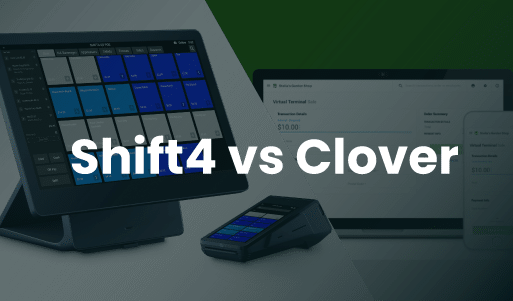
The choice between Clover and Shift4 comes down to one question: Do you run a restaurant or a retail store? The two systems are built for different jobs, and the wrong choice can lock you into years of fees that don’t fit how you operate. Shift4’s POS, now called Shift4 Dine (formerly SkyTab), targets restaurants, while Clover spreads across retail, cafes, and food service. Below, we compare Clover vs. Shift4 on pricing, payment processing, contracts, hardware, and features, then lay out which business type each one actually fits.
Key Takeaways:
- Your business type decides the winner: Shift4 Dine fits restaurants, while Clover fits retail and mixed formats.
- Your payment processing rate, not the monthly software fee, drives your real long-term cost.
- Shift4 Dine includes free hardware but requires Shift4 processing and a 36-month contract.
- Clover charges upfront for hardware, and your rate depends on whether you buy direct or through a reseller.
- Neither system lets you fully choose your own payment processor, so specialized retailers often need a processor-agnostic POS.
The Short Answer: Clover vs. Shift4 Dine
Shift4 Dine is the better fit for restaurants, and Clover is the better fit for retail and mixed-format businesses. Shift4 Dine (formerly SkyTab) gives restaurants built-in coursing, kitchen display, and tableside ordering with free hardware and a $29.99 monthly fee, in exchange for required Shift4 processing. Clover serves retail, cafes, service businesses, and restaurants from a single platform, with a wider hardware range and an app marketplace. You buy the hardware, and your processing rate depends on the reseller. Neither lets you fully choose your own payment processor, so specialized retailers often need a processor-agnostic alternative.
Clover vs. Shift4 at a Glance
Clover is a retail-and-restaurant POS from Fiserv built on proprietary hardware you buy outright, while Shift4 Dine (formerly SkyTab) is a restaurant-only POS from Shift4 that gives you free hardware in exchange for required Shift4 payment processing.
| Comparison point | Clover (by Fiserv) | Shift4 Dine / SkyTab (by Shift4) |
|---|---|---|
| Built for | Retail, service businesses, cafes, quick-service, and full-service restaurants | Full-service and quick-service restaurants, bars, food trucks |
| Software cost | Priced by business type. Software $0 to $129.85/mo, or a full system financed at $16 to $354/mo over 36 months | $29.99/mo per terminal; handhelds $19.99 to $30/mo each |
| Processing rates | 2.3% to 2.6% + $0.10 in person; 3.5% + $0.10 keyed or online | 2.75% + $0.15 blended (2.3% to 2.5% at higher volume) |
| Use your own processor? | Limited. Third-party processing allowed on some plans at higher fees and reduced features; otherwise tied to Fiserv | No. Shift4 processing is required to keep the hardware deal |
| Hardware model | Proprietary, Clover-branded only; you own it | Free kit (workstation, cash drawer, receipt printer, card reader); remains Shift4 property |
| Hardware upfront cost | Devices from $199 (Go) to $1,899 (Station Duo), bought outright or financed over 36 months | $0 upfront; lifetime hardware warranty while on contract |
| Contract | Buy hardware upfront for month-to-month software, or finance over 36 months; resellers may add longer terms and early-termination fees | 30-day trial, then 36-month term; auto-renews |
| App ecosystem | 400+ app App Market | Restaurant features built in (online ordering, loyalty, reservations); smaller third-party catalog |
| Standout strength | Hardware range and app flexibility across business types | Low monthly cost and no upfront hardware spend for restaurants |
| Main limitation | Proprietary hardware lock-in and per-device fees add up | Forced Shift4 processing; no rate shopping |
| User rating (Capterra) | 3.8 / 5 (560+ reviews) | 4.0 / 5 (100+ reviews) |
Clover figures reflect official Clover.com pricing as of June 2026; Shift4 Dine figures reflect Shift4 published pricing and reseller data. Processing rates are not listed on Clover’s pricing pages and vary by provider, so confirm all rates and terms in writing before signing.
Shift4, SkyTab, and Shift4 Dine Are the Same Product
Yes. SkyTab and Shift4 Dine are the same point-of-sale system. On May 12, 2026, Shift4 officially renamed SkyTab to Shift4 Dine. The software, hardware, pricing, interface, and support did not change. Only the name did.
The rename was a branding decision, not a product change. Shift4, the payments company that builds and owns the system, folded its restaurant POS under its own name instead of marketing a separate “SkyTab” brand. Existing merchants kept their equipment and accounts, and no action was required on their part. The old skytab.com website now redirects to dine.shift4.com.
| What changed | What stayed the same |
|---|---|
|
What changed
|
What stayed the same
|
If you come across older reviews that mention “Harbortouch,” that is a separate legacy POS brand Shift4 also owns. SkyTab was Shift4’s newer restaurant POS, and it is the product now called Shift4 Dine.
Is “Shift4” the company or the POS system?
Both names get used, so the distinction matters when you compare options.
- Shift4 is the parent company and payment processor (NYSE: FOUR), headquartered in Center Valley, Pennsylvania. It handles the card processing behind the POS.
- Shift4 Dine is the restaurant point-of-sale product, formerly called SkyTab, that runs on Shift4’s processing.
A search for “Clover vs Shift4” is, in practice, a comparison of Clover against the Shift4 Dine (SkyTab) POS. That is the system this guide compares throughout.
What Is Clover?
Clover is a point of sale system owned by Fiserv that runs on proprietary hardware and serves retail, service, and restaurant businesses. Merchants buy Clover-branded terminals and add capabilities through the Clover App Market as their needs grow, rather than replacing the system.
Clover is used by more than 700,000 businesses across the United States, which makes it one of the most widely deployed POS platforms. Its flexibility comes from apps and a range of devices, from the handheld Go reader to the dual-screen Station Duo. Card processing runs through Fiserv by default, and outside processors are permitted only on select plans and at higher cost.
Best for: retail stores, salons and service businesses, cafes, and operations that blend retail with food service and want one system across all of them.
What Is Shift4 Dine?
Shift4 Dine (formerly SkyTab) is a restaurant point-of-sale system from Shift4 that provides free hardware in exchange for using Shift4 payment processing. It is built specifically for food service, not general retail.
Restaurants pay $29.99 per month per terminal with no upfront hardware cost, and the standard kit includes a touchscreen workstation, cash drawer, receipt printer, and card reader. Online ordering, loyalty, reservations, and a kitchen display system are built into the platform rather than sold as separate apps. The tradeoff is commitment: card processing must run through Shift4, and the service carries a 36-month agreement after a 30-day trial.
Best for: full-service restaurants, bars, and quick-service spots that want restaurant features out of the box and prefer a low monthly fee over owning their hardware.
Clover vs. Shift4 Pricing and Fees
For both Clover and Shift4 Dine, the monthly software charge is the smallest number that matters. Payment processing rates and contract terms determine what you actually pay over the life of the system.
Software and Payment Processing Fees
| Cost item | Clover | Shift4 Dine |
|---|---|---|
| Monthly software | $0 to $129.85/mo, priced by business type and plan (see table below) | $29.99 per terminal |
| Each added device | Additional devices add a monthly software fee | Handhelds $19.99 to $30/mo each |
| In-person processing | 2.3% to 2.6% + $0.10 (lower rate on higher plans) | 2.75% + $0.15 blended (2.3% to 2.5% at higher volume) |
| Keyed or online processing | 3.5% + $0.10 | Included in blended rate; online ordering built in |
| Who sets your rate | Fiserv direct, or whichever reseller you buy from | Shift4 only |
Clover’s processing rate depends heavily on where you buy. The same hardware can carry interchange-plus pricing from one reseller and flat rates above 3% from another, so the rate is negotiable if you ask for a sample statement and an interchange-plus quote. Shift4 Dine sets one rate, and you cannot shop it elsewhere.
Clover Pricing by Business Type
Clover does not use a universal plan list. It is priced by industry, and on Clover.com, you either finance a full system over 36 months or buy the hardware upfront and pay a monthly software fee.
| Business type | Hardware (one-time) | Software (monthly) | Or finance over 36 months |
|---|---|---|---|
| Retail | $349 to $2,648 | $84.95 to $104.90 | $16 to $240/mo |
| Quick-service restaurant | $849 to $2,648 | $89.95 to $109.90 | $135 to $245/mo |
| Full-service restaurant | $1,799 to $4,447 | $89.95 to $129.85 | $179 to $354/mo |
| Personal services (salons, spas) | $349 to $1,899 | $84.95 | $16 to $180/mo |
| Professional services | Quoted separately | $0 to $84.95 | Software only |
| Home and field services | $0 to $749 | $29.95 to $84.95 | Up to $125/mo |
Prices apply to Clover.com direct orders. Resellers and banks that sell Clover set their own pricing and contract terms. For a plan-by-plan breakdown of every tier and add-on fee, see our full guide to Clover POS pricing.
Hardware and Contract Costs
| Cost item | Clover | Shift4 Dine |
|---|---|---|
| Hardware model | Buy outright; you own the device | Free kit included; Shift4 retains ownership |
| Hardware cost (Clover.com direct) | Per device: Go $199, Compact $349, Flex Pocket $699, Flex $749, Mini $849, Station Solo $1,799, Station Duo $1,899; Kiosk priced on request. Finance over 36 months, or buy a full system by business type ($349 to $4,447) | $0 upfront (workstation, cash drawer, receipt printer, card reader) |
| Kitchen display | Add-on device plus app fee | Included in the base kit for most setups; extra screens cost more |
| Contract | Hardware bought upfront keeps software month-to-month; financed hardware runs 36 months; resellers may require longer | 30-day trial, then 36-month term; auto-renews |
| Early termination | $500+ fee through many resellers | Hardware returns to Shift4; confirm any remaining fees |
| PCI compliance | Varies by provider; may carry a monthly fee | Included, no separate PCI fee |
| Annual fees | None standard direct | Some merchants report ~$400 to $500 per device/year; confirm in writing |
What Shift4 Dine’s “Free Hardware” Really Costs
Shift4 Dine’s free hardware is paid back through a processing rate you cannot negotiate away. The math favors processing rate over hardware price for any business with real card volume.
Take a restaurant running $40,000/month in card sales at a $40 average ticket (1,000 transactions):
- Shift4 Dine: $29.99 software + roughly $1,250 processing (2.75% + $0.15) = about $1,280/mo. Hardware $0 upfront. Over 36 months, about $46,000.
- Clover (quick-service Standard, hardware bought upfront): $89.95 software + roughly $1,100 processing (2.5% + $0.10) = about $1,190/mo, plus $1,899 once for hardware. Over 36 months, about $44,700.
A 0.25% difference in processing rate on $40,000/month is $100/month, or $3,600 over a 36-month term. That single rate gap costs more than buying the Clover hardware outright. The monthly software fee is noise. Your processing rate, and whether you can negotiate it, is the number that decides the real cost.
Example assumes flat-rate processing and standard published software pricing. Negotiated interchange-plus rates, added devices, app subscriptions, and sales volume will move these totals, so confirm every figure in writing before signing.
Contracts and Processor Lock-In: Clover vs. Shift4
Both systems lock you in, but in different ways. Shift4 Dine locks you to its payment processing. Clover locks you to its hardware and, in most cases, a multi-year reseller contract.
| Lock-in factor | Clover | Shift4 Dine |
|---|---|---|
| Payment processor | Fiserv by default; limited third-party on some plans at higher cost | Shift4 only; required, no alternative |
| Contract length | Month-to-month direct; 36 to 48 months through many resellers | 36 months after a 30-day trial; auto-renews |
| Early exit | $500+ termination fee through many resellers | Hardware returns to Shift4; verify any remaining fees |
| Hardware ownership | You buy it, but it ties to your merchant account and loses function if you leave | Shift4 owns it; you return it on cancellation |
| Rate negotiation | Possible through interchange-plus resellers | Not possible; one set rate |
Shift4 Dine ties you to one processor
The free hardware is the leash. Shift4 processing is mandatory, so you cannot move to a cheaper processor without giving up the system. If your volume grows and a better rate exists elsewhere, you stay on Shift4’s rate for the length of the term.
Clover ties you to hardware and your reseller
Clover hardware is built by Fiserv and sold through banks and independent resellers, and your processing rate depends entirely on who you buy from, so a processing-rate comparison across providers is worth running before you sign. Buy direct from Clover.com, and you can stay month-to-month at published rates. Buy from a reseller and you may sign a 36 to 48 month contract with an early-termination fee. The device links to your merchant account, so it loses most of its function if you cancel, even though you paid for it.
A processor-agnostic POS avoids both traps. That option is covered later in this guide.
Clover vs. Shift4 Hardware Compared
Clover offers a broad hardware lineup you buy and own, spanning retail and restaurant use. Shift4 Dine offers a smaller, restaurant-focused kit included free with your processing agreement.
| Device category | Clover (buy outright) | Shift4 Dine (included) |
|---|---|---|
| Mobile card reader | Clover Go ($199), pairs with a phone or tablet | Not offered as a standalone reader |
| Handheld / tableside | Clover Flex ($749, built-in printer and scanner) and the lighter Flex Pocket ($699) | Handheld (all-in-one mobile terminal) and Tablet (8″ tableside ordering) |
| Countertop terminal | Clover Compact ($349), Mini ($849, 8″), and Station Solo ($1,799, 14″ with printer and cash drawer) | Workstation (touchscreen with integrated customer display) |
| Customer-facing screen | Station Duo ($1,899; 14″ merchant plus 8″ customer) | Integrated into the Workstation, or a standalone Customer-Facing Display |
| Kitchen display (KDS) | Kitchen Display System (14″ and 24″) | 16″ or 22″ touchscreen, optional bump bar |
| Self-service kiosk | Clover Kiosk (24″ touchscreen with printer; priced on request) | Kiosk (self-service with digital receipts) |
| Peripherals | Printers, cash drawer, scanner, and scales using third-party brands like Star, Zebra, and CAS | Printers, cash drawer, scanner, scales; vendor-specified models |
| Cost model | Buy each device outright (Go $199, Compact $349, Flex Pocket $699, Flex $749, Mini $849, Station Solo $1,799, Station Duo $1,899; Kiosk priced on request), or finance over 36 months | $0 upfront; standard kit included with active Shift4 processing |
| Ownership | You buy it, but it ties to your merchant account and loses function if you cancel | Shift4 owns it; returned if you cancel |
Clover’s first-generation Station, Mini, Flex, and Mobile devices reach end of app updates on May 15, 2026, so current buyers should confirm they are getting Gen 2 or newer hardware. If you are deciding between buying devices one at a time or as a packaged setup, our breakdown of POS hardware bundles weighs the cost tradeoffs.
Which Hardware Lineup Fits Your Business
- Clover suits retail and mixed formats that need barcode scanners, scales, and a self-checkout kiosk, and that prefer to own equipment outright; our retail POS kit guide helps match those devices to your store.
- Shift4 Dine covers full-service and quick-service restaurant needs (workstation, tableside handhelds, KDS) with no upfront hardware cost, as long as you accept Shift4 processing.
Clover vs. Shift4 Dine Features by Business Type
Shift4 Dine is built for restaurants, and Clover is built to cover retail, service, and restaurants from one platform. Your business type decides which depth matters.
Restaurant Features: Clover vs. Shift4 Dine
Shift4 Dine includes the core restaurant tools in the base platform: table management, ordering, kitchen display, tableside ordering and payment on handheld and tablet devices, QR-code ordering, online ordering, reservations, loyalty, and tip management. Nothing on that list is a paid add-on.
Clover covers the same ground, but the depth depends on your plan and apps. Clover’s full-service restaurant plans add floor plans, course firing, and bar tabs, while its quick-service restaurant plans focus on counter and takeout workflows. Some restaurant workflows still require App Market apps, and each app may incur its own monthly fee.
| Restaurant feature | Clover | Shift4 Dine |
|---|---|---|
| Table management and floor plans | Full-service restaurant plan | Built in |
| Course firing / coursing | Full-service restaurant plan | Built in |
| Kitchen display (KDS) | Add-on device and app | Built in |
| Tableside ordering and payment | Clover Flex handheld | Shift4 Dine Handheld |
| Online ordering | Via app, some free, some paid | Built in, native |
| Reservations | Via third-party app | Built in |
| Loyalty | Via app (often paid) | Built in |
Retail Features: Where Both Fall Short
Clover handles general retail (inventory, barcode scanning, weight-scale support, and compact countertop terminals like the Mini and Compact), but its inventory depth thins out for large catalogs, and loyalty and advanced reporting often move to paid apps. Shift4 Dine is not a retail system at all. It tracks ingredient-level inventory for food service and has no real retail vertical.
Specialized retail formats expose the gap. Liquor stores, vape and smoke shops, convenience stores, and dispensaries need case-break inventory, age verification, large-catalog management, vendor and purchase-order tools, and multi-store control. Clover reaches some of this through apps, and Shift4 Dine does not target it. Operators in these verticals usually outgrow both, which is the opening covered later in this guide.
Ease of Use, Onboarding, and Support
Both systems are straightforward to run day-to-day. The real difference is in setup and who stands behind support after you buy.
| Factor | Clover | Shift4 Dine |
|---|---|---|
| Interface | Tablet-style, familiar to most staff | Built around restaurant workflows |
| Installation | Self-setup, or paid help through a reseller | Free professional installation by technicians |
| Training | Self-guided plus reseller-dependent help | Included, with on-site and on-demand training |
| Support hours | 24/7 phone and chat | 24/7 phone and online |
| Support consistency | Varies by reseller or ISO | Direct from Shift4; some users report slow response |
Clover’s support quality depends heavily on where you bought the system, since resellers handle much of the service. Shift4 Dine support is provided directly by Shift4 and includes onboarding and installation, though some reviews note slower response times during busy periods.
Integrations and App Ecosystem
Clover wins on breadth through its App Market. Shift4 Dine wins on restaurant features that work without installing anything.
| Integration type | Clover | Shift4 Dine |
|---|---|---|
| App marketplace | 400+ apps across categories | Smaller catalog; core tools built in |
| Delivery | DoorDash, Uber Eats via apps | DoorDash, Uber Eats, native online ordering |
| Accounting | QuickBooks, Xero via apps | QuickBooks, Xero |
| Labor / scheduling | App Market options | 7shifts and built-in scheduling |
| Hotel / PMS | Via apps | Oracle OPERA, InnQuest, Ezee |
| Developer API | Yes, open developer platform | Yes, for custom integrations |
Clover’s model is add-what-you-need, so flexibility is high but costs stack as you install paid apps. Shift4 Dine bundles the common restaurant integrations into the platform, which lowers add-on cost but offers fewer outside choices.
Clover vs. Shift4 Dine Reviews and Ratings
Shift4 Dine scores higher on user-review platforms, while Clover carries a larger review base and more mixed sentiment. Use the figures below as directional, since review counts and dates differ.
| Source | Clover | Shift4 Dine |
|---|---|---|
| Capterra | 3.8 / 5 (560+ reviews) | 4.0 / 5 (100+ reviews) |
| G2 | 3.8 / 5 (100+ reviews) | 3.2 / 5 (limited review volume; fewer than 50) |
| Trustpilot | 2.8 / 5 (2000+ reviews) | 4.5 / 5 (800+ reviews) |
Independent research adds context. In an Evercore ISI survey of more than 200 restaurant operators, SkyTab ranked first in customer satisfaction at 4.29 out of 5, with 93% of customers reporting no plans to switch. Clover’s most common complaints center on billing surprises and reseller pricing rather than the software itself, which points to the fact that you buy more than you run. For operators already running Clover, our roundup of common Clover POS issues and fixes covers the technical side.
Who Should Choose Clover
Choose Clover if you:
- Run retail, a cafe, a service business, or a mix of formats from one system.
- Want a wide hardware range and the option to own your devices.
- Value an app marketplace to add features as you grow.
- Prefer to buy direct from Clover.com to keep month-to-month terms and negotiate processing.
- Need barcode scanning, weight scales, or a self-checkout kiosk.
Who Should Choose Shift4 Dine
Choose Shift4 Dine if you:
- Run a full-service or quick-service restaurant, a bar, or a food truck.
- Want restaurant features like coursing, KDS, and tableside ordering built in.
- Prefer a low monthly fee and no upfront hardware cost.
- Accept Shift4 as your payment processor for the length of the contract.
- Want installation, training, and 24/7 support included.
Where Both Fall Short for Retail: The Processor-Agnostic Option
Clover and Shift4 Dine both tie you to their payment processing, and neither is built for deep retail inventory. Specialized retailers usually need a third option.
KORONA POS is a processor-agnostic POS for retail businesses such as liquor stores, vape and smoke shops, convenience stores, and dispensaries. Many of these are high-risk industries that mainstream processors avoid, an area where KORONA POS helps merchants find the right provider. It integrates with any major payment processor, so you can shop for your own rates instead of accepting a single locked-in provider. Its retail tools handle large catalogs, case break inventory, vendor and purchase order management, and multi-store control, with U.S.-based support and an unlimited free trial.
KORONA POS holds 4.7 on G2 and 4.7 on Capterra. It fits operators whose inventory and processing needs outgrow what a restaurant-first or app-dependent system can cover. KORONA POS is a point-of-sale platform, not a payment processor, and it connects to the processor you choose.
Estimate Your Real Monthly Cost
Software fees are easy to compare. The number that decides your total cost is processing, and that depends on your card volume and negotiated rate.
A short estimator turns the pricing tables above into a number tied to the reader’s own volume, which is the detail most comparison posts leave out. Our Clover fee calculator does this for Clover and estimates your monthly cost from your own sales volume.
Switching POS Systems: What to Check First
Before you switch to or from either system, confirm five things: your current contract, your data, hardware compatibility, processing terms, and a tested go-live plan.
If you are still comparing options, our guide on how to choose a POS breaks down the criteria that matter most.
- Current contract and exit fees. Check your existing term length and early-termination cost before you commit to anything new.
- Data export. Confirm you can export your menu or product catalog, modifiers, pricing, customer records, and gift card balances.
- Hardware compatibility. Clover and Shift4 Dine both use proprietary hardware, so plan to replace devices rather than carry them over.
- Processing terms in writing. Get the processing rate, contract length, and any annual or PCI fees documented before signing.
- Test before go-live. Run test transactions, refunds, split checks, and reporting, then schedule the switch during a slow period and train staff first. Our step-by-step guide on how to set up a POS system covers the full launch sequence.
Speak with a product specialist and learn how KORONA POS can power your business.
Frequently Asked Questions
Is Shift4 Dine cheaper than Clover?
It depends on your card volume. Shift4 Dine costs less upfront with free hardware and $29.99 monthly, but its 2.75% + $0.15 processing is fixed. Clover costs more upfront, yet negotiable processing can make it cheaper at higher volume.
Is SkyTab the same as Shift4 Dine?
Yes. SkyTab and Shift4 Dine are the same point-of-sale system. Shift4 renamed SkyTab to Shift4 Dine on May 12, 2026. The software, hardware, pricing, and support did not change. Only the brand name did.
Can I use my own payment processor with Clover or Shift4 Dine?
Shift4 Dine requires Shift4 processing, with no alternative. Clover uses Fiserv by default and allows outside processors only on select plans at higher cost. Neither offers full processor freedom, so confirm terms before signing if rate flexibility matters.
Does Clover require a long-term contract?
It depends on where you buy. Buying direct from Clover.com can keep you month-to-month. Buying through many resellers means a 36 to 48 month contract with early-termination fees above $500. Always confirm the term and exit cost in writing.
What hidden fees should I watch for with Shift4 Dine?
Shift4 Dine advertises $29.99 monthly with no upfront cost, but watch for required Shift4 processing, a 36-month auto-renewing contract, handheld add-on fees, and possible per-device annual charges some merchants report. Get every fee documented before signing.
Which POS is better for retail?
Neither is ideal for serious retail. Clover handles general retail but thins out on large catalogs and charges for apps. Shift4 Dine targets restaurants only. Specialized retailers, such as liquor, vape, and convenience stores, usually need a dedicated retail POS.
Which POS is better for restaurants?
Shift4 Dine is built for restaurants, with coursing, kitchen display, tableside ordering, and online ordering included. Clover handles restaurants, too, but often requires paid apps for the same level of depth. For full-service dining, Shift4 Dine usually fits better.
Can I keep my current hardware if I switch?
Usually not. Clover and Shift4 Dine both run on proprietary hardware, so devices from other systems will not transfer. Plan to replace your terminals when you switch, and factor that cost into your decision.