


Seven questions, scored against the strengths and gaps covered in this review. No email required.
Besides liquor, wine, and beer, what else do you sell or plan to add?
Pick every category that applies now or in the next two years.
How many locations do you run?
Roughly what do you run through card terminals each year?
Card volume only, across all locations.
How do you feel about who processes your card payments?
How much do delivery apps and online ordering matter to you?
How painful is entering distributor invoices today?
How much does a vendor’s public track record weigh on your decision?
Santé POS is a point of sale system that launched in 2023 for liquor stores and wine shops. If you have sat through the demo, you already know the software looks sharp.
What you likely do not know is how much it costs, since Santé publishes no pricing information, or whether their payment processing is mandatory.
Below, we cover Santé POS features, the arithmetic behind the software fees, what the absence of outside reviews means for your due diligence, and which alternatives deserve a look before you sign anything.
Key Takeaways:
- Santé POS is a three-year-old liquor and wine store platform, with its strongest work in invoice receiving and delivery app management.
- Santé keeps its rates off its website. Outside reporting puts base software at $99 per month, plus $49 each for delivery apps and eCommerce.
- Payment processing looks mandatory, and at $2 million in card volume, a 20 basis point spread costs $4,000 a year.
- Santé has no reviews on G2, Capterra, Trustpilot, or Software Advice, so demand references from stores your size.
What Is Santé POS?
Santé is a cloud-based point of sale system built specifically for liquor stores and wine shops, headquartered in New York City, and shipping since 2023.
It is one of the newer entrants among the best liquor store POS systems and is easily the fastest-growing. The company combines checkout, inventory receiving, eCommerce, delivery app management, and marketing into one platform, and it pitches itself as an operating system for the store instead of a register.
The company came out of Y Combinator’s Summer 2023 batch, and the Y Combinator directory remains the cleanest public record of when the company began, because several startup databases still list 2022.
Funding And Traction
Santé raised a $7.6 million seed round in February 2026, led by Bonfire Ventures with participation from Operator Collective, Y Combinator, and Veridical Ventures, as Tech Startups reported alongside most of the trade press. Santé’s own posts add TipTop and UpHonest Capital to that list.
The company reported 400% growth over the prior year and more than $500 million in card payments processed. Named customers on Santé’s site include Joe Canal’s in New Jersey, Morton Williams in New York, Wine Cellar of Queens, and Leary’s Liquor Cabinet in Connecticut.
Who Santé is Built For
Santé fits independent liquor stores, wine shops, and small multi-location operators who want one vendor for software, payments, and online sales.
The company has signaled plans to expand into grocery and convenience retail, with liquor and wine remaining the current focus.
Santé POS Features
Santé’s feature set covers the daily operations of a liquor or wine store, with the strongest work concentrated in inventory receiving and multi-channel selling. Here is what the platform actually includes, drawn from Santé’s own feature documentation.
AI-Powered Receiving And Invoice Scanning
Invoice scanning is Santé’s best feature and the main reason stores switch. Scan a distributor invoice with a camera, and the system reads the line items, flags cost changes, handles credit reporting, and manages price levels without manual keying.
Automated line-item capture is now the feature that separates modern retail invoice software from systems that still expect you to type, and it feeds everything downstream in liquor store inventory management, from reorder points to margin reporting.
Smart Ordering And Pricing Intelligence
Santé’s ordering agent analyzes budget, distributor deals, and shopper trends to suggest purchase quantities. A separate pricing tool flags cost increases and off-margin products so shelf prices stay profitable against local competition.
Delivery App Management
Santé consolidates third-party delivery orders into the POS with no extra tablets on the counter. Orders can be accepted and edited directly in the system, and each sale writes back to inventory automatically instead of requiring re-entry at the register. Santé also operates its own local delivery network with fulfillment inside a 10-mile radius at no added cost.
Worth noting
The exact app roster varies across Santé’s own pages. The homepage lists DoorDash, Grubhub, and Instacart, while the features page names DoorDash and Uber Eats. Confirm which apps are live in your market.
eCommerce And Interstate Shipping
Santé includes a built-in webstore with automatic product image mapping, auto-generated product descriptions, and a checkout built for conversion.
The platform handles state-by-state shipping rules for interstate sales and integrates with UPS, FedEx, and WeShip.
Compliance is the hard part of that promise, not the logistics, so it helps to know what selling wine online requires in licenses and destination-state rules before you judge how much of the work a POS can absorb.
Liquor-Specific Handling
The platform covers the operational details generic retail software misses: case and pack breakdowns from one SKU, bottle and keg deposits automated by state eligibility, lottery reporting by register and employee, and mix-and-match or case discount promotions.
Selling a six-pack out of a case without breaking your stock count sounds trivial until a system gets it wrong, and case break inventory remains among the clearest tests of whether a POS was truly built for beverage retail.
Back-office tools include multi-store management, flexible staff permissions, blind drop for cash counting, attendance tracking, and detailed sales reporting. Integrations cover QuickBooks, Wine-Searcher, Vivino, Google Shopping, Google Analytics, and digital shelf labels.
Where Santé POS’s Feature Set Thins Out
Three gaps deserve mention, and none of them disqualify the platform on its own.
Age verification is not listed. Santé’s public features page does not name age verification or ID scanning among its capabilities, which is unusual for a liquor-specific POS. Competitor write-ups conflict on the point: one says Santé includes built-in age verification, another says the hardware bundle ships without a scanner that reads IDs. Ask for a live demonstration of ID scanning on the exact hardware you would buy.
Single vertical. Santé serves liquor and wine only. If you plan to add a smoke shop, a convenience store, or a CBD counter, you would need a second system or a migration. Those categories carry their own requirements, and the software built for a smoke and vape shop or a convenience store handles compliance and product mix differently than a wine-first platform does.
Multi-location depth. Santé supports multiple locations. The question is depth, and depth in areas like inter-store transfers, consolidated purchasing, and per-location reorder points tends to come from years of running large chains. A three-year-old platform has had less time to accumulate that.
Santé POS Pricing: What It Actually Costs
Santé does not publish pricing. There is no pricing page on the company website, and the pricing question in their own FAQ is answered without a number, stating only that the software fee is flat and varies by the size of the operation.
Everything below comes from outside reporting and from arithmetic on Santé’s own figures. Confirm current rates with their sales team before you decide.
What Santé’s Own Numbers Imply
Santé’s own cost article, published in June 2026, lists a typical unbundled liquor store stack at $129 per month for POS, $99 per month for eCommerce, $79 per month per credit card terminal for a gateway fee, and $49 per month for delivery app integrations.
For a two-register store, that stack totals $435 per month, or $5,220 per year. The article then claims a two-register store saves over $2,600 per year by moving to Santé.
Work backward and Santé’s own math implies $2,620 a year, or $218 per month, for a two-register store. Two unrelated methods landing $20 apart suggests both are close to the truth.
The Payment Processing Requirement
Santé requires merchants to use its payment processing, according to competitor reports, and nothing on Santé’s own site contradicts that.
Their integrations list names no outside payment processors, and their FAQ answers the cost question by offering to match or beat your current rates.
Companies that merely connect to whoever you already use do not make that offer. Companies that sell processing do.
Get the requirement confirmed in writing. If it holds, it outweighs every software fee on this page combined.
Plenty of retailers assume bundling is unavoidable, but a POS without bundled processing is an established category, not a workaround, and keeping an outside payment processor is often what separates negotiating your rates from accepting them.
Payment processors giving you trouble?
We won’t. KORONA POS is not a payment processor. That means we’ll always find the best payment provider for your business’s needs.
Why Bundled Processing Costs More Than it Looks
When software and processing come from the same vendor, three things follow. Shopping rates against competing processors stops being an option.
Renegotiating at renewal means threatening to replace your entire POS. And the cost of leaving your processor becomes the cost of leaving your software.
All three trace back to collapsing two products into one contract, which is why the difference between a POS and payment processor deserves attention before you sign, and why choosing between integrated and non-integrated payments is a commercial call, not a technical one.
The dollars are not small. Processing spread is measured in basis points, where one basis point equals 0.01% of card volume. Regulators use the same unit for a reason: Federal Reserve data tracks card economics in basis points because fractions of a percent compound into serious money at retail scale. Here is what a modest spread costs a liquor store per year:
Effective Rate Calculator
Grab one monthly merchant statement. Two numbers off it tell you what you are really paying to accept cards.
A store doing $2 million in card volume with a 20 basis point disadvantage gives up $4,000 a year, or $20,000 over five years.
No software discount on the market closes that gap. Closing it means shopping the rate itself, which is only possible when your POS permits it, and the spread between the cheapest credit card processing options and a default bundled rate is usually wider than store owners expect.
Total Annual Cost, Added up
Two costs decide your actual annual spend, and neither appears anywhere on Santé’s website.
Hardware comes first. The company lists no equipment prices and does not itemize what a bundle contains, so whether you buy terminals from Santé or supply your own can swing the first-year figure by hundreds of dollars.
Card processing comes second, and it is by far the larger unknown. Santé’s FAQ pledges to beat your existing rate, which confirms the company sets that number without ever disclosing it. Apply the basis-point table above to a store turning $2 million in card volume and even a slim disadvantage reaches four figures annually.
That leaves the $2,620 derived above as the only annual cost you can pin down before a sales call, and it is the smallest piece of the bill. Our breakdown of POS system cost covers what software, hardware, and processing typically run across retail categories, which is the nearest benchmark available until Santé quotes you directly.
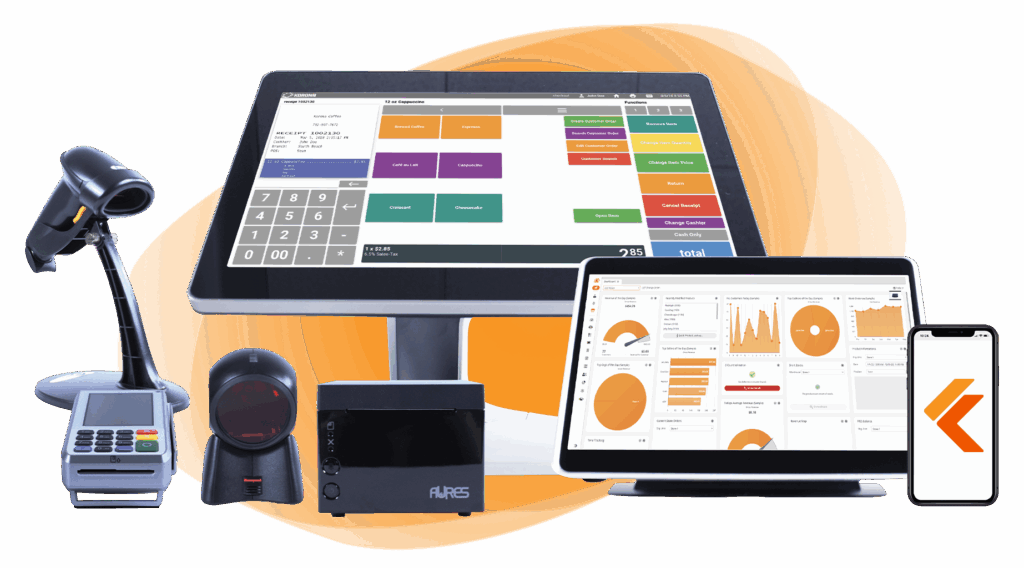
Build Your Own POS
Whether you run a retail store, café, or admissions booth, we have the point of sale hardware designed for your specific needs. Start building your ideal POS system now.
Santé POS Reviews: What Store Owners Actually Say
Santé has no independent reviews on G2, Capterra, Software Advice, Trustpilot, or Google Reviews as of August 2026. Every testimonial available comes from Santé’s own website.
Those testimonials are specific and credible on their face. Store owners describe switching from LiquorPOS after 26 years, from Atlantic Systems after more than a decade, and from WinePOS and Clover, and they consistently cite faster receiving and easier staff training. Named stores with verifiable addresses are attached to each quote.
How to Run Diligence on a Vendor With no Public Reviews
Ask for references matching your store size and card volume, not their flagship accounts. A one-register shop learns little from Joe Canal’s experience.
Ask for a customer who has been live more than 18 months. Early adopters are enthusiastic by selection. The useful signal comes from stores that have survived a holiday rush, a state compliance change, and a distributor switch on the platform.
Ask what a bad support escalation looked like and how it resolved. A vendor unable to name one has either not been running long enough or is dodging the question.
Post in your state retailer association group or your regional package store forum. Owners talk candidly to each other in ways they will not on a reference call the vendor arranged.
Santé POS Pros and Cons
Pros
- Invoice receiving automation that genuinely removes hours of manual data entry each week
- A unified delivery hub that consolidates third-party apps and local delivery into one screen, widely regarded as best in class
- eCommerce, marketing, and interstate shipping native to the platform instead of bolted on
- A modern interface that staff learn quickly, cited repeatedly in customer testimonials
- Purpose-built for liquor and wine, with case breaks, deposits, and lottery handled natively
- Named, verifiable reference customers including multi-store operators
Cons
- Required in-house processing, which strips your rate leverage for the life of the system
- No rates listed anywhere on their public site
- No independent third-party reviews on any major software review platform
- Only three years in market, so state-specific compliance and multi-store edge cases are still being discovered
- Liquor and wine only, with no path if you expand into another retail vertical
- Age verification and ID scanning are absent from the documented feature set
- Conflicting public information on support hours and hardware policy
- Venture backing introduces pressure on pricing and roadmap over time, a structural point about the model and not a knock on the team
Santé POS Alternatives
If Santé is not the right fit, four alternatives cover the realistic range of options for a liquor or wine retailer. Worth saying plainly before the list: bundled processing is the norm in this category, not a Santé quirk.
Three of the four systems below either require their own processing or charge you for bringing your own. Only one does not.
KORONA POS
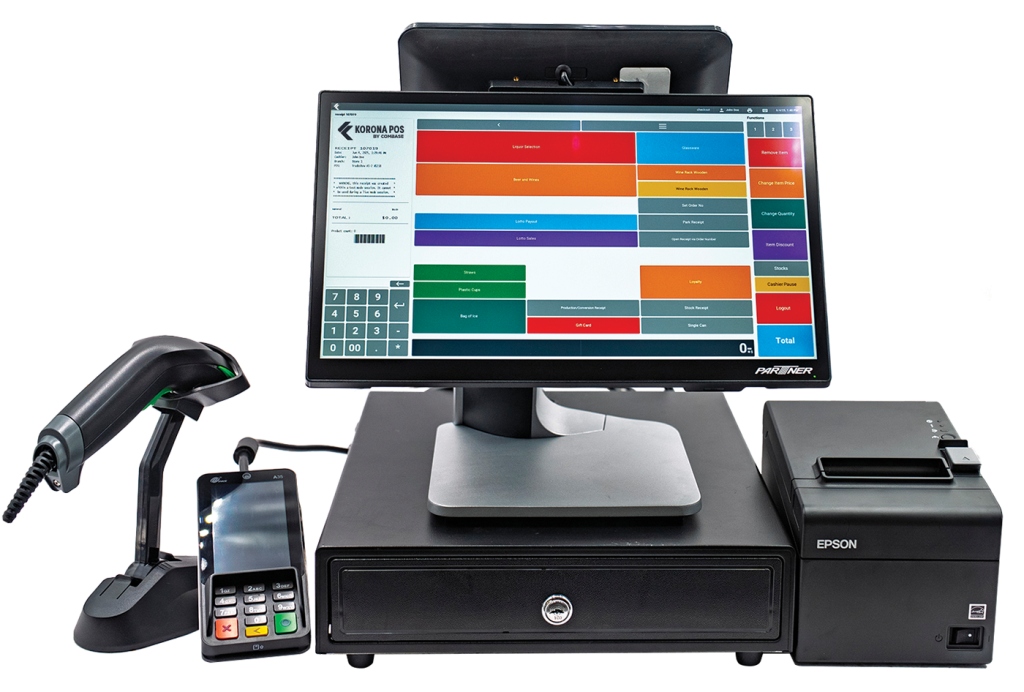
KORONA POS is processor-agnostic, the direct answer to the concern this review keeps returning to. You pick your merchant services provider, negotiate your own rates, and can switch later without replacing the POS. All rates are public: $59, $79, and $99 per month per terminal, billed separately from processing, with no forced contracts and no setup fees.
The system handles case breaks, bottle deposits, mix-and-match pricing, automated ordering, and custom ABC analysis, and it spans multiple verticals if you later add a smoke shop or convenience counter.
Ratings run 4.5 to 4.8 across major review sites. Honest caveats: the interface is more utilitarian than newer systems, per-terminal pricing adds up across many registers, and general support runs weekdays 6 a.m. to 6 p.m. Pacific, with 24/7 reserved for sales-stopping emergencies.
Best fit for stores that want processor freedom and deep inventory control over the slickest possible screen.
mPower Beverage
mPower has served beer, wine, and spirits retailers since 2009 and remains independently owned, with coverage in 46 states plus DC.
The platform offers three vetted processing partners instead of one mandatory provider, a catalog of more than 20,000 preloaded beverages, and multi-location support with inter-store transfers and consolidated purchasing. Delivery runs through CityHive for DoorDash and Uber Eats, plus Shopify for online ordering.
One caveat on cost. mPower’s marketing describes its rates as flat and transparent, but the current pricing page carries no numbers and routes you to a demo instead.
Outside listings report about $120 per month per register with a $1,000 setup fee, and an older mPower pricing page noted that the monthly subscription rate requires integrated processing through one of their partners. Ask whether that condition still applies.
Best fit for owners who want a long operating history and processor choice from a company with no venture timeline.
Bottle POS
Bottle POS is liquor-specific and has been owned by POS Nation since 2022. Software runs $59 per month for Starter. It includes a 20,000-plus-SKU liquor database, automated purchase orders, case-break tracking, ID-reading age-verification scanners as a hardware option, and a dual-pricing option that passes card-processing costs to customers through separate cash and card prices.
That last feature deserves scrutiny before you count it as a saving, since dual pricing moves the fee onto your customer instead of erasing it. Our full Bottle POS review walks through the tiers in detail.
Read the fine print on processing. All three Bottle POS tiers state on the company’s own quote builder that they require a Bottle POS processing agreement, so the lock-in concern raised earlier applies here, too.
Ratings also swing widely by platform, from 3.9 on GetApp to 4.8 on Trustpilot, and Bottle POS’s own pages cite different Trustpilot figures in different places.
Best fit for one-location stores and small chains that want a proven liquor system and accept bundled processing.
Lightspeed Retail
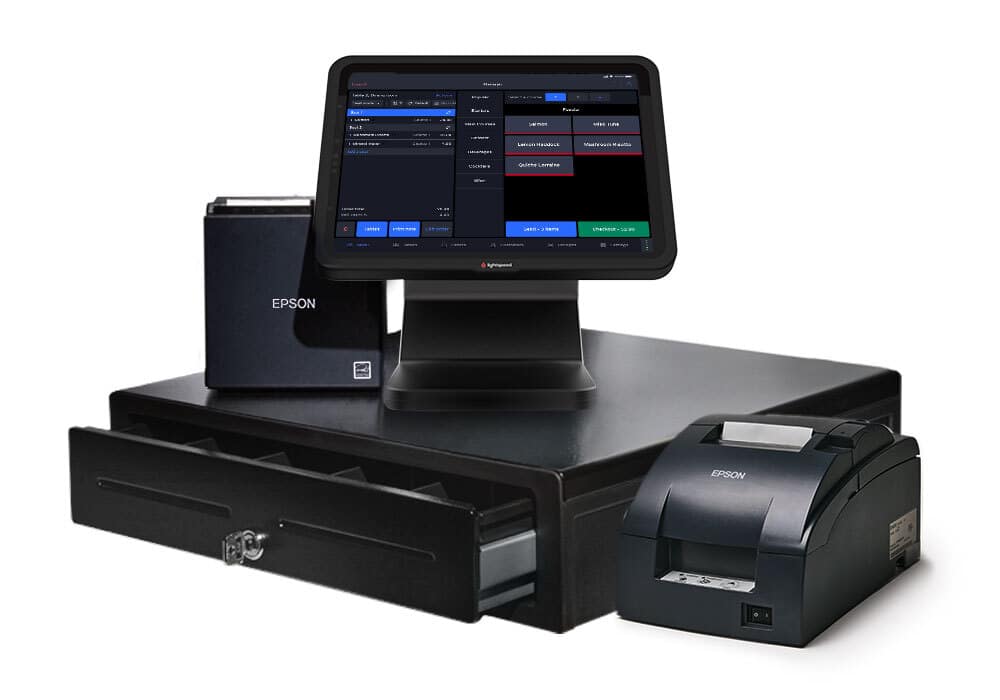
Lightspeed suits wine shops that lead with eCommerce and need a deep catalog and analytics tooling. Retail plans run $89 per month for Basic, $149 for Core, and $289 for Plus on an annual billing plan, with higher rates month-to-month, and each location needs its own subscription.
Those tiers add up quickly across locations, and our Lightspeed POS pricing breakdown and full Lightspeed review cover what merchants actually pay.
The processor question does not go away here either. Lightspeed Payments is effectively mandatory, and merchants who bring an outside processor face a monthly fee tied to their transaction volume.
Industry reporting pegs that fee at $400 per month, but Lightspeed’s service agreement derives it from volume tables instead of stating a flat rate, so confirm your own number before assuming $400.
Best fit for larger wine retailers with serious online catalog ambitions and budget to match.
Legacy Systems Worth Knowing About
Santé’s own testimonials name LiquorPOS, Atlantic Systems, WinePOS, and Clover as the systems their customers left. If you are running one of these, the context is worth having.
Heartland’s LiquorPOS is winding down, with active development stopped and support tapering. Heartland has not published an official end-of-life date, and the March 2026 date circulating online traces to competitor marketing, not to any Heartland notice.
We covered what happened to LiquorPOS separately, including what is verified and what is rumor. You can switch on your own timeline, but a legacy system with no security patches and locked-in processing is already a liability.
Whichever direction you go, plan the data before the software. Inventory, customers, vendors, and years of sales history all have to survive the move, and planning your historical sales data migration is what separates a weekend cutover from a month of reconciliation.
Santé POS vs. the Alternatives
| Comparison point | Santé | KORONA POS | mPower | Bottle POS | Lightspeed Retail |
|---|---|---|---|---|---|
| Vertical focus | Liquor and wine only | Multi-vertical specialty retail | Beer, wine, spirits only | Liquor and wine only | General retail |
| Processing model | Bundled, reported as required | Processor-agnostic, you choose | Choice of three partners | Processing agreement required | Lightspeed Payments required |
| Cost of using your own processor | Not offered | None, you keep the savings | Included in the model | Not offered | Monthly fee tied to volume |
| Publishes pricing | No | Yes, all tiers | No, demo required | Yes, all tiers | Yes, all tiers |
| Starting software cost | About $99 per month, outside-reported | $59 per month per terminal | About $120 per month per register, reported | $59 per month | $89 per month billed annually, per location |
| Built-in eCommerce | Yes | Included from Core plan | Via Shopify | Free web store integration | Yes |
| Delivery app hub | Yes, unified | Via integration | Via CityHive | DoorDash integration | Via integration |
| Multi-location | Supported | Yes, franchise module +$30 per month | Yes, with transfers | Yes, on upper tiers | Yes, priced per location |
| G2 rating | No listing | 4.7 from 50 reviews | 4.0 from 1 review | 5.0 from 2 reviews | 4.0 from 292 reviews |
Is Santé POS Right for Your Store?
Santé fits best when convenience outweighs leverage. Choose it if you run one or two stores, your card volume is modest enough that a processing spread does not dominate your economics, a unified delivery hub is your top priority, and you want one vendor and one bill.
Look elsewhere if any of the following apply:
- You do high card volume. Past about $1.5 million a year, the processing spread dwarfs any software fee on the table, and you need room to shop rates.
- You run or plan more than three locations. Multi-store depth takes years to build, and Santé has had three.
- You sell across more than one vertical. A liquor-only platform becomes a constraint the day you add a second concept.
- You want your software decision and your processing decision to stay separate. Bundling them means one negotiation instead of two, and you lose the one that costs more.
The honest summary: Santé built a good product quickly and deserves a demo. The caution has nothing to do with the software. It concerns signing a contract that hands one company control of both your operations and your card rates, at a point when nobody outside their customer base can verify how they behave at renewal.
Bring Your Statement to the Demo
Before you sign with any POS vendor, pull your last three merchant statements and calculate your effective rate.
If the line items look like alphabet soup, our guide to reading merchant statements walks through a real example line by line. Then ask every vendor on your shortlist a single question: can I keep this processor, and can I change it later?
With KORONA POS, the answer is yes in both directions, because processing is never bundled into the software.
Software is $59 to $99 per month per terminal, published in full, with processing billed separately by whichever provider you pick. Bring your statement to a demo and see what your current volume looks like on rates you chose yourself.
Speak with a product specialist and learn how KORONA POS can power your business.
Frequently Asked Questions
How Much Does Santé POS Cost?
No rates appear on Santé’s website. Outside reporting from January 2026 sets base software at $99 monthly, with delivery app integration and the website builder adding $49 each, landing a fully loaded store at $197. Arithmetic on Santé’s own cost comparison points to $218 monthly for two registers. Card processing is billed on top and usually exceeds the software bill.
Does Santé POS Require You to Use Their Payment Processing?
Competitor reporting says yes, and Santé’s own site points the same direction: no outside processors appear in their integrations, and their FAQ promises to undercut whatever you pay now. Get that requirement in writing before signing.
Is Santé POS Good For Small Liquor Stores?
Santé suits one and two-location independents, especially owners who want eCommerce and delivery apps running in the same system as the register. Lower card volume also means the bundled processing stings less than it would at scale.
When Was Santé POS Founded And Who Owns it?
Darren Fike and Antoine Balaresque started Santé Technologies, Inc. in 2023, and the company operates out of New York City. It remains privately held, backed by a $7.6 million seed round closed in February 2026 with Bonfire Ventures leading.
Does Santé POS Work For Wine Shops?
Yes. Santé supports vintage tracking, case and bottle sales, and an online wine catalog with images and descriptions, and it integrates with Wine-Searcher and Vivino.
Can Santé POS Handle Multiple Locations?
Yes, with inventory and sales management for several stores under one dashboard. Chains past three locations should stress-test stock transfers between sites, combined purchase orders, and reorder thresholds set per store, because maturity there arrives only with time.
Does Santé POS Have Age Verification?
Santé’s documented feature set does not mention it, and outside sources disagree on whether ID scanning hardware ships with the system. Insist on a live walkthrough using the precise hardware you intend to buy.
What Are The Best Santé POS Alternatives?
KORONA POS for processor freedom and multi-vertical retail. mPower Beverage for an independent liquor-only system with a choice of three processing partners. Bottle POS for a proven liquor platform, with its own processing agreement attached. Lightspeed Retail for wine shops leading with eCommerce.