

ROI in retail is the clearest measure of whether your business is actually making money. In the sections below, you’ll find how to calculate retail ROI, what benchmarks to aim for, which mistakes quietly drain margins, and the best practices that move the needle. KORONA POS can help you implement these improvements.
Key Takeaways:
- A good retail ROI typically falls between 10% and 30%, varying by segment and channel.
- Loyalty programs and retention consistently outperform paid acquisition on ROI.
- Technology like KORONA POS offers dual pricing and is processing agnostic, directly protecting net margin per transaction.
What is ROI in Retail?
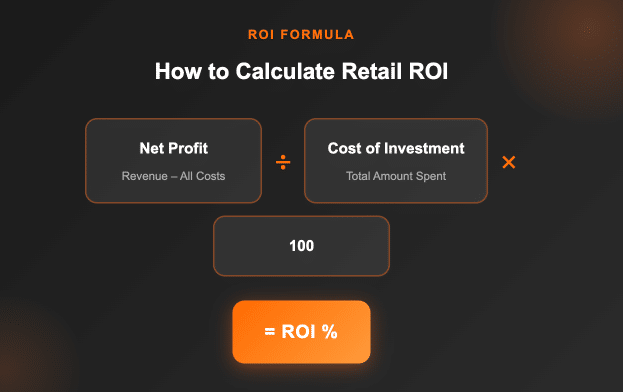
ROI in retail measures the profit a store generates relative to the investment. Calculate it by dividing net profit by the investment cost, then multiplying by 100 for a percentage.
If you invest $10,000 in a marketing campaign and it drives $15,000 in net profit, your ROI is 50%.
Retailers track ROI across inventory, store locations, promotions, and staff to figure out what’s actually making money, and what’s quietly draining it.
How to Calculate ROI in Retail?
The formula itself is straightforward, but knowing which numbers to plug in is where most retailers slip up. A solid grasp of your retail sales analytics makes the calculation far more accurate and actionable.
- Identify your net profit: Revenue minus the total cost of goods, labor, and overhead tied to that investment.
- Define your cost of investment: The exact amount spent on inventory purchase, a campaign, a new fixture, etc.
- Apply the formula: Divide net profit by the cost of investment, then multiply by 100.
Example Calculation
A retailer invests $10,000 in new inventory. After selling the products, they generate $15,000 in revenue with $2,000 in operating costs.
Net Profit: $15,000 – $10,000 – $2,000 = $3,000
ROI: ($3,000 ÷ $10,000) × 100 = 30%
For every dollar invested, the retailer earned $1.30 back.
Key Metrics That Impact ROI in Retail
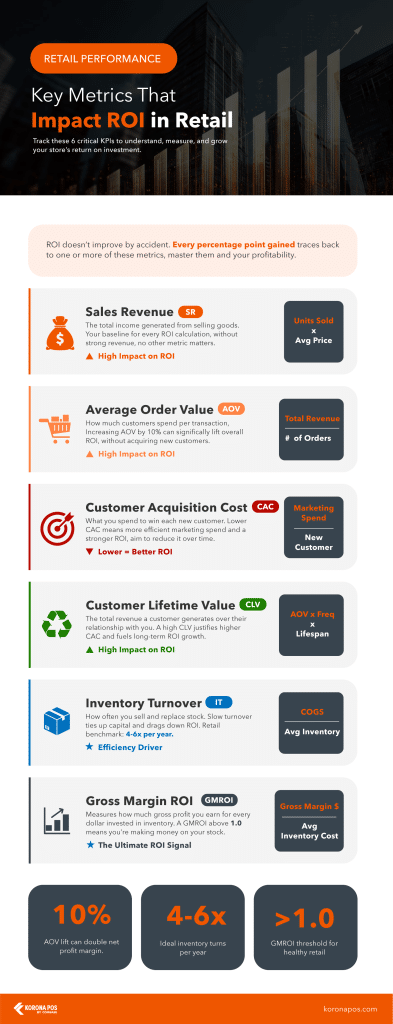
ROI doesn’t move on its own. It responds to a handful of operational and financial signals. Keeping tabs on the right retail metrics and KPIs tells you exactly which levers to pull when margins start slipping.
1. Sales Revenue vs. Operating Costs
The gap between what you bring in and what it costs to operate is your clearest ROI signal. If revenue grows but operating costs grow faster, ROI shrinks, even when sales look healthy on paper. If a store generates $500K in revenue but spends $480K on rent, staff, and logistics, the margin is razor-thin. Widening that gap, not just growing revenue, is what moves ROI in a meaningful direction.
2. Average Order Value (AOV)
AOV measures how much a customer spends per transaction. A higher AOV means more revenue without extra acquisition spend. Retailers frequently note that product bundling and upsells at checkout are among the fastest ways to lift AOV without heavy discounting.
3. Customer Acquisition Cost (CAC)
CAC tells you what it costs to bring one new customer through the door. Spending $50 on ads to acquire a customer who buys once for $40 is a losing strategy. Lowering CAC through referrals or loyalty programs makes every marketing dollar work harder.
4. Customer Lifetime Value (CLV)
CLV puts CAC in perspective. A customer who spends $200 per year for 5 years is worth $1,000, meaning a $50 acquisition cost is a solid investment. Retailers who understand CLV prioritize retention over constant new customer chasing.
5. Inventory Turnover
A deep dive into inventory turnover ratio explains why slow-moving stock quietly kills ROI. A sporting goods store sitting on last season’s inventory ties up capital that could fund better-performing products. Higher turnover means healthier cash flow and fewer markdowns.
6. GMROI (Gross Margin Return on Investment)
GMROI measures how much gross profit you earn for every dollar tied up in inventory. It’s one of the most direct metrics to measure retail inventory ROI. A GMROI below 1.0 means your inventory is costing you more than it’s returning.
Benchmarks: What is a Good ROI in Retail?
In retail, a good ROI typically falls between 10% and 30%, depending on the category. Grocery margins are razor-thin, so 5–10% is respectable. Fashion and beauty can push 20–40%. Liquor stores sit in a sweet spot, steady consumer demand and strong repeat traffic push ROI to 20–35%. The benchmark shifts by channel, too. eCommerce often incurs higher acquisition costs, which eat into returns.
Retail Segment | Average ROI Range | Notes |
Grocery | 5–10% | High volume, low margin |
Apparel/Fashion | 15–30% | Seasonal risk affects returns |
Beauty/Personal Care | 20–40% | Strong repeat purchase rate |
Electronics | 8–15% | Competitive pricing pressure |
Liquor Stores | 20–35% | Steady demand, strong repeat traffic |
eCommerce (general) | 10–25% | Ad spend can erode margins |
Anything above 20% across the board signals a healthy, well-managed retail operation.
Best Practices to Improve ROI in Retail
Strategic improvements across operations, customer relationships, and technology infrastructure can significantly boost profitability. Here are the most impactful practices retailers can act on today.
Optimize Pricing Strategies
Dynamic pricing responds to demand fluctuations, competitor actions, and inventory levels. A retail price calculator helps determine optimal markups based on costs and market conditions. Electronics retailers often adjust prices weekly on high-demand items, while clearance discounts move slow-moving inventory before it becomes obsolete or outdated.
Improve Customer Experience
Customer experience improvements directly influence repeat purchases and word-of-mouth referrals. Staff training on product knowledge, faster checkout processes, and personalized recommendations create memorable shopping moments. A home goods store that remembers customer preferences and offers style consultations builds stronger relationships than competitors focused solely on transactions.
Have trouble getting your POS customer service on the phone?
KORONA POS offers 24/7 phone, chat, and email support. Call us at 833.200.0213 to see how reliable we are.
Leverage Retail Technology
Modern retail technology streamlines operations and captures valuable customer data. Cloud-based POS systems track sales patterns, manage employee schedules, and integrate with accounting software. KORONA POS offers features such as automated reordering and customer purchase history to inform smarter business decisions across multiple locations.
Streamline Inventory Management
Effective inventory planning prevents stockouts and reduces carrying costs. Advanced inventory management systems forecast demand based on historical data and seasonal trends. A garden center that orders spring planting supplies in January avoids overstocking while meeting peak season demand without emergency rush orders.
Maximize Marketing ROI
Strategic retail marketing targets high-value customers through multiple channels. Email campaigns promoting loyalty programs cost less than paid advertising while generating higher conversion rates. Understanding different types of loyalty programs helps businesses select rewards structures that encourage repeat visits and larger basket sizes.
Strengthen Customer Engagement
Active customer engagement builds a community around your brand. In-store retail events like product demonstrations, workshops, or seasonal celebrations attract foot traffic and create buzz. A bookstore hosting author signings or reading clubs generates excitement beyond standard retail transactions while deepening customer connections.
Monitor Financial Metrics
Regular analysis of profit margins, expense ratios, and sales trends identifies opportunities for improvement. Weekly reviews of top-performing products versus underperformers guide purchasing decisions. A liquor store owner tracking daily sales by category quickly spots emerging trends and adjusts inventory orders accordingly, rather than waiting for end-of-month reports.
Discover Advanced Analytics and Custom Reports
Speak with a product specialist and learn how KORONA POS can work for your business.
Real-World Examples of ROI in Retail
To illustrate how ROI calculations translate into actionable business decisions, let’s examine several concrete examples from retail operations.
Example #1: Pine & Peoria Liquor Store in Tulsa, OK
After purchasing Pine & Peoria and Pine & Harvard liquor stores in Tulsa, OK, Kristen Lee switched POS software to improve inventory management and sales reporting. The seamless transition delivered better backend control and operational efficiency, demonstrating clear ROI through enhanced business functionality and streamlined store management.
Example #2: How a Grocery Chain Fixed Inventory Waste
Cub, a Minnesota-based grocery chain, fixed produce waste by partnering with AI forecasting platform Afresh. As Tech Brew reported, the system analyzes billions of data points to forecast demand for each item. Since rollout, Cub has seen an 18% drop in produce shrink and a 2.5% lift in sales.
Mistakes That Kill ROI (and Quick Fixes)
Most retailers don’t lose ROI in one dramatic moment. It erodes quietly through repeated missteps in pricing, inventory, and operations. Here are the most common mistakes and how to correct them fast.
Ignoring Gross Margin Until It’s Too Late
Many retailers track revenue but overlook what’s actually left after costs. By the time the problem surfaces, the damage is done. Running regular checks with a gross profit margin calculator keeps you ahead of margin compression before it becomes a cash flow crisis.
Letting Inventory Management Slip
Poor inventory control bleeds money from both ends; overstock ties up capital, while stockouts push customers to competitors. The challenges of inventory management are well-documented, but most are preventable with tighter reorder processes, cycle counts, and category-level visibility into what’s actually moving.
Inventory management a headache?
KORONA POS makes stock control easy. Automate tasks, generate custom reports, and learn how you can start improving your business.
Neglecting Equipment and Asset Tracking
Broken or untracked equipment quietly inflates operating costs. A malfunctioning refrigeration unit in a liquor store or a faulty POS terminal at peak hours directly hurts sales and service. Solid equipment inventory management keeps assets accounted for and maintenance from becoming a surprise expense.
Failing to Convert Foot Traffic Into Sales
Bringing customers through the door means nothing if they leave empty-handed. Weak product placement, undertrained staff, and slow checkout all suppress conversion. A focused effort to increase retail conversion rates through better floor layouts, upselling training, and frictionless payment can lift ROI without spending a dollar more on marketing.
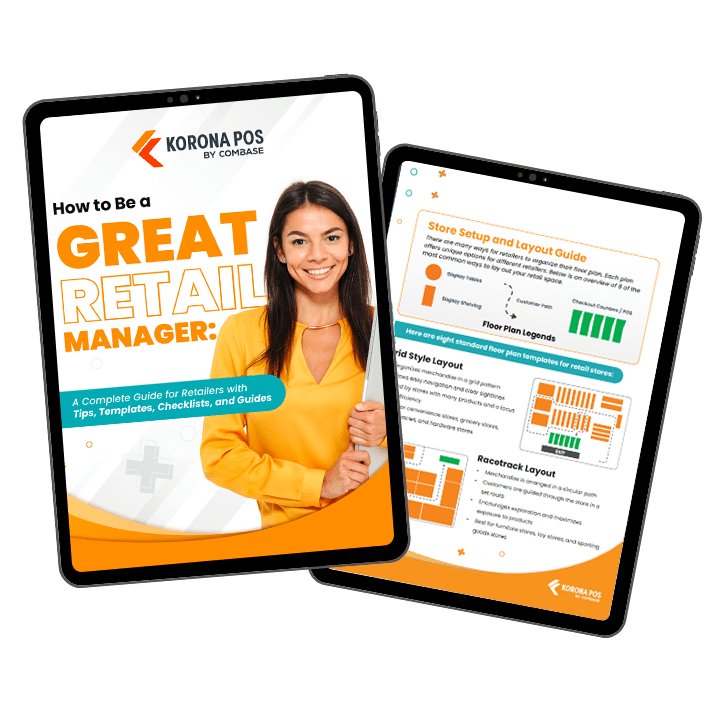
Free printable templates and checklists to help you manage retail operations with ease
See the ROI Difference with KORONA POS
KORONA POS helps retail businesses improve ROI by tackling the areas that quietly drain revenue. Its inventory management software automatically recalculates reorder levels based on purchase history and seasonal trends.
It also provides detailed reporting on sales patterns, margins, and employee performance, so you can make smarter decisions faster.
NOTE
KORONA POS handles integrated payment processing, integrates with major payment processors and supports dual pricing and supports dual pricing.
Businesses can offset card processing fees by offering a cash discount, thereby directly protecting their margins on every transaction. Click below to schedule a demo with one of our product specialists or call us at 833-200-0213.
Speak with a product specialist and learn how KORONA POS can power your business.
FAQs
1. How can digital signage improve retail ROI?
Digital signage drives sales by promoting products and influencing purchasing decisions at key moments. Displays can highlight promotions and bestsellers, increasing basket sizes and customer engagement. Retailers report higher impulse purchase rates when signage is strategically placed near checkout or in high-traffic areas.
2. What is a good return rate retail?
A healthy return rate typically falls between 5-10% for most retail sectors, though online retailers often see higher rates of 20-30%. Lower return rates signal better product quality, accurate descriptions, and stronger customer satisfaction.
3. What industries benefit the most from digital signage?
Grocery stores, fashion retailers, electronics stores, and quick-service restaurants see the strongest results from digital signage due to high foot traffic and frequent promotional cycles. Liquor stores also benefit, with signage that highlights new arrivals or featured brands, driving measurable sales lifts.