

Retail Conversion Rate Calculator
Find your rate and see what a 1% improvement is worth in dollars.
Key Takeaways:
- Retail conversion rate is the percentage of people who walk into your store and make a purchase. Most stores convert between 20% and 40% of foot traffic, but even a small improvement has an outsized impact on revenue.
- The most common reasons customers leave without buying are avoidable: poor store layout, understaffing during peak hours, checkout friction, and stockouts of in-demand products.
- Improving conversion is not about getting more people through the door. It is about making better use of the traffic you already have.
Most retailers pour their energy into driving foot traffic: social media, local ads, promotions, events. And then a significant percentage of the people who actually show up walk out without buying anything. That gap between visitors and buyers is your conversion rate, and for most brick-and-mortar stores, it is one of the most underleveraged opportunities in the business.
This post covers what retail conversion rate actually means, what a good one looks like, why customers leave without buying, and the specific changes that move the number.
What Is Retail Conversion Rate?
Retail conversion rate is the percentage of people who enter your store and complete a purchase. The formula is simple: divide your total transactions by your total foot traffic over the same period, then multiply by 100. If 400 people walk through your door on a Saturday and 120 of them buy something, your conversion rate for that day is 30%.
It is one of the most telling metrics in physical retail because it reflects the quality of the in-store experience.
What Is a Good Retail Conversion Rate?
Benchmarks vary significantly by retail category. Specialty retail typically converts between 20% and 40%. Grocery runs much higher because most people who walk in have come to buy. Apparel tends to sit lower, often in the 10%-20% range. Electronics and furniture can run even lower due to longer consideration cycles.
One useful reference point: e-commerce sites typically convert at 2% to 4%. Brick-and-mortar stores perform dramatically better because in-store shoppers have already made a physical commitment to visit, which means their purchase intent is higher from the moment they walk in.
How to Calculate Your Retail Conversion Rate
You need two numbers: total transactions for a period (available from your POS) and total foot traffic for the same period (from a door sensor or people counter). Divide transactions by foot traffic and multiply by 100. A store with 90 transactions and 300 visitors is converting at 30%.
The most common mistake is using gross visitor counts without filtering out staff, delivery drivers, and repeat entries. A dedicated door sensor with a bi-directional counter handles this more accurately than a manual tally.
Why Customers Leave Without Buying
The four most common reasons customers leave empty-handed are poor store layout, understaffing during peak hours, checkout friction, and stockouts. Each one is diagnosable and fixable, which is what makes conversion rate such a tractable metric compared to foot traffic.
Poor layout means customers disengage before they find something to buy. Understaffing means questions go unanswered and customers leave rather than wait. Checkout friction means a customer who has already decided to buy abandons the transaction at the last moment. Stockouts mean the customer came for something specific, could not find it, and left without browsing. Fixing even one of these consistently moves the number.
8 Ways to Increase Retail Conversion Rate
These eight strategies address the most common conversion gaps in brick-and-mortar retail, from the moment a customer walks in to the moment they reach the register.
1. Optimize Your Store Layout for How People Actually Shop
Most shoppers in the US naturally drift to the right when they enter a store and pass through a decompression zone just inside the entrance, where they are still orienting themselves. Placing your highest-demand or most visually striking merchandise slightly past the entrance on the right side catches customers when they are most receptive and optimizes your store layout.
Dwell time is directly tied to conversion: research shows that each 1% increase in customer dwell time correlates with a 1.3% to 2% lift in sales. Rosa, a small gift shop owner in Oregon, moved her checkout counter from the front of the store to the back and saw dwell time and basket size both increase because customers were walking past more merchandise to get there.
Remember, though, store conversion rates vary widely by business type. A gift shop will have a far lower conversion rate than a liquor store, for instance.
2. Staff the Right Way at the Right Times
Staffing patterns built around administrative convenience rather than actual traffic patterns leave money on the table. The question is not how many people you have scheduled in a week, it is whether you have the right coverage at the right times.
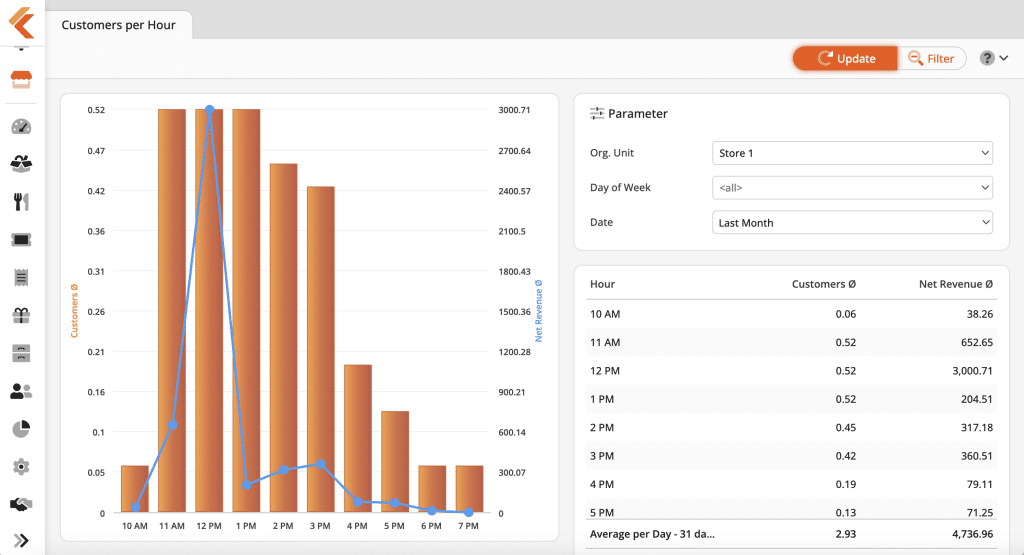
Your POS system's sales-by-hour data is the fastest way to find staffing gaps. If it shows a consistent spike between 11am and 1pm on Saturdays but your schedule treats Saturday as a flat day, you are reliably understaffed at your highest-conversion window every week.
3. Let Customers Try Before They Buy
The single biggest structural advantage physical retail has over e-commerce is the ability to let customers experience a product before committing to it. Touch, taste, smell, and fit are things an online store cannot replicate, and retailers who build product trial into the shopping experience use that advantage deliberately.
4. Reduce Friction at Checkout
A customer who has decided to buy but encounters a long line or a slow POS register may reconsider. The retail checkout experience is the most fragile point in the conversion process because it is where the customer actively parts with money, and any friction can prompt them to pause.
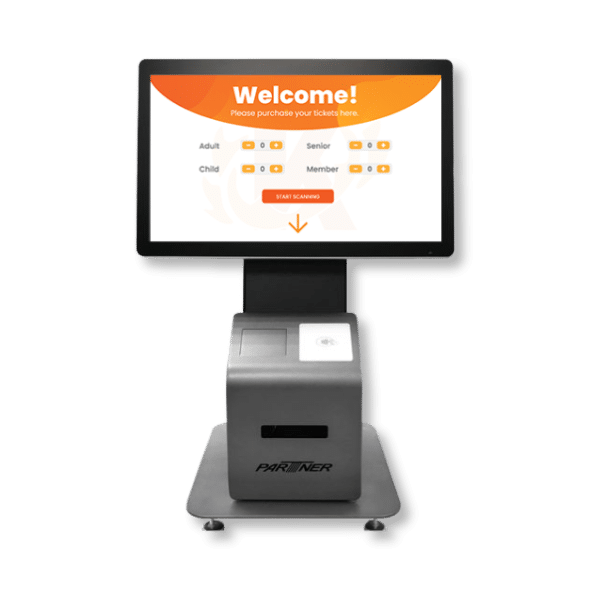
Mobile POS and self-checkout both address this from different angles. Mobile POS lets staff complete transactions anywhere on the floor, eliminating the bottleneck of a single register during peak hours. Self-checkout works well for low-complexity purchases where the customer simply wants a fast exit.
5. Use Data to Find When and Where You Are Losing Customers
Improving conversion without data is guesswork. You need to know not just your overall rate but how it shifts by day, hour, and season, because the fix for a Saturday afternoon slump is different from the fix for a Tuesday morning one.
Cross-referencing your hourly sales data with foot traffic counts tells you exactly where your drop-off moments are. If foot traffic peaks at 3pm on Sundays but transactions-per-hour shows a flat line at that time, that is a specific, diagnosable problem tied to staffing, inventory, or layout during that window.
6. Fix Stockouts Before They Cost You Sales
A stockout is a conversion killer entirely within your control. The fix is straightforward: use continual cycle counting and set reorder levels for your products so your inventory system flags them before they hit zero, not after. Most modern POS systems, including KORONA POS, let you set a minimum stock threshold per product per warehouse so the system surfaces low-stock items automatically before the shelf goes empty.
For seasonal SKUs with unpredictable demand spikes, use your sales history to set reorder points rather than guessing. A five-week rolling average of past sales is a reliable baseline for most retail categories and removes the manual judgment call from restocking decisions.
7. Build a Loyalty Program That Brings People Back Ready to Buy
Repeat customers convert at significantly higher rates than first-time visitors because they already trust the store and know what they want from it. Priya, a home goods retailer in Washington, DC, built a tiered loyalty program through KORONA's CRM, giving members early access to new arrivals and a points structure tied to purchase size. Within two quarters, her loyalty members were converting at nearly twice the rate of non-members and spending about 30% more per visit.
PRO TIP!
A simple points-for-purchases program that customers understand and trust will outperform a complicated tiered system that nobody bothers to track. The mechanism matters less than the consistency.
8. Train Staff to Sell, Not Just Assist
There is a meaningful difference between a staff member who answers questions when asked and one who actively engages customers and guides them toward a purchase. The first is customer service. The second is selling, and only one directly moves your conversion rate.
Giving staff two or three specific product recommendations to offer during the week, tied to current promotions or high-margin items, creates a floor culture where selling feels natural. A brief, relevant suggestion at checkout is low-pressure and converts more often than most retailers expect.
How to Track Whether Your Changes Are Working
Set a baseline conversion rate, make one change at a time, give it four to six weeks, and measure the delta. The metrics to watch alongside conversion rate are average transaction value, items per basket, and Customers Per Hour trends, because together they tell you whether converted customers are also spending more.
KORONA Studio's Customers Per Hour report can be run week over week or month over month to show whether your staffing and layout changes are producing a different pattern. Pair that with transaction data from the same periods and you have a clear before-and-after picture that goes beyond gut feel.
Discover Advanced Analytics and Custom Reports
Speak with a product specialist and learn how KORONA POS can work for your business.
Retail Conversion Rate Is a Metric You Can Move, If You Know Where to Look
Most conversion rate problems are not mysterious. They are the predictable result of specific, fixable conditions: the wrong staff coverage at the wrong time, a layout that does not guide customers toward purchase, a product that ran out before the weekend, a checkout line that asked too much of someone who had already decided to buy.
Retailers who consistently improve their conversion rates are paying attention to their data, making targeted changes, and measuring the results.
Retail Conversion Rate: FAQs
Does conversion rate differ between weekdays and weekends?
Almost always, yes. Most retailers see higher conversion on weekends because customers have more time to browse and shop with intention. Tracking conversion by day of week rather than as a single weekly average gives you a much more useful picture of where you actually have a problem.
Can a high conversion rate actually be a bad sign?
It can be. A very high conversion rate sometimes means your marketing is so targeted that only highly motivated buyers are finding you, which can cap your growth. If your rate is above 60% consistently, it may be worth asking whether you are reaching enough new customers.
How does checkout speed affect conversion for customers who are already in the store?
More than most retailers realize. Studies show that customers will abandon a purchase after about four minutes of waiting in line, even if they came in ready to buy. Faster checkout does not just improve experience; it directly protects conversions you have already earned.