



Franchise best practices are what separate owners who grow from those who struggle. In the sections below, we cover what it takes to run a successful franchise: from understanding your agreement and managing inventory to marketing your location and choosing the right tools.
Whether you’re opening your first location or scaling to multiple, the principles covered here apply directly to how you operate day to day.
Key Takeaways:
- Successful franchisees follow brand standards, track their finances closely, and treat operations as a system, not a guessing game.
- The right tools, from your POS to your reporting software, directly impact how well your locations perform and scale.
- Marketing and community presence are not optional extras. They are what separates a busy location from a struggling one.
Understand the Fundamentals of Franchising
Franchising operates on a licensing model where franchisors grant business rights to independent operators in exchange for fees and royalties.
Franchisees gain access to proven business systems, established branding, and operational support while maintaining ownership of their individual units. The franchisor provides training, marketing resources, and ongoing guidance.
Before launching a franchise system, business owners should master legal requirements, documentation standards, and support infrastructure. Learning how to start a franchise properly protects both parties and establishes a foundation for sustainable growth across multiple locations.
10 Franchise Best Practices: What Successful Franchises Get Right
Becoming a franchisee is one of the most accessible paths to business ownership, but success is far from guaranteed. The franchisees who thrive long-term are the ones who adopt the right habits early and stick to them consistently.
1. Use the Right Technology
A centralized POS system is one of the first and most important investments a franchisee will make. Look for software that handles sales, inventory, and reporting in one place. Fewer manual processes mean fewer errors and more time spent on what actually moves the needle in your store.
2. Follow Brand Standards
Customers expect the same experience every time, regardless of which location they visit. Drifting from brand standards puts your franchise agreement at risk and damages customer trust. The franchisees who earn the most respect from their franchisors are the ones who treat consistency as non-negotiable.
3. Track Your Finances Closely
Understanding how much franchise owners actually make starts with monitoring your own numbers. Track profit margins, labor costs, and overhead consistently. Many franchisee failures stem not from low sales but from poor cost management that goes unnoticed. Set clear benchmarks and review them regularly.
4. Leverage Reporting Tools
Gut instinct is not enough. Using one of the best franchise reporting systems gives you clear visibility into sales trends, inventory movement, and staffing efficiency. When you understand your numbers, you can spot problems early and make confident decisions rather than reactive ones.
Discover Advanced Analytics and Custom Reports
Speak with a product specialist and learn how KORONA POS can work for your business.
5. Manage Inventory With Discipline
Poor inventory control is one of the fastest ways for a franchisee to lose money. Wasted stock, missed reorders, and shelf gaps all hurt your bottom line. Tools like convenience store inventory management software or multi-store retail management software help automate reorder points and keep stock accurate across your location.
Inventory management a headache?
KORONA POS makes stock control easy. Automate tasks, generate custom reports, and learn how you can start improving your business.
6. Know Your Franchise Agreement
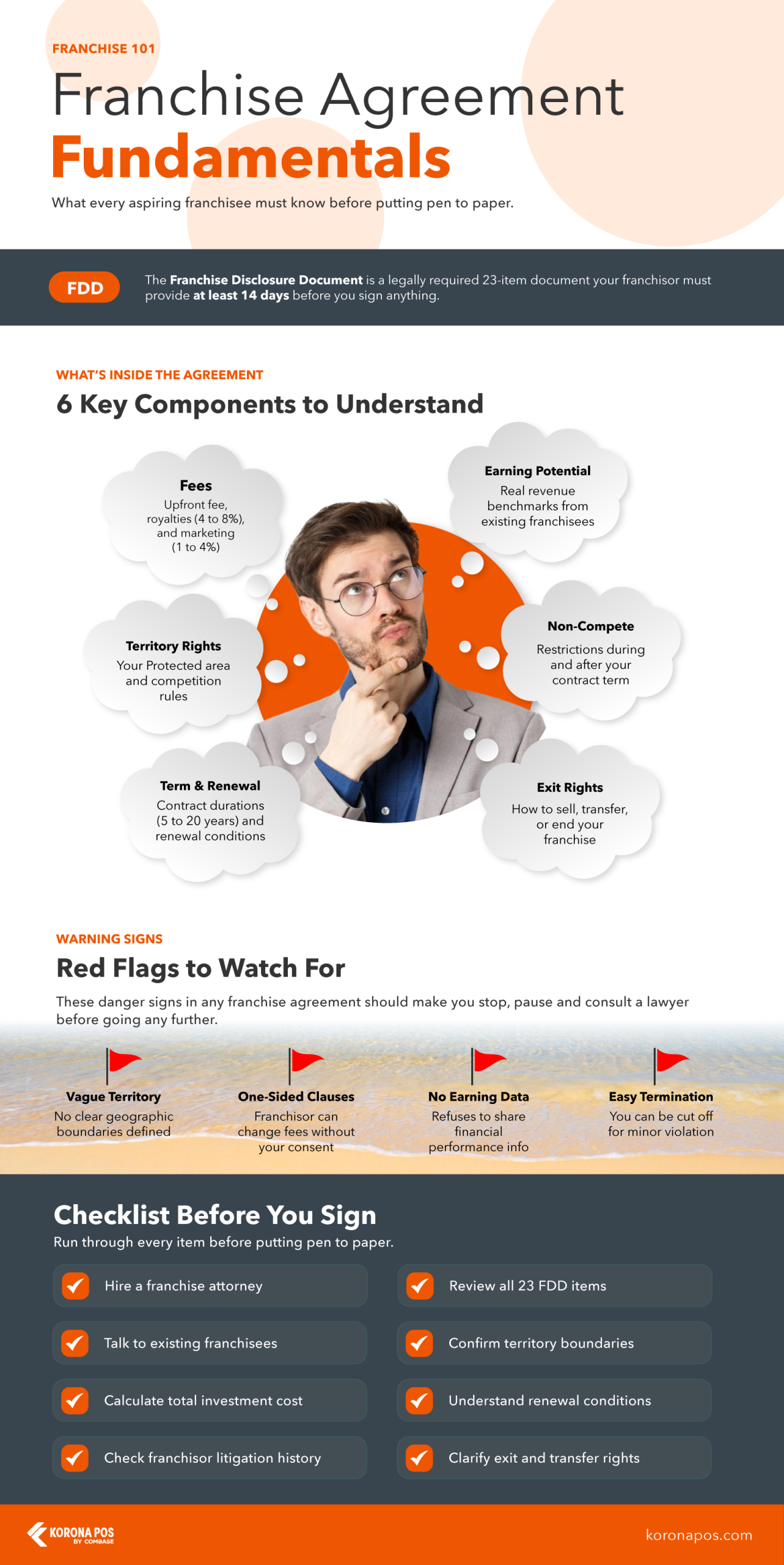
Too many franchisees sign agreements without fully understanding what they’re committing to. Knowing the difference between a chain and a franchise clarifies your rights, obligations, and limits as an owner. Understanding where your autonomy ends prevents costly disputes and sets realistic expectations from the start.
7. Build a Training System
Without a structured onboarding process, inconsistencies creep in fast. Develop repeatable training materials covering operations, customer service, and compliance. Franchisees who invest in thorough onboarding see faster ramp-up times, fewer mistakes, and a more reliable team. A well-trained staff is one of the strongest assets a franchisee location can have.
8. Pick the Right Market
Not every concept works in every location. A coffee shop franchise, for example, thrives in high-foot-traffic areas but may underperform elsewhere. Research your local demographics and competition before committing. The strongest franchisees pick concepts aligned with genuine local demand rather than brand name recognition alone.
9. Optimize Your POS for Daily Operations
A slow POS system creates friction for staff and customers every single day. Looking at how Subway structures its POS setup offers a useful benchmark for what efficient operations look like at scale.
PRO TIP!
Prioritize speed, accuracy, and integration with inventory and loyalty programs when evaluating your current setup.
Speak with a product specialist and learn how KORONA POS can power your business.
10. Communicate With Your Franchisor
Franchisees who treat their franchisor as a partner consistently perform better. Proactive communication helps you access support faster, flag issues early, and stay ahead of brand updates. The relationship you build with your franchisor is a direct business asset.
PRO TIP!
Share your performance data, ask questions when something is unclear, and participate in franchisee networks.
How Successful Franchises Market Themselves?
Marketing as a franchisee means balancing the franchisor’s brand guidelines with the needs of your local market. Whether you’re just getting started or looking to scale, following proven franchise marketing best practices gives you a clear roadmap to attract and retain customers consistently.
1. Leverage Local Digital Marketing
Franchisees who show up in local search results have a significant edge. Claim and optimize your Google Business Profile, run location-targeted ads, and stay active on social media with content relevant to your area. National brand campaigns build awareness, but local digital marketing is what drives foot traffic through your specific door.
2. Build an Email List and Reward Loyalty
Email marketing remains one of the highest-return channels available to franchisees. Collect customer emails at the point of sale and consistently send relevant offers, updates, and promotions.
PRO TIP!
Pair that with a loyalty program to encourage repeat visits. Customers who feel rewarded come back more often and spend more per visit.
3. Get Involved in Your Community
Franchisees who are visible in their local community build trust faster than any ad campaign can. Community presence turns your location into a neighborhood staple rather than just another chain outlet, which is a key trait of any successful multi-store retail business.
PRO TIP!
Sponsor local events, partner with nearby businesses, and run in-store promotions tied to local occasions.
4. Use Your Franchisor’s Marketing Resources
Most franchisors provide marketing toolkits, templates, and co-op advertising funds that franchisees underuse. A solid franchise guide will outline exactly what support is available to you and how to access it without duplicating effort.
PRO TIP!
Before spending your own budget on creative assets, check what’s already available through your franchisor.
5. Track What’s Working and Cut What Isn’t
Marketing without measurement is guesswork. Monitor which channels drive the most traffic, conversions, and repeat customers. Use your POS data to connect promotions directly to sales results. When you know which campaigns perform, you can put more budget behind them and stop wasting money on tactics that don’t move the needle for your location.
Simplify Franchise and Multi-Location Operations with KORONA POS
KORONA POS offers the right franchise POS, built for franchisees and multi-location operators who need one system to manage it all. From consolidated inventory and automated royalty payments to detailed sales reports and employee management tools, every feature is designed to keep your locations aligned.
NOTE!
KORONA POS is processor-agnostic, offers dual pricing, and includes US-based customer support that actually answers.
It serves retailers, quick-service restaurants, convenience stores, and entertainment venues alike.
Ready to see it in action? Sign up for a free demo or call KORONA POS directly at 833-200-0213. The team is ready to walk you through everything and help you find the right setup for your locations.