


Inventory errors are expensive — and manual counts are slow, frustrating, and outdated. Meanwhile, RFID automates inventory tracking using radio-frequency tags, giving you real-time visibility with far less labor.
In this guide, we’ll explain what RFID is, how it works, its pros and cons, costs, and which businesses benefit most — so you can decide if RFID is right for your business.
Key Takeaways:
- RFID inventory management uses radio waves to automatically track inventory in real time.
- While RFID has higher upfront costs than barcodes, it delivers long-term savings through labor reduction and fewer inventory errors.
- RFID works best for retailers, manufacturers, logistics operations, and any business managing high volumes or returnable assets.
What Is RFID Inventory Management?
RFID inventory management uses radio-frequency identification to track inventory automatically. Instead of scanning barcodes one-by-one, RFID systems read multiple tagged items at once—even through packaging—providing faster counts, better accuracy, and real-time stock visibility across locations.
What Are RFID Tags?
RFID tags are small devices attached to products or assets. Each tag contains a microchip and antenna that store identifying data. When an RFID reader emits radio waves, tags respond with their information—no direct line of sight required.
Types of RFID Tags
Not all RFID tags work the same way, and choosing the wrong type can drive up costs fast. The two main categories—passive and active RFID—serve very different inventory and asset-tracking use cases.
Passive RFID Tags
Most tags used for RFID are passive tags. Passive RFID tags are powered by the electromagnetic field generated by an RFID reader during communication. They do not have their own power source.
Active RFID Tags
Active tags, which are more expensive than passive tags, have their own battery power source, allowing them to broadcast signals at a greater distance, independently of an RFID reader.
How RFID Inventory Management Works
RFID inventory management automates tracking by combining tags, readers, and software to collect inventory data continuously without manual scanning. Here’s how the process works step by step.
Step #1: Tagging Inventory
Each item or asset is tagged with an RFID label containing a unique identifier tied to your inventory system.
Step #2: Reading and Tracking
RFID readers scan tags automatically as items move through doors, shelves, or warehouses—capturing data in real time.
Step #3: Data Sync and Reporting
Inventory data syncs with your inventory management system, providing live counts, alerts, and reporting across locations.
Inventory management a headache?
KORONA POS makes stock control easy. Automate tasks, generate custom reports, and learn how you can start improving your business.
Pros of RFID in Inventory Management
The benefits of using RFID in your inventory management system go well beyond simple convenience. From faster stock counts to better visibility across locations, RFID gives retailers and warehouse operators a serious edge over manual tracking methods. Here are the main advantages.
Improved Efficiency
RFID readers can scan dozens or even hundreds of tags in seconds, all without needing a direct line of sight. Compare that to barcode scanning, where each item must be picked up, positioned, and scanned individually.
- Bulk scanning allows entire shelves, pallets, or shipments to be counted in a single pass.
- Store associates can complete cycle counts in minutes instead of hours.
- RFID eliminates the need to open boxes or move products around just to get an accurate count.
- Inventory audits that once required closing the store or pausing warehouse operations can now happen during normal business hours.
Reduced Labor Costs
Because RFID automates so much of the counting and tracking process, businesses need fewer staff hours dedicated to inventory management.
- One employee with a handheld RFID reader can do the work that previously took a team of three or four.
- Annual physical inventory counts, which often require overtime pay or temporary hires, become much shorter and less costly.
- Staff members can be reassigned from repetitive counting tasks to higher-value work, such as customer service, merchandising, or order fulfillment.
- Fewer human touchpoints also means fewer data entry mistakes.
Instant Stock Visibility
RFID provides an up-to-the-minute view of what you have in stock, where each item is located, and when it last moved.
- Store managers can see exact inventory levels across every location from a single dashboard.
- Out-of-stock situations are easier to catch early, so replenishment orders go out before shelves sit empty.
- Inventory discrepancies between what the system says and what’s actually on hand become rare, not routine.
- Omnichannel fulfillment becomes more reliable because the system provides accurate counts for buy online, pick up in store (BOPIS) and ship from store workflows.
Returnable Asset Tracking
RFID is especially useful for businesses that manage reusable assets like pallets, totes, kegs, crates, and shipping containers. These items move constantly between locations, and keeping track of them manually at scale is nearly impossible.
- Each returnable asset is assigned its own RFID tag, allowing it to be tracked as it moves through the supply chain.
- Businesses can identify exactly where an asset is at any given time.
- RFID helps companies enforce accountability with partners or distributors by providing a clear record of when and where each asset was last scanned.
- You can use RFID to locate items across warehouses, distribution centers, and retail locations without searching manually.
Cons of RFID in Inventory Management
While RFID offers clear advantages, it’s not without trade-offs. Businesses should understand the potential drawbacks before committing to a rollout. Here are the main inventory management challenges that come with RFID.
High Initial Investment Costs
RFID systems require a meaningful upfront investment, especially when compared to barcode setups that can be deployed for under $5,000.
- A small-to-mid-sized RFID rollout typically costs between $15,000 and $75,000, which includes tags, readers, antennas, and software integration.
- Passive RFID tags cost roughly $0.08 to $0.30 each, but the cost adds up quickly when tagging thousands of items.
- Active RFID tags, which include their own battery and offer longer read ranges, can cost $15 to $50 or more per unit.
- Beyond hardware, there are also costs for staff training, workflow redesign, and ongoing system maintenance.
Privacy and Security Concerns
RFID tags transmit data wirelessly, which introduces risks that don’t exist with traditional barcodes. Without proper safeguards, unauthorized readers could potentially access tag information.
- Sensitive product or asset data could be intercepted if tags aren’t properly encrypted.
- Businesses that handle high-value goods, pharmaceuticals, or regulated products may need to meet stricter data protection compliance standards.
- Customer privacy concerns can also arise, especially if RFID tags on purchased items remain active after the point of sale.
- Organizations need clear policies for data access, storage, and retention to minimize risk.
Complexity of Integration
RFID delivers the most value when it’s tightly connected to your point-of-sale system, inventory management software, and warehouse operations. Getting all of those pieces to work together smoothly is not always straightforward.
- Legacy systems or older POS platforms may not support RFID without significant upgrades or middleware.
- Poor integration can create data silos, where inventory information in one system doesn’t match what another system shows.
- The transition period from barcode to RFID often requires running both systems in parallel, which increases short-term complexity and cost.
- Staff need time to learn new workflows, and the learning curve can slow operations temporarily.
Signal Interference
RFID technology relies on radio waves, and certain physical environments can cause read errors or reduced accuracy.
- Metal shelving, racks, and fixtures can reflect or block RFID signals, which leads to missed reads.
- Liquids absorb radio waves, so products stored in bottles, cans, or wet environments may be harder to scan reliably.
- Dense packaging or tightly stacked inventory can create “dead zones” where tags are difficult for readers to detect.
- Site testing and antenna placement adjustments are often necessary during setup to find the best configuration for a specific store or warehouse layout.

Free printable templates and checklists to help you manage retail operations with ease
Examples of RFID Inventory Management
RFID is widely used across industries where inventory volume, speed, and traceability matter most.
- Food & Beverage: Tracks returnable assets like kegs, crates, and pallets across distribution routes. Also supports recall readiness and lot-level traceability.
- Retail: Speeds up cycle counts, improves stock accuracy, and helps reduce shrink across multiple store locations.
- Manufacturing: Monitors raw materials and work-in-progress as items move through each production stage. Bottlenecks are easier to spot and resolve.
- Warehousing & Distribution: Automates location tracking, speeds up order picking, and cuts down on mislabeled or misplaced shipments.
Which Businesses Benefit Most From Using RFID for Inventory Management?
| Business Type | Inventory Challenge | Why RFID Is Valuable |
|---|---|---|
| Retail | High SKU counts, frequent stock movement, and shrink | Enables near-instant inventory visibility across stores and channels, supporting faster replenishment and more reliable omnichannel fulfillment. |
| Manufacturing | Limited visibility between production stages | Improves tracking across the production lifecycle, helping teams identify delays, balance workflows, and reduce work-in-progress losses. |
| Food & Beverage | Asset loss, traceability gaps, and compliance pressure | Strengthens lot-level traceability and reusable asset tracking. Recalls become faster and compliance reporting becomes easier. |
| Logistics & Distribution | Manual scans and location errors slow fulfillment | Automates location and movement tracking, increasing throughput while reducing mis-picks and labor dependency. |
RFID software can benefit businesses across many industries, especially where accurate inventory tracking directly affects profitability. The ability to automate RFID data collection removes much of the manual effort that slows down operations and introduces errors. Here are the business types that stand to gain the most from RFID inventory tracking software.
Retailers
Apparel, footwear, and specialty retail stores see some of the biggest gains from RFID. High SKU counts and constant product movement make manual tracking unreliable at scale.
- RFID speeds up cycle counts and gives store teams accurate stock numbers across every location.
- Buy-online-pick-up-in-store (BOPIS) and ship-from-store workflows become more reliable because inventory records actually reflect what’s on the shelf.
- Shrink is easier to identify and address when every item is tagged and tracked from receiving to point of sale.
Manufacturers
RFID helps manufacturers keep a close eye on raw materials, components, and work-in-progress as items move through each production stage.
- Production bottlenecks are easier to spot when every component is tracked automatically.
- Planning accuracy improves because managers have a clear picture of material availability and stage completion.
- Waste and rework go down when teams can trace where and when issues occur on the line.
Food and Beverage Industry
For food and beverage companies, RFID addresses two persistent problems: asset loss and traceability gaps.
- Reusable containers like kegs, crates, and pallets can be tracked across every stop in the distribution network.
- Lot-level traceability makes recall response faster and more precise.
- Compliance reporting becomes simpler because the data is already captured automatically at each checkpoint.
Logistics and Distribution
Warehouses and third-party logistics providers (3PLs) rely on speed and accuracy to stay competitive. RFID supports both.
- Location tracking at the dock door and throughout the facility cuts down on lost or misplaced inventory.
- Order picking becomes faster because workers don’t need to scan each item individually.
- Mis-picks and shipping errors drop when the system verifies contents automatically before dispatch.
How Much Does RFID Inventory Management Implementation Cost?
RFID inventory management implementation costs vary depending on the scale and complexity of the RFID infrastructure and business processes. Here’s a breakdown of the typical costs:
Passive RFID Implementation Costs
Passive tags cost ~$0.08–$0.30 each, making them suitable for high-volume retail inventory. A typical small retail deployment ranges from $15,000–$40,000 including readers and software.
Active RFID Implementation Costs
Active tags cost ~$15–$50+ per unit but offer longer read ranges and onboard power. Deployments often exceed $50,000–$100,000, making them best for asset tracking rather than individual items.
How to Choose the Best RFID Inventory Management System
The right RFID inventory management system should simplify your day-to-day — not add complexity or hidden costs. Look for software that integrates directly with your POS, delivers real-time inventory visibility, and scales cleanly as your business grows.
Key factors to evaluate before choosing an RFID platform:
- POS integration: Inventory data should sync automatically with sales, returns, and transfers—no manual reconciliation.
- Real-time reporting: Dashboards should update instantly so teams can act on discrepancies, not chase them later.
- Multi-location support: RFID should work across stores, warehouses, or production sites from one system.
- Flexible pricing: Avoid long-term contracts, per-tag lock-ins, or proprietary hardware that limit future changes.
- Operational fit: The system should match your workflows, staff capacity, and inventory volume—not force a redesign.
Difference Between Barcode vs. RFID Tags
| Feature | Barcode | RFID |
|---|---|---|
| Scanning Method | Requires direct line of sight; each item scanned one at a time | Wireless radio waves; reads multiple tags at once without line of sight |
| Read Speed | One item per scan; full counts are slow and labor-heavy | Hundreds of tags per second; full cycle counts take minutes |
| Read Through Packaging | No; labels must be visible and unobstructed | Yes; reads through boxes, packaging, and containers |
| Accuracy | Prone to human error from manual handling and missed scans | Very high; automated reads reduce miscounts significantly |
| Cost per Label/Tag | Fractions of a cent per label | $0.08 to $0.30+ per passive tag; $15 to $50+ per active tag |
| Setup Cost | Low; typically under $5,000 for scanners and labels | Higher; $15,000 to $75,000+ for readers, tags, and software |
| Labor Requirements | High; staff must scan each item individually | Low; one person can count entire sections quickly |
| Best For | Small stores with low SKU counts and infrequent audits | High-volume retailers, multi-location operations, and asset tracking |
Requires direct line of sight; each item scanned one at a time
Wireless radio waves; reads multiple tags at once without line of sight
One item per scan; full counts are slow and labor-heavy
Hundreds of tags per second; full cycle counts take minutes
No; labels must be visible and unobstructed
Yes; reads through boxes, packaging, and containers
Prone to human error from manual handling and missed scans
Very high; automated reads reduce miscounts significantly
Fractions of a cent per label
$0.08 to $0.30+ per passive tag; $15 to $50+ per active tag
Low; typically under $5,000 for scanners and labels
Higher; $15,000 to $75,000+ for readers, tags, and software
High; staff must scan each item individually
Low; one person can count entire sections quickly
Small stores with low SKU counts and infrequent audits
High-volume retailers, multi-location operations, and asset tracking
The difference between RFID and barcodes is significant. Barcodes rely on line-of-sight scanning, meaning each item must be handled and scanned individually. This makes them low-cost but labor-intensive, especially as inventory volume grows.
RFID tags communicate wirelessly, allowing multiple items to be read at once—even through packaging or containers. This enables faster counts, higher accuracy, and less manual effort, particularly in high-SKU or fast-moving environments.
Speak with a product specialist and learn how KORONA POS can power your business.
RFID vs. Barcode: What’s Better for Your Business?
Barcodes are a practical choice for small or single-location businesses with limited SKUs and stable inventory. They’re inexpensive, easy to implement, and sufficient when counts are infrequent and manual labor is manageable.
RFID becomes the better option as inventory complexity increases. Businesses with high SKU counts, multiple locations, frequent audits, or returnable assets often see RFID pay off through faster counts, improved accuracy, and reduced labor—offsetting the higher upfront investment over time.
Upgrade Your Inventory Management With RFID and KORONA POS
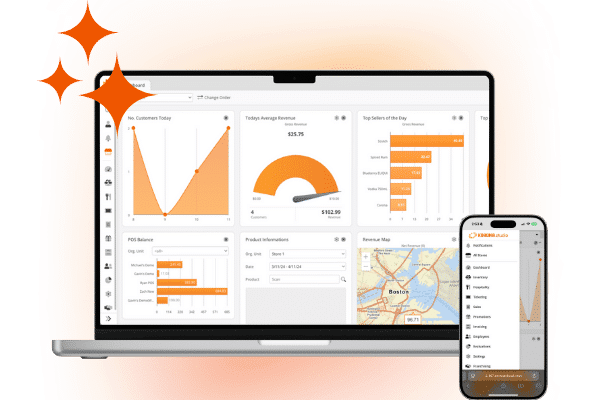
RFID delivers the most value when it’s connected directly to your point of sale. With KORONA POS, RFID inventory data syncs with sales, transfers, and reporting in real time—giving you accurate visibility across locations without added complexity.
Ready to reduce manual counts and improve inventory accuracy? Schedule a demo to see how RFID and KORONA POS work together to make taking inventory at scale a breeze.
Frequently Asked Questions About RFID Retail Inventory Management
1. How long do RFID tags last before they need to be replaced?
Passive tags last over 10 years since they have no battery. Active tags typically last 3 to 5 years before needing replacement.
2. Can RFID and barcode systems work together?
Yes. Many retailers run hybrid setups, using barcodes for low-volume items and RFID for high-turnover or high-value products.
3. What is the typical ROI timeline for RFID in retail?
Generally, most retailers recoup their RFID investment within 12 months through labor savings, fewer stock errors, and reduced shrinkage.
4. How often should retailers conduct RFID inventory counts?
Daily or even twice daily. RFID reduces full store counts to minutes, so frequent counting becomes practical and cost-effective.
5. Is RFID practical for small retailers?
Sometimes. Small stores with low SKU counts rarely need RFID. It becomes worthwhile once inventory volume or location complexity grows.