

Key Takeaways:
- Most retailers negotiate vendor terms based on gut feel and relationship history. The ones who consistently get better pricing, longer payment windows, and stronger return policies bring specific POS data to the table instead.
- Your POS system is already generating the reports you need: sales velocity by supplier, gross margin by product, inventory turnover, stockout history, and return rates.
- Vendors negotiate with retailers every day. Showing up with a printed one-page summary of your sales data immediately changes the dynamic of your negotiations.
Most retailers walk into vendor meetings the same way: a sense of how things have been going, a few complaints about a late shipment, maybe a rough idea of how much they spent last quarter. Vendors know this. They also know that retailers without specific numbers on hand are much harder to negotiate with than those who do.
Your POS system is generating detailed supplier-level data every time you make a sale. Sales velocity, gross margin, inventory turnover, stockout history, return rates: it is all there. This post shows you exactly which reports to pull, what they tell you, and how to use them to ask for better terms and actually get them.
The POS Reports That Give You Negotiating Leverage
These are the specific reports worth pulling before any vendor conversation. Each one answers a different question, and together they build a complete picture of how a supplier is actually performing for your business.
Supplier Analysis: Your Starting Point
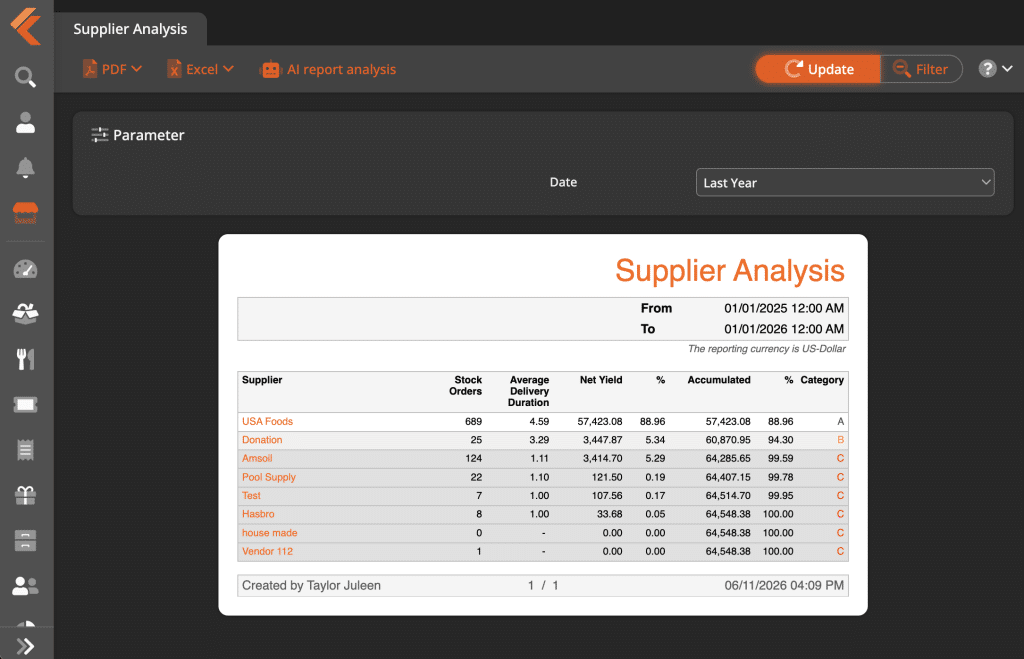
Before you look at individual products, look at your suppliers as a whole. In KORONA Studio, the Supplier Analysis report (under the Evaluations tab) gives you a side-by-side view of every supplier in your system: number of orders placed, average delivery duration, gross profit generated from that supplier’s products, and a Net Yield percentage. Each supplier is also automatically assigned a performance category based on their margin contribution.
PRO TIP!
This is the report to open first: it immediately tells you which supplier relationships are worth investing in and which deserve scrutiny. A supplier with high order volume but a low Net Yield percentage is a conversation waiting to happen. A supplier with strong margins and fast delivery is one you want to deepen the relationship with, and the data gives you a reason to ask for exclusivity or priority fulfillment in return.
Inventory Order Report: Your Volume Proof
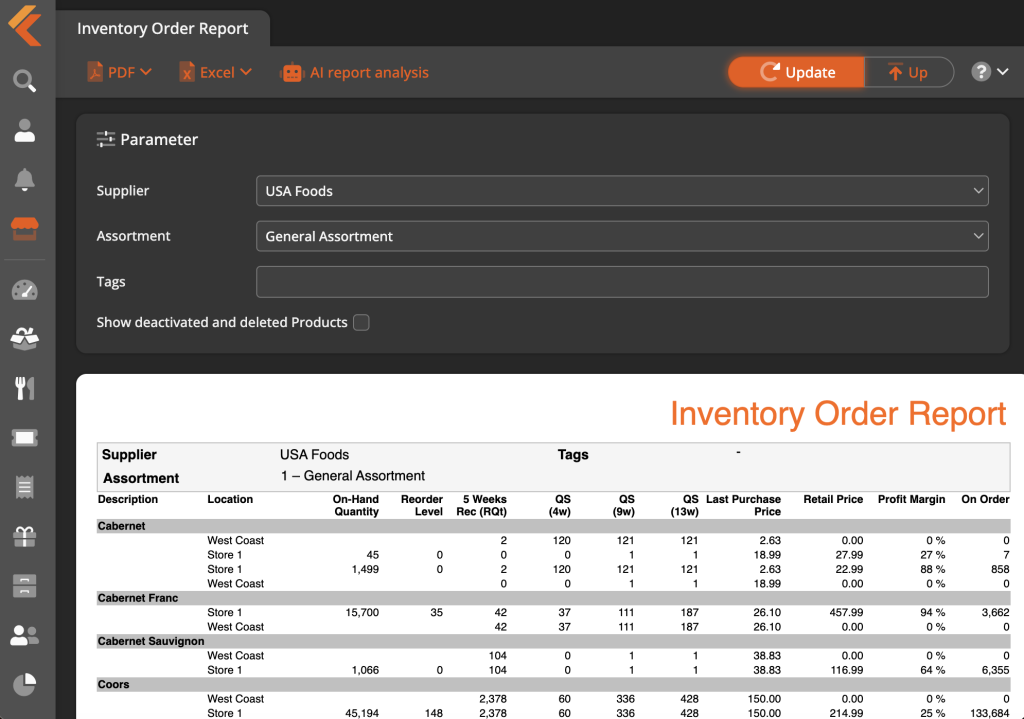
When a vendor says your volume does not justify better pricing, this is the report you pull back out. The Inventory Order Report in KORONA Studio (Evaluations tab) breaks down every product from a specific supplier and shows your current on-hand quantities, past sales for the last 4, 9, and 13 weeks, and a recommended reorder quantity for the next five weeks based on recent sales trends.
PRO TIP!
The 13-week sales column is particularly useful in negotiations: it shows sustained volume over a full quarter, not just a recent spike. If you moved 600 units of a supplier’s product over the past 13 weeks across your locations, that is a concrete number. Bring a printed copy or a screenshot. “We sold 600 units in the last quarter, and we are projecting similar volume” is a different conversation from “we sell a lot of your stuff.”
Commodity Group Report: Your Margin Argument
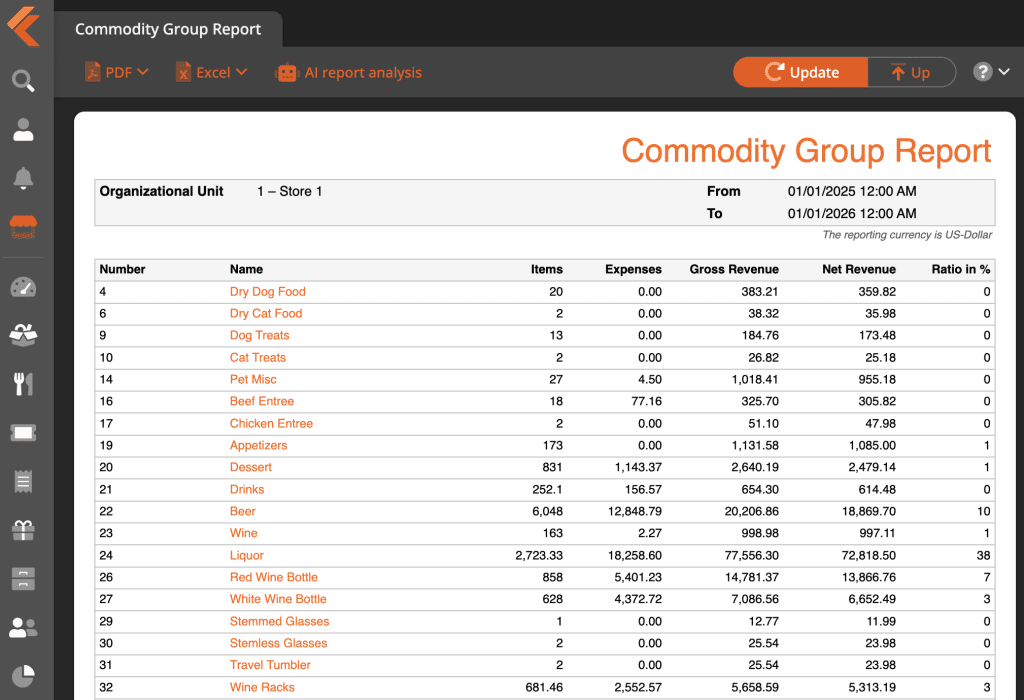
The Commodity Group Report (Evaluations tab in KORONA Studio) shows gross revenue, expenses, net revenue, and net yield by product category and sub-category. When a supplier’s products are consistently showing compressed margins, the report gives you the exact numbers to bring to the negotiation.
FOR EXAMPLE:
Consider James, a sporting goods retailer in the Mid-Atlantic who noticed his margins on one supplier’s footwear line had been declining over two seasons. He pulled the Commodity Group Report, filtered it to that category, and walked into the next vendor meeting with a printed sheet showing net yield had dropped from 31% to 22% over 12 months while his order volume held steady.
He asked for a 4% cost reduction to restore his margin to a workable level. The supplier came back with 3%. That one conversation recovered roughly $8,000 in annual margin on that product line without changing a single thing about how his store operated.
Stock Return Rates Report: Your Quality Argument
If a supplier’s products are coming back at a higher-than-expected rate, you have a data-backed case for better return terms, a quality guarantee, or a credit on defective units. The Stock Return Rates report in KORONA Studio (Evaluations tab) plots return percentages against sales rates by SKU and flags products where returns are running disproportionately high relative to volume.
PRO TIP!
A vendor who knows you are tracking return rates by product is a vendor who takes quality complaints more seriously. Showing up with a list of specific SKUs and their return percentages shifts the conversation from “we’ve been having some issues with these” to “SKU 4471 has a 14% return rate over the past six months. Here is the data.” That specificity changes what vendors feel they can dismiss.
Short Stocks History: Your Reliability Argument
Stockouts caused by supplier delays or fulfillment failures cost you sales and customer trust. If a vendor has been chronically late or short on fulfillment, your stock history is the evidence. In KORONA Studio, your Short Stocks dashboard (home screen widget) surfaces products that have hit their reorder threshold, and the stock history within each product’s record shows when it went to zero and how long it stayed there.
PRO TIP!
Documenting supplier-side stockouts over a period gives you concrete leverage to negotiate tighter lead time commitments, penalty clauses for missed delivery windows, or safety stock arrangements. A supplier who sees you tracking their delivery performance is far more likely to prioritize your orders.
Discover Advanced Analytics and Custom Reports
Speak with a product specialist and learn how KORONA POS can work for your business.
What to Actually Ask Your Vendors For
Most retailers only ask for a price reduction. That is the hardest thing to get because it directly hits the supplier’s margin. The following terms are all negotiable and often easier to obtain than a straight cost cut, especially when you bring data to support the ask.
Here is a table of the most commonly negotiable vendor terms and the data that supports each one:
| What to ask for | Data that supports the ask |
|---|---|
| Cost price reduction | 13-week sales volume from your Inventory Order Report showing sustained demand |
| Extended payment terms (net 30 to net 60) | Consistent order history and on-time payment record |
| Lower minimum order quantities | Low turnover data on specific SKUs that do not justify large orders |
| Swell or spoilage allowance | Return rates and expiry loss data by product |
| Priority fulfillment during peak season | Historical sales velocity during seasonal windows |
| Return window extension for slow movers | Turnover rate and seasonal demand patterns by SKU |
| Penalty clause for late deliveries | Stockout history tied to supplier lead times |
| Exclusive or semi-exclusive arrangement | Top-performer status in Supplier Analysis by gross profit and Net Yield |
A few of these are worth calling out specifically:
- Extended payment terms are one of the easiest wins to achieve and one of the most impactful for cash flow: moving from net 15 to net 45 on a $20,000 monthly order gives you an extra $20,000 in working capital at any given time.
- Minimum order quantity reductions matter most for seasonal or niche SKUs where you need flexibility.
- Swell allowances (a pre-agreed percentage deducted from invoices to cover unsellable goods) are standard in many categories but are rarely offered proactively.
How to Structure the Conversation
Bringing data to a vendor meeting only works if you present it in a way that does not come across as hostile. The goal is a better deal for both sides, so framing it that way makes vendors more likely to respond constructively. A practical three-part structure works best:
- Make the specific ask. “We would like to discuss a cost adjustment that gets us back to the 28% to 30% range.”
- Start with strength. Acknowledge what is working. “Your product moves well for us. Here is what the last quarter looked like.”
- Introduce the problem. Be specific. “The challenge is that our margin on this category has compressed from 31% to 22% over the same period, which makes it harder for us to justify expanding the floor space.”
PRO TIP!
Keep your data to one page if you can. A printed summary of the three or four most relevant numbers is more persuasive than a spreadsheet. Vendors sit across the table from many retailers, so the ones who come in with a focused, specific ask backed by clean data are the ones who are taken seriously.
How Often Should You Renegotiate?
At a minimum, renegotiate once a year before your major buying season. That is when your purchase decisions carry the most financial weight, and you have the most leverage over a supplier seeking your order.
Beyond that, renegotiate whenever something significant changes: a meaningful volume increase, a supplier-side failure like a stockout or quality issue, a new competitor entering your market with the same product at a lower cost, or a sustained margin compression that you can now document with several quarters of data. For your top five suppliers by spend, a quarterly data review is worth building into your routine, even if you do not hold a formal negotiation every quarter. It keeps you current on how each relationship is actually performing and makes the annual conversation much sharper.
Your POS Data Is a Negotiating Asset. Start Treating It Like One.
Vendors negotiate with dozens of retailers. Most of those conversations are vague, relationship-driven, and based on whoever pushes hardest. When you walk in with a printed summary showing 13 weeks of sales volume, a margin compression trend, and a specific ask tied to a specific number, you are operating in a different category.
The data your POS system generates every day is evidence of how your business performs and is your strongest tool for building vendor relationships that actually work in your favor.
Vendor Negotiation FAQs
Should I share my POS data directly with vendors?
- Selectively, yes. Sharing high-level sales velocity and volume data strengthens your position and signals that you are a data-driven buyer worth prioritizing. Avoid sharing margin data, competitor pricing, or anything that reveals how much you depend on a single supplier. Share what helps your case; keep the rest internal.
What if I am a small retailer with low order volume? Do I still have leverage?
More than you think. Volume is one form of leverage but not the only one. Consistent payment history, low return rates, and long-term loyalty are all things suppliers value. A small retailer who pays on time, orders predictably, and rarely causes issues is a better customer than a high-volume one who is constantly disputing invoices.
Is it worth negotiating with every vendor, or just the top ones?
- Focus on your top five to eight suppliers by annual spend first. That is where the financial impact of better terms is largest. Once you have a rhythm, extend the practice down the list. A 3% cost improvement on a supplier you spend $5,000 a year with recovers $150. The same improvement on a supplier you spend $80,000 a year with recovers $2,400. Prioritize accordingly.