



Key Takeaways:
- Price from margin: Doubling your cost gives you a 50% margin, but markdowns and card fees pull your real margin lower.
- Buy by season: Use last year’s sales to decide what to reorder, and order holiday stock early.
- Raise the average sale: Bundles, gift wrapping, and personalization give customers a reason to add one more item.
- Track a short list of numbers: Gross margin by category, sell-through, and inventory turnover show you what to fix first.
To run a gift shop well, pick a clear niche, set prices based on your margin, buy inventory based on sales data, and check a few key numbers every week. The last two depend on accurate stock and sales records, which is why many owners move to automated inventory management early. This guide covers eight steps that work whether you sell to tourists, locals, or both.
Step 1: Choose a Niche and Stock to It
Shoppers can find generic gifts anywhere, so give them a reason to pick your shop. Choose a focus such as local makers, home décor, stationery, seasonal gifts, personalized items, or eco-friendly products, and add an item only if it fits. A shop with a clear point of view is easier to buy for, easier to market, and harder to compare on price.
If you’re in a tourist area, add a small set of convenience items such as sunscreen, phone chargers, ponchos, and snacks. Travelers forget things, and these items bring in people who didn’t come for gifts. Putting your logo on a few products, like mugs or tees, also gives shoppers something to take home that carries your name.
Step 2: Set Prices From Your Margin
Keystone pricing means doubling your cost, which leaves you with a 50% gross margin, or half of each sale after paying for the item. That’s a good starting point, but markdowns, card fees, and theft or damage all reduce it. Track your gross margin by product category so you know which items carry the shop.
Marcus buys 100 mugs at $6 and prices them at $12. He sells 90 at full price and marks 10 down to $7.20, then pays a 3% card fee on every sale. His real margin is about 45%, not 50%.
Enter your numbers to see your real margin after markdowns and card fees, and the price you need to hit your target.
Your real margin
—
Margin at full price
—
Markup on cost
—
Profit per 100 items
—
Price needed for your target
—
Covers your markdowns and card fees.
Step 3: Buy Inventory From Sales Data, Season by Season
Buying what you personally like is the fastest way to end up with unsold stock. Use your POS data to find your top-performing items and reorder those first. Then use ABC analysis, which ranks items by revenue, to identify the few products that matter most.
Dana runs a lake-town gift shop and used to order 200 beach towels each May on instinct. After checking last year's sales, she saw she had sold only 90 by Labor Day and ordered 100 instead. She put the saved cash into fall and holiday stock.
Inventory management a headache?
KORONA POS makes stock control easy. Automate tasks, generate custom reports, and learn how you can start improving your business.
Step 4: Use Displays and Bundles to Raise the Average Sale
People rarely come in for a single item, so group related products together. A candle, a card, and a gift bag priced as a set gives the buyer a finished gift and gives you a bigger sale. Bundles also work as a markdown tool, since you can pair a slow seller with a fast one.
Keep your retail space clean and rotate displays often, with best sellers at eye level and near the register. Group items by occasion or price, such as "host gifts" or "under $25," instead of only by category. Ask customers and staff what people pick up and put back, since that shows you what to change.
Step 5: Add Services That Give People a Reason to Stop
Small services set you apart from stores that only sell products. Offer gift wrapping and gift messages, personalization such as engraving or monograms, and a coffee or pastry counter if you have room. If you plan to serve food, our guide to opening a quick-service restaurant covers what that involves.
Partnering with nearby businesses can also bring in traffic by selling tickets for local attractions, hosting maker events, or sharing tour information. Wall Drug in South Dakota started as a small drug store in 1931 and drew travelers with free ice water. It now gets about 2 million visitors a year, according to NPR.
Step 6: Build an Email List and Sell Online
Collect customer emails at checkout and offer a small discount or giveaway entry as the reason to sign up. Use the list to announce new arrivals, bundles, and holiday ordering deadlines. Loyalty programs can add another reason to return, though they matter less for shops with mostly one-time visitors.
An online store reaches people beyond your foot traffic, and platforms like Shopify, Etsy, and WooCommerce make it easy to start. Many gift shops end up with a hybrid online-offline model, where the same stock sells in both places. Make sure the site loads fast, shows clear photos and return terms, and offers gift wrapping and gift messages at checkout.
Step 7: Track a Short List of Numbers Every Week
Revenue alone can hide a problem, because a busy month can still lose money when margins are thin. Each week, check gross margin by category, sell-through (the share of your stock that sold), and inventory turnover (how often you sell and replace stock). Our list of retail KPIs explains each one with formulas.
Your POS should produce these numbers without spreadsheet work. Use inventory management software to track stock levels and avoid overstocking. For gift shops specifically, see our page on gift shop inventory management software.
| Markup (on cost) | Retail price | Gross margin (on price) |
|---|---|---|
| 50% | $15.00 | 33.3% |
| 75% | $17.50 | 42.9% |
| 100% (keystone) | $20.00 | 50.0% |
| 125% | $22.50 | 55.6% |
| 150% | $25.00 | 60.0% |
| 200% | $30.00 | 66.7% |
Margin = (price - cost) / price. Markup = (price - cost) / cost.
Step 8: Stay Compliant as You Grow
Keep up with sales tax filings, license renewals, and insurance each year, because requirements change. Items like alcohol and tobacco need their own licenses, so check before you stock them. Rules vary by state and city, so confirm details with your local business office or a lawyer.
If you sell online or collect customer emails, check your state's privacy and sales tax rules, plus any rules for customers outside the US. This matters most when you start shipping to other states.
What to Have in Place Before You Open
If you're still setting up, work through this checklist first:
- Concept and audience: pick your niche and who you sell to (Step 1).
- Market research: visit nearby shops and note what's missing.
- Legal setup: register your business name, choose a structure, get a tax ID, and apply for licenses and permits.
- Funding: budget for the rent deposit, build-out, fixtures, first inventory, marketing, and 6 to 12 months of operating cash.
- Location: look for foot traffic, complementary businesses, parking, accessibility, and zoning that allows retail.
- Suppliers: trade shows, wholesalers, local makers, and consignment.
- Store design: an easy-to-browse layout, good fixtures, a window display, and a checkout area that's easy to reach.
- Systems: POS, inventory software, accounting, and customer records.
Fixtures and equipment alone commonly cost roughly $3,200 to $31,000 for a typical 500 to 1,000 square foot shop, according to ZenBusiness. Rent and first inventory come on top of that, so build your own number from real quotes.
What to Look For in a Gift Shop POS System
A gift shop POS system should do more than ring up sales:
- Real-time stock counts and barcode scanning so you always know what's on hand.
- Reports on sales and product analytics that show margin and your best and worst sellers.
- Gift cards, which are a steady product for gift shops.
- Cloud-based access so you can check sales from home.
- Contactless payments, which depend on the payment processor you choose.
- Mobile or tablet checkout to keep lines short. Our guide to the retail POS kit lists the hardware you need.
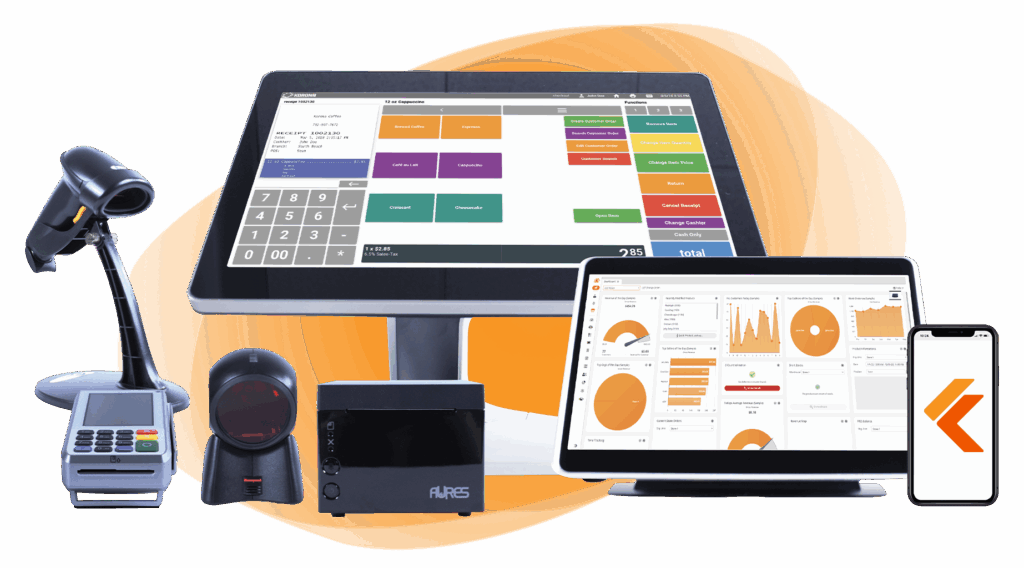
Build Your Own POS
Whether you run a retail store, café, or admissions booth, we have the point of sale hardware designed for your specific needs. Start building your ideal POS system now.
Where Should You Start When Running a Gift Shop?
Start with pricing and inventory, because they decide how much cash you have left each month. Run your current prices through the calculator above, then pull last year's sales to plan your next order. Once those two are steady, add services, email, and online sales.
Speak with a product specialist and learn how KORONA POS can power your business.
Gift Shop FAQs
Do you need a special license to sell alcohol or tobacco in a gift shop?
Yes, in most places. Alcohol and tobacco usually need their own state and local licenses, separate from your general business license. Check with your state's licensing agency before you stock either.
Is it worth taking products on consignment?
It can be. Consignment lowers your upfront inventory cost because you pay the maker only after an item sells. The tradeoff is a smaller margin and extra tracking, so put the terms in writing and use your POS to track what you owe each maker.
What should you do with gift shop items that do not sell?
Mark them down in steps instead of all at once, and set an end date for clearance. Pair slow sellers with fast sellers in a bundle, or move them near the register. A slow sellers report shows which items to act on first.