


Key Takeaways:
- New Mexico has no statewide license cap, an online application system, and a cannabis market that crossed $1 billion in cumulative sales in its first few years. The barrier to entry is lower than most states, but the operational and compliance demands once you are open are significant.
- Age verification, purchase limit enforcement, inventory tracking, and BioTrack reporting are ongoing daily requirements that most guides do not prepare you for adequately.
- New Mexico is a non-Metrc state, which means you have more flexibility in your tech stack than operators in Metrc states, but you are also responsible for building compliant systems from scratch rather than relying on state-mandated infrastructure.
New Mexico is one of the more accessible states in which to start a dispensary in the country. There is no statewide cap on retailer licenses, the application process is fully online, and the market has been growing steadily since recreational sales launched on April 1, 2022. The Cannabis Control Division has approved over 1,050 retailer licenses and the state has already generated over $215 million in sales in 2025 (source: [insert source]).
Still, actually running a compliant dispensary after you open is a different challenge altogether: one that involves age verification on every transaction, purchase limit tracking, inventory controls that satisfy state regulators, and daily to-dos that most startup guides skip past too quickly. This post covers both the licensing process and what day-to-day compliance actually looks like.
Is New Mexico a Good State to Open a Dispensary?
The market fundamentals are strong. New Mexico legalized adult-use cannabis through the Cannabis Regulation Act in April 2021, and the state has consistently grown since legal sales launched. The tourism economy, particularly in Santa Fe and Albuquerque, drives meaningful foot traffic from out-of-state customers who cannot purchase legally at home. The state also exempts cannabis businesses from Section 280E of the federal tax code at the state level, meaning you can deduct business expenses from state income taxes in ways operators in other states cannot.
But the competitive picture is more nuanced. With over 1,050 retailer licenses already issued and no cap on new ones, saturation is a real concern in established markets.
PRO TIP!
Because of saturation, operators entering the market today need a clearer value-add than they did in 2022. That could mean sharper product curation or a stronger customer experience.
What Licenses Do You Need?
The Cannabis Control Division issues ten license types for cannabis businesses in New Mexico. For a retail dispensary, the two most relevant are the Cannabis Retailer License and the Integrated Cannabis Microbusiness License.
Cannabis Retailer vs. Integrated Microbusiness: Which Is Right for You?
The Cannabis Retailer License is the standard path for a dedicated dispensary. It allows you to purchase cannabis products from licensed producers and manufacturers and sell them to adult consumers. The Integrated Cannabis Microbusiness License is designed for smaller-scale operators who want to cultivate, produce, and sell within a single license at a reduced fee structure. Microbusiness licenses come with plant-count limits and production caps, but they offer a lower-cost entry point for operators seeking vertical integration without the overhead of full-scale production.
| Cannabis Retailer License | Integrated Microbusiness License | |
|---|---|---|
| Best for | Dedicated dispensary focused on retail sales | Small-scale operator wanting to cultivate and sell under one license |
| Can sell adult-use cannabis | Yes | Yes |
| Can cultivate cannabis | No (separate producer license required) | Yes, within plant count limits |
| Can manufacture products | No (separate license required) | Yes, within production caps |
| License fee | Standard rate per CCD fee schedule | Discounted rate based on plant count and functions |
| Scale | No cap on retail volume | Production and plant count limits apply |
| Right for you if | You want to focus on retail and source products from established producers | You want to grow and sell your own product at a smaller scale |
A few additional licenses are worth knowing about even if you do not need them at launch:
- Class 1 Manufacturing License: Required if you want to package products or sell cannabis flower deli-style (weighed and packaged on-site for customers).
- On-Site Consumption Area License: Type I (edibles and vapor, no smoking) or Type II (smoking allowed). Requires you to also hold or apply for a retailer license first.
- Cannabis Courier License: If you plan to offer delivery, this is a separate license category.
Step-by-Step: How to Open a Dispensary in New Mexico
Step 1: Form Your Business Entity
Register your business with the New Mexico Secretary of State. Most operators choose an LLC or corporation. All controlling persons (anyone with 10% or greater financial or voting interest) must submit to a background check. Felony convictions involving fraud, embezzlement, deceit, or involvement of a minor in drug sales can result in disqualification.
PRO TIP!
Get your Certificate of Good Standing and Certificate of Registration from the Taxation and Revenue Department early. Both are required application documents and take time to obtain.
Step 2: Write Your Business Plan and Social Equity Plan
A business plan is not technically required by the CCD, but it is expected in your application and evaluated as evidence of your readiness to operate. It should include your:
- Market analysis
- Operational plan
- Financial projections
- Staffing strategy
The Social and Economic Equity Plan is required, not a formality. The CCD needs a clear plan for promoting diversity in hiring and activities, especially in communities hit hardest by cannabis prohibition. Budget real time for this document.
Step 3: Secure a Compliant Location
New Mexico’s zoning rules set minimum distances from sensitive uses: at least 300 feet from schools and daycare facilities, and 600 feet from other licensed dispensaries. Municipal approval is required, but municipalities cannot ban dispensaries outright under the Cannabis Regulation Act. They can set additional local zoning requirements beyond the state minimums.
PRO TIP!
One requirement that catches operators off guard: cannabis products must not be visible from a public place without the use of binoculars, aircraft, or other optical aids. Your storefront design needs to account for this from the beginning.
Step 4: Prepare Your Application Documents
The CCD reviews a substantial documentation package before approving a license. Have the following ready before you submit:
- Background check documentation for all controlling persons
- Proof of age (21+) for each controlling person
- Certificate of Good Standing from the Secretary of State
- Certificate of Registration from the Taxation and Revenue Department
- Security plan including camera placement and alarm system details
- Floor layout of the licensed premises
- Zoning approval from your municipality
- Social and Economic Equity Plan
- Business plan
Step 5: Apply Through NM-PLUS
All applications must be submitted through NM-PLUS, New Mexico’s online cannabis licensing portal. Paper applications are no longer accepted. Register at the NM-PLUS portal using the Self Register link, confirm your email, and submit your application through the dashboard. You can designate an agent to manage the process on your behalf.
Once the CCD deems your application complete, they have 90 days to grant or deny the license. Incomplete applications reset that clock, so submit a thorough package the first time.
PRO TIP!
The 90-day clock starts once the CCD deems your application complete. Applications with missing documents or inconsistencies get flagged and go back to you for correction, which can add weeks or months to your timeline. Have an attorney or experienced cannabis consultant review your package before submission.
Step 6: Build Out Your Store
Security requirements in New Mexico are detailed and non-negotiable. Every limited-access area where cannabis is cultivated, stored, weighed, packaged, or sold must have operational video surveillance. All point-of-sale areas require camera coverage. You also need a security alarm system at each premises.
Your floor plan needs to clearly separate the limited-access sales floor from any public-facing areas. Display samples may be available for customers to inspect by sight and smell, but retail staff must assist. Samples cannot be consumed or removed from the premises and must be stored in a locked location when not being inspected. Plan your display fixtures around these rules before you build out.
Step 7: Set Up Your Compliance and POS Systems
This is where most startup guides end the conversation too early. Getting your POS and compliance systems right before you open is as important as anything else on this list, because regulatory failure at the register could cost you your license.
New Mexico Is a Non-Metrc State
New Mexico uses BioTrack as its cannabis tracking system rather than Metrc. In practical terms, this means:
- You have more flexibility in your cannabis technology solutions than operators in California or Colorado
- Your compliance infrastructure is your responsibility to build and maintain, not the state’s to enforce
- Your POS needs to handle the daily compliance heavy lifting, with BioTrack reporting sitting on top of that
What Your POS Needs to Handle Every Day
At a minimum, your POS needs to reliably do the following on every transaction:
- Age verification: Confirm every customer is 21+ before any cannabis product posts to the receipt
- Purchase limit tracking: New Mexico limits adult-use customers to 2 oz of flower, 16g of concentrate, and 800mg of edibles per transaction
- Audit trail: Every sale must be logged with verification records for regulatory review
- BioTrack compatibility: Your inventory system needs to produce reporting that works alongside the state tracking system
How KORONA Handles Age Verification
In KORONA POS, age verification is configured through Settings > Verification Requirements. You assign an Age Limit verification to any cannabis product. When that product is scanned at the register, the system prompts the cashier to enter the customer’s date of birth before the item posts to the receipt. If the customer does not meet the age threshold, the product is blocked from the transaction entirely.
The verification is logged on every receipt, creating a clean audit trail. If you have a barcode scanner configured, it emits a triple beep when a verification prompt fires so cashiers cannot accidentally bypass it.
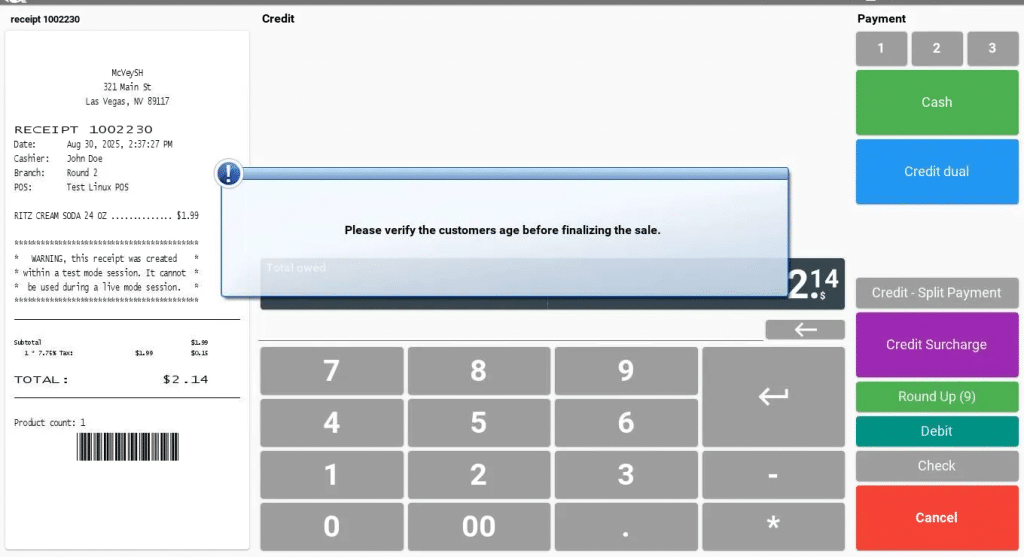
For purchase limit tracking, setting up customer records in KORONA with purchase history lets staff see a customer’s recent transaction data before completing a sale, which is particularly important for frequent visitors.
How Much Does It Cost to Open a Dispensary in New Mexico?
Startup costs for a New Mexico dispensary vary significantly based on location, buildout scope, and whether you are starting from scratch or converting an existing retail space. The ranges below reflect realistic estimates across these variables:
| Cost category | Estimated range |
|---|---|
| License application fee | $1,000 to $5,000 |
| Store buildout and fixtures | $30,000 to $150,000 |
| Security system (cameras, alarm, vault) | $10,000 to $40,000 |
| Opening inventory | $20,000 to $60,000 |
| POS system and compliance tech | $2,000 to $8,000 |
| Legal and consulting fees | $5,000 to $25,000 |
| Signage and branding | $3,000 to $10,000 |
| Working capital reserve | $30,000 to $100,000+ |
| Total estimated range | $100,000 to $400,000+ |
The license fee itself is relatively modest compared to other states, but the buildout, security system, and opening inventory are where most operators underestimate spend. Legal and consulting fees are also easy to minimize on paper and regret in practice. A cannabis attorney who knows New Mexico’s CCD and NM-PLUS application process is worth the investment.
PRO TIP!
Working capital deserves special attention. Many cannabis businesses operate in a cash-heavy environment because federal banking restrictions limit access to traditional merchant services. Budget for cash handling infrastructure, a safe, and potentially an armored transport service depending on your volume.
Taxes and Ongoing Compliance
New Mexico cannabis retailers pay two types of tax on adult-use sales:
- Cannabis Excise Tax: Currently 12% of the sales price, rising gradually to 18% by July 1, 2030. Medical cannabis patients and caregivers are exempt.
- Gross Receipts Tax (GRT): Applies to all cannabis sales including medical. Both taxes must be filed electronically through the Taxation and Revenue Department’s Taxpayer Access Point (TAP) portal.
Beyond taxes, two other ongoing compliance areas deserve attention:
- License renewal: Your renewal window opens 60 days before expiry and is triggered by an automated email. Your business must be in good standing with the Taxation and Revenue Department at renewal time.
- Packaging: All products must include warnings about potential adverse events, the New Mexico Poison Control hotline, and child-resistant packaging. Non-compliant labeling is grounds for product seizure. Build packaging compliance into your vendor selection process, not as a last check before shelving.
How Long Does It Take to Open a Dispensary in New Mexico?
Plan for six to twelve months from decision to opening day. Here is a realistic breakdown:
- Months 1 to 2: Business formation, location scouting, legal setup, business plan and social equity plan development.
- Months 2 to 3: Location secured, zoning approval obtained, application documents assembled.
- Month 3: NM-PLUS application submitted.
- Months 3 to 6: CCD review period (90 days from complete application).
- Months 6 to 9: License approved, store buildout begins, security system installed, staff hired and trained.
- Months 9 to 12: POS and compliance systems configured, soft opening, grand opening.
PRO TIP!
This timeline assumes a clean application with no revision requests from the CCD. A flagged or incomplete application can add two to three months. Build in buffer.
New Mexico Is Open for Cannabis Business. Come Prepared.
The opportunity in New Mexico is real: a growing market, no license cap, a tourism economy that drives foot traffic, and a regulatory environment that is structured to encourage new entrants rather than protect incumbents.
The operators who succeed in the long term are the ones who built compliant, well-run operations from the start, trained their teams properly, chose technology that enforced compliance automatically rather than relying on staff vigilance, and treated regulatory requirements as a foundation rather than an obstacle. Get those fundamentals right, and New Mexico is genuinely one of the better states in the country to build a dispensary business.
How to Open a Dispensary in New Mexico: FAQs
Can I apply for a New Mexico dispensary license if I have a prior cannabis conviction?
- You are not automatically disqualified, but it depends on the nature of the conviction. The CCD performs background checks on all controlling persons and can deny applications for felony convictions involving fraud, embezzlement, deceit, or involving a minor in drug sales. A prior cannabis possession or use conviction is generally less likely to disqualify you than a drug distribution conviction involving minors. If you have any relevant prior convictions, consult a cannabis attorney before applying.
Does New Mexico allow cannabis delivery, and do I need a separate license for it?
Yes, cannabis delivery is permitted in New Mexico, but it requires a separate Cannabis Courier License. You cannot deliver under your retailer license alone. The courier license covers transportation of cannabis products to authorized recipients. Payment cannot be collected at the point of delivery; transactions must be completed before the courier departs the licensed premises.
Can an out-of-state resident own a New Mexico dispensary?
- Yes. New Mexico does not require owners to be state residents, unlike some other cannabis states. However, all controlling persons must still pass background checks and meet the CCD’s eligibility requirements. If you are managing the business remotely or through a designated agent, make sure your operational plan reflects that clearly in your application, as the CCD evaluates whether applicants demonstrate sufficient business ability and experience to operate compliantly