

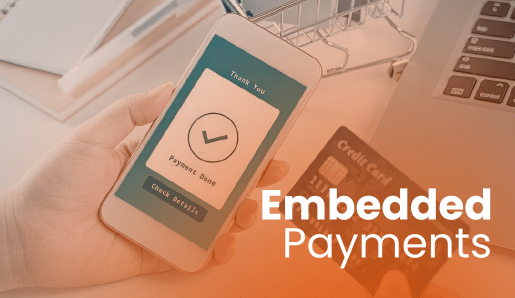
The global embedded payments market hit $24.7 billion in 2024 — and it’s growing at 30% a year. Here’s what that means for your business, and how to get ahead of it.
What Are Embedded Payments?
The term “embedded payments” means payment capability is built directly into a product or experience, so the transaction happens invisibly, without disrupting the customer.
When you take an Uber, for example, you get out of the car, and the payment has already happened. There’s no terminal, no redirect, and no receipt to sign. The payment was woven into the ride itself. That’s an embedded payment.
Why “Invisible” Is the Goal
The best checkout experience is one that the customer barely notices. When payments are embedded, friction at the point of sale disappears (and friction is exactly what’s killing conversions).
Nearly 70% of shopping carts are abandoned before checkout, according to the Baymard Institute. That’s an estimated $270 billion in lost sales every year.
The Numbers Behind the Trend
Embedded payments are one of the five megatrends J.P. Morgan identified as reshaping the global payments landscape, with current payment volumes of $1.1 trillion and growing rapidly.
Market Size at a Glance
| Metric | Figure |
|---|---|
| Global embedded payments market (2024) | $24.7 billion |
| Projected annual growth rate (2025–2034) | 30.3% CAGR |
| Global transaction volume (2024) | $1.1 trillion |
| Projected transaction volume by 2028 | $2.5+ trillion |
| US embedded payments market by 2032 | ~$30 billion |
Sources: GM Insights, Juniper Research, SNS Insider, J.P. Morgan POWER+ Framework
The Adoption Curve Is Already Steep
BCG research found that more than half of independent software vendors in North America now offer embedded payments in their platforms. Businesses that haven’t made the shift are already behind the curve.
Juniper Research puts the growth even more starkly: embedded payment transaction volume will more than double between 2024 and 2028.
Why Payment Friction Is a Revenue Problem
The Abandonment Crisis
Friction at checkout frustrates customers and directly eats into your bottom line. The data paints a clear picture.
- 70% of shopping carts globally are abandoned before purchase
- 61% of shoppers abandon when their preferred payment method isn’t available
- 21% bail because the checkout process feels too complicated
- 18% of US shoppers leave because checkout took too long
The Generational Urgency
Gen Z is twice as likely to abandon a cart rather than pay with a method they didn’t choose. And they’re not coming back. This means getting the payment experience right the first time is essential.
PRO TIP!
Stripe research shows one-click checkout can cut checkout time by 50% and improve conversion rates by up to 30% for returning customers.
What Embedded Payments Look Like at the Point of Sale
Embedded payments are transforming in-store retail, food service, ticketing, and hospitality right now. Here’s how:
Tap-to-Pay & Contactless
With contactless payments, customers tap a card, phone, or wearable. The transaction is complete before a cashier looks up. This method takes the debit PIN, swipe, and friction out of the equation.
Digital Wallets
Apple Pay and Google Pay are now the fastest-growing payment methods globally. Supporting them is baseline and no longer optional.
Loyalty + Payment in One Step
When loyalty programs are embedded in the POS, customers earn rewards and pay in a single action, eliminating the need for a separate app or a “did you find your account?” moment.
Split Payments & Flexible Plans
With embedded payments, customers split transactions across methods or set up payment plans on larger purchases, handled entirely within one system.
Self-Checkout & Kiosk Flows
With self-checkout, ordering and payment become one unified flow rather than two systems awkwardly connected. These tools lead to faster lines, lower labor costs, and happier customers.
Membership & Subscription Billing
For wineries, museums, gyms, or any recurring-revenue business, automatic billing runs in the background, eliminating manual processing and missed renewals.
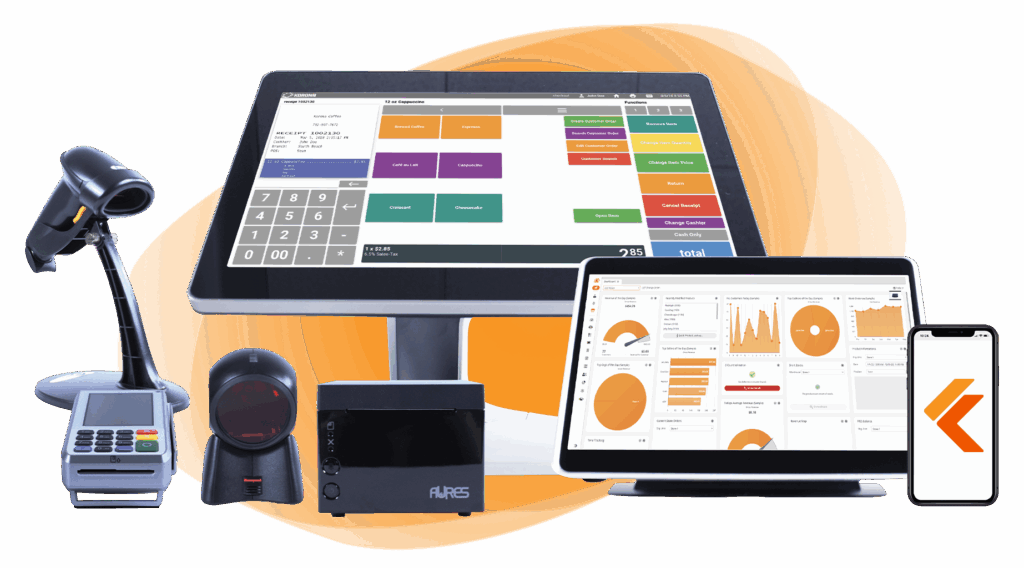
Build Your Own POS
Whether you run a retail store, café, or admissions booth, we have the point of sale hardware designed for your specific needs. Start building your ideal POS system now.
The Fragmentation Problem Most Retailers Don’t See
Most retail payment setups are more broken than they appear: a POS from one vendor, a payment gateway from another, hardware terminals from a third. On paper, it looks integrated, but in practice, it creates what NewStore calls a fragmentation tax.
In these situations, employees switch between apps, devices fall out of sync, and transaction data and order data live in different systems. The result is slower checkouts, failed payments, and reconciliation that consumes hours of staff time each week.
What True Embedded Payments Eliminate
When payments are native to your POS platform rather than bolted on, the seam disappears entirely. Transaction, order, and customer data all live in one place, in real time. That’s unified commerce in practice, and the direction every serious retailer is moving.
How KORONA POS Delivers Embedded Payments
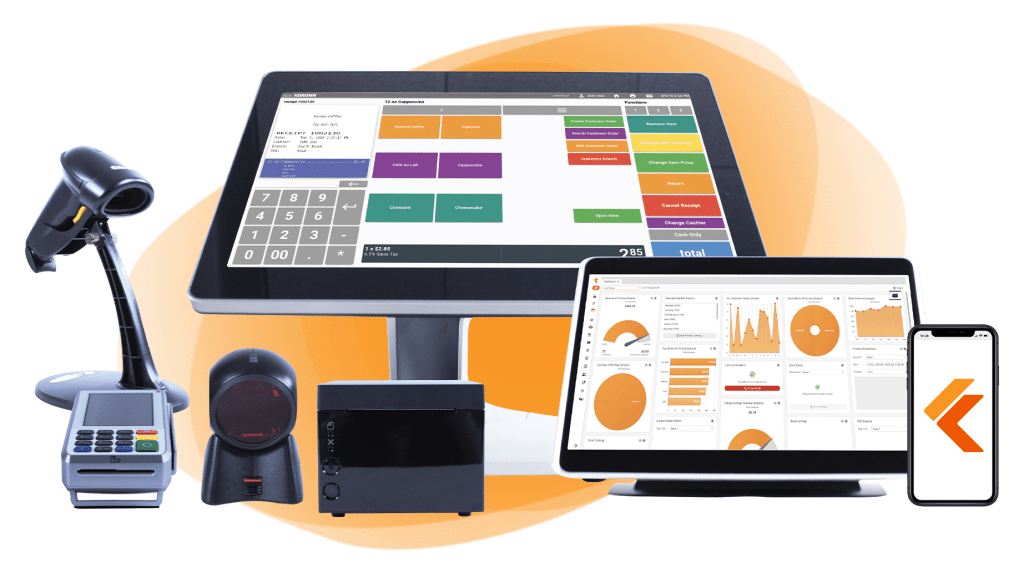
Most POS systems solve the payment problem by locking you in. They offer one processor, one set of rates, and one experience — take it or leave it. KORONA POS was built differently.
Payment Processor Freedom
Unlike Clover (locked to Fiserv) or Toast (locked to their own processor), KORONA integrates with virtually any payment processor via PAX or Dejavoo terminals. You can shop around for better rates, negotiate, and even switch altogether, all without changing your POS.
For any business watching margins, that flexibility alone pays for itself.
Payment processors giving you trouble?
We won’t. KORONA POS is not a payment processor. That means we’ll always find the best payment provider for your business’s needs.
Everything Modern Payments Requires
KORONA supports all of it, natively:
- EMV chip cards
- Contactless NFC payments
- Apple Pay & Google Pay
- Digital wallets & mobile payments
- Split payments across any method combination
- Custom payment plans for large transactions
- Gift cards — custom-designed and instantly redeemable
- Loyalty & CRM embedded directly in checkout
Real-Time Reporting Across Every Location
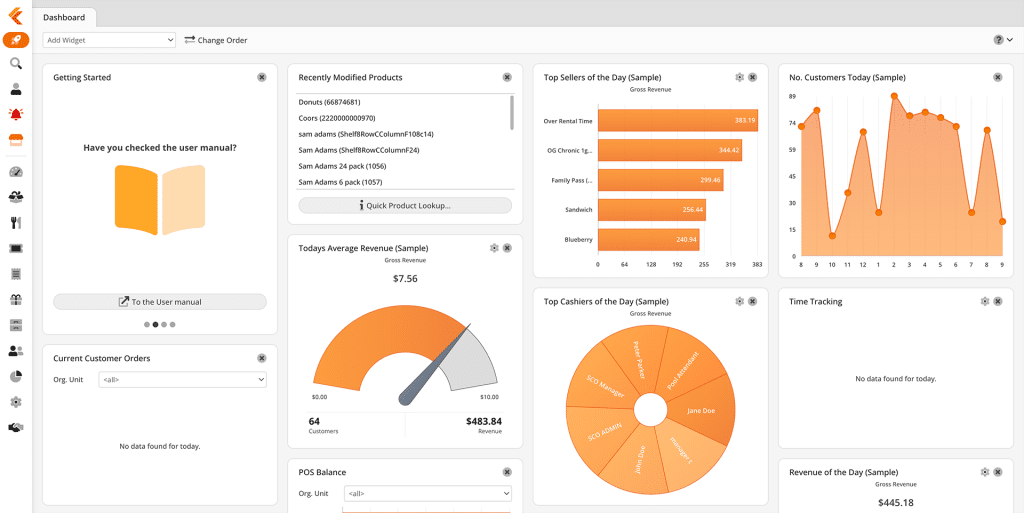
All payment data is unified in KORONA’s cloud-based back office, accessible from anywhere. Every transaction from every location lives in one dashboard, whether you’re running one store or fifty.
The convenience results in end-of-day reconciliation surprises. No data is living in disconnected systems.
Built to Evolve With Open API
The embedded payments landscape will continue to evolve. KORONA’s open API means you can integrate new payment tools, connect to eCommerce platforms, and build custom workflows without waiting on a vendor to catch up.
PRO TIP!
KORONA’s processor-agnostic model is especially valuable for high-risk merchants (liquor, vape, CBD) who need access to specialized processors that traditional locked-in systems won’t support.
Embedded Payments vs. Traditional POS Payments
| Traditional POS Payments | Embedded Payments (KORONA POS) | |
|---|---|---|
| Processor choice | Locked in | Any processor |
| Loyalty integration | Separate system | Built into checkout |
| Payment methods | Card only or limited | All modern methods |
| Reporting | Siloed by system | Unified, real-time |
| Self-checkout support | Rare | Native |
| Subscription billing | Manual | Automated |
| API access | Limited or none | Fully open |
The Bottom Line: Why Embedded Payments Are the Future of Retail POS
Get started with KORONA POS today!
Explore all the features that KORONA POS has to offer with an unlimited trial. There’s no commitment or credit card required.
Payments are a customer experience, a retention tool, and a growth lever. The businesses that win the next decade will be the ones that make paying feel effortless. Embedded payments are how you get there. KORONA POS is built to deliver exactly that.
Ready to See It in Action?
Start your free trial of KORONA POS today. You’ll get no contracts, no long-term commitments, and 24/7 US-based support from day one.