

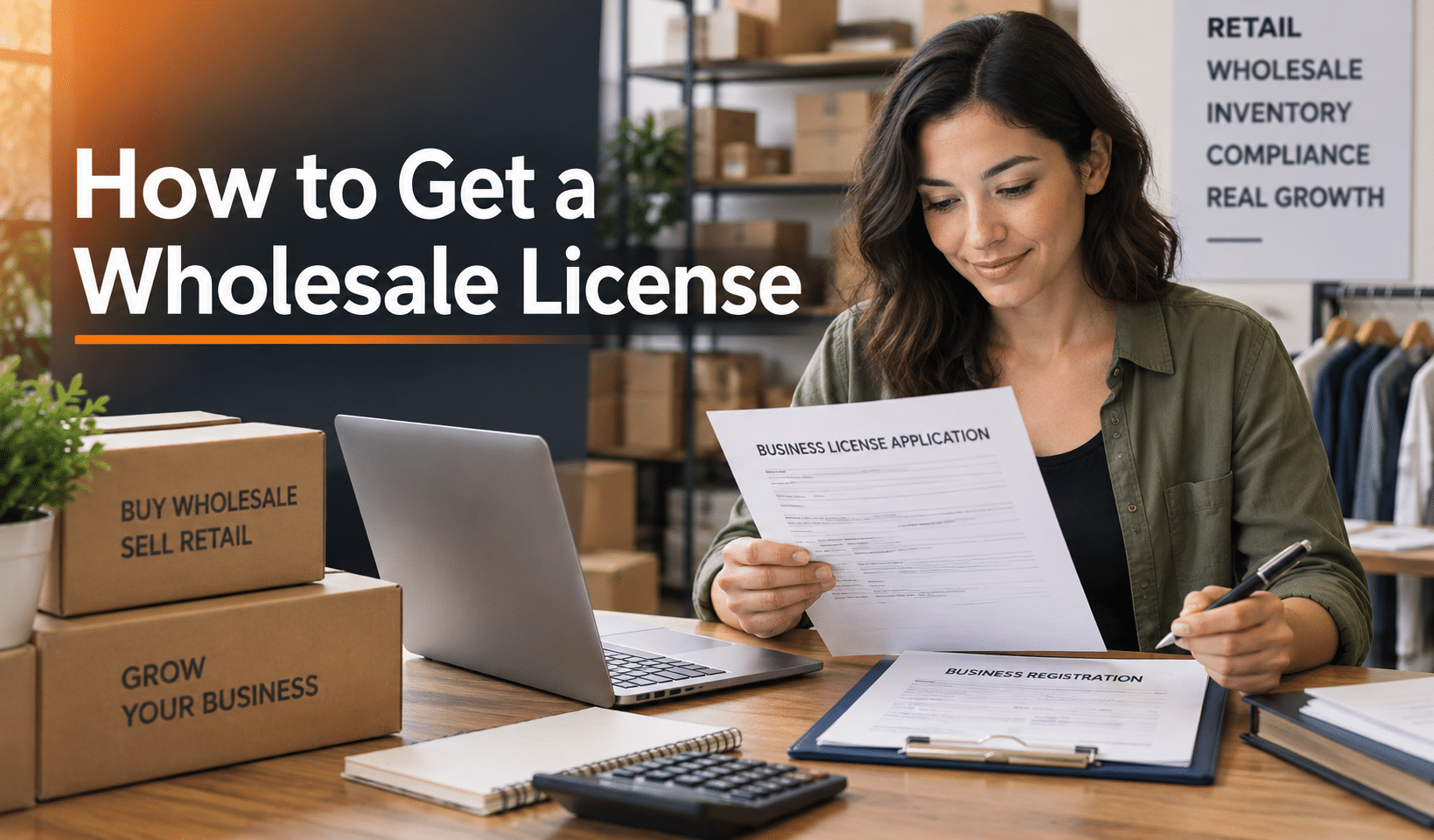
A wholesale license lets a retailer buy inventory at lower prices and skip sales tax on goods bought for resale. Most owners picture one complicated form, but the real process breaks down into business registration, an EIN, and a state resale permit.
The guide below covers how to get a wholesale license step by step, what liquor, vape, and CBD retailers need beyond the basic permit, what the license actually costs in 2026, how resale certificates work across state lines, and when a license needs renewal.
Key Takeaways:
- A wholesale license is usually a resale or seller’s permit under a different name, not a separate document.
- Three steps cover most of it: register the business, get an EIN, then apply for a state sales tax permit.
- Liquor, vape, and CBD retailers need extra licensing that the base permit doesn’t include.
- Cost ranges from free in many states to thousands of dollars for regulated products like alcohol.
What is a Wholesale License?
A wholesale license is, in nearly every state, a resale or seller’s permit by another name rather than a distinct document you apply for separately. States call it different things, including a wholesale license, a resale certificate, or a seller’s permit, but they all serve the same core purpose.
The permit tells suppliers and tax authorities that a business buys inventory to resell, not to keep for personal use, so it can buy wholesale without paying sales tax at the register.
Once a retailer holds this permit, a supplier or wholesaler can sell to the retailer tax-free, and the retailer instead collects sales tax when the item finally sells to a customer. That single shift is why suppliers, distributors, and manufacturers ask for a copy before they will open a wholesale account.
Not having this permit does not just delay the first bulk order. It also means a retailer pays sales tax on every wholesale purchase up front, which chips away at the margin buying wholesale is supposed to create.
Wholesale License vs. Seller’s Permit vs. Resale Certificate
A seller’s permit, resale certificate, and wholesale license are usually the same document under three different names, and which term applies depends entirely on the state. A few states also call it a vendor permit, resale card, or reseller license, so the paperwork looks different from state to state, even though the function stays identical.
California illustrates the confusion well. The state does not issue anything called a wholesale license; what a California retailer needs is a seller’s permit from the California Department of Tax and Fee Administration, and “wholesale license” is simply the informal name people use for it locally.
Because the terminology changes by state, the safest approach is to search a state’s tax authority site for “seller’s permit” or “resale certificate” instead of “wholesale license,” since that’s the language the actual application will use.
Retailers also generally need additional licenses beyond this permit, and which ones apply depends on the state, city, and industry, so it’s worth confirming the full list with a state’s tax office before assuming the resale permit alone covers everything.
Wholesale Licensing For Regulated Retail (Liquor, Vape/Tobacco, CBD, Convenience)
Liquor stores, tobacco and vape shops, and CBD retailers carry licensing requirements the standard resale permit alone doesn’t cover.
Buying inventory wholesale in these categories means the resale permit is only the entry ticket. The products themselves are separately regulated, and skipping that layer can shut a supplier relationship down before it starts.
Liquor and Alcohol Wholesale Purchasing
A liquor store buying alcohol wholesale needs a state liquor license first, since opening a liquor store always starts with that license before any wholesale account gets approved.
Purchasing then usually flows through a three-tier distribution system instead of a direct wholesaler relationship, and wholesalers who purchase and resell beverage alcohol also need a federal wholesaler’s permit from the Alcohol and Tobacco Tax and Trade Bureau (TTB) before a supplier will ship product.
State fees for the alcohol wholesaler tier vary widely. In New Mexico’s fee schedule, for example, a wholesaler’s license to sell all alcoholic beverages for resale costs $2,500 a year, while a wine-only wholesaler license runs closer to $750.
Tobacco and Vape Retail Licensing
A vape or smoke shop typically needs a state tobacco retailer license in addition to its resale permit. Anyone opening a vape shop for the first time should also expect a growing number of states to add a vapor-specific license on top of that requirement.
West Virginia is a recent example: its 2026 Vape Safety Act requires vape and smoke shops to hold a dedicated state license, with an annual license fee of $1,200. Retailers should check whether their state treats vape products as tobacco, as a separate regulated category, or both, since the answer changes what a supplier will ask for before opening an account.
CBD and Hemp Product Licensing
CBD and hemp product retailers face the widest state-by-state variation of any category here, and it keeps shifting: several states have tightened hemp retail rules within the last year alone.
Some states require no retail-specific license at all beyond the resale permit, while others require a dedicated registration or product-level approval before a retailer can stock hemp-derived goods, a process this guide to getting a license to sell CBD walks through in more detail.
A state-by-state compliance guide is a good starting point before placing a first wholesale hemp order, but confirm current requirements directly with the state’s health or agriculture department, since guides like this one can lag behind new rules.
Convenience stores often stack several of these requirements at once, since a single location may sell tobacco, alcohol, and CBD side by side, which is why anyone opening a convenience store should map out licensing for each category before signing a lease.
Confirming each category’s licensing separately, as opposed to assuming one resale permit covers the whole shelf, avoids a supplier declining an order over missing paperwork.
Steps to Getting Your Wholesale License
Getting a wholesale license comes down to three core steps almost everywhere: register the business, secure a sales tax permit, and apply for the resale license itself. Application fees and exact procedures shift from state to state, but the underlying order stays the same.
Step 1: Register Your Business And Apply For an EIN
Registering the business legally is the first step toward a wholesale license. That means choosing a name and a legal structure, such as a sole proprietorship, partnership, corporation, or LLC, since the choice affects the taxes a business owes and the paperwork ahead. Many owners loop in an attorney before filing.
Once the business is registered, applying for a federal Employer Identification Number, or EIN, comes next. The IRS issues EINs online immediately after a business completes the application, typically in about fifteen minutes, while a mailed application takes roughly four weeks to process.
Step 2: Get a Sales Tax Permit or ID
A sales tax permit lets a retailer collect sales tax on the goods it sells, and most states require it before they will issue a resale certificate.
Cost and process both vary by state: many states, including California and Texas, issue this permit for no charge, while others charge a modest registration fee or ask for a refundable security deposit tied to expected sales volume.
Step 3: Apply For Your Wholesale License
Applying for the wholesale license itself is the final step, and it happens only after the EIN and sales tax permit are both in hand.
Requirements vary by state, but most applications ask for the same core details: the business’s legal name and DBA, the names of any partners or officers, and a description of what the business sells.
Processing time ranges from a few business days in some states to two or three weeks in others, so applying early is smarter than waiting until a supplier deal is ready to close.
Using Your Resale Certificate in Other States
A resale certificate does not automatically work in every state, so a multi-state retailer needs to check before assuming coverage.
Most states will honor a resale certificate issued by another state, but roughly a dozen states, including California, Florida, and Massachusetts, require an out-of-state business to register locally and obtain that state’s own certificate before buying tax-free there.
Checking a list of holdout states before sourcing inventory or opening a location in a new state can save a business from an unwelcome sales tax bill.
For a retailer expanding into one of these states, the fix is straightforward: register for that state’s sales tax permit, then use the resulting in-state certificate for purchases made there.
Skipping this step usually means paying sales tax upfront and filing for a refund later, which slows down cash flow more than the registration itself would.
How Much Does a Wholesale License Cost?
A standard wholesale or resale permit costs little to nothing in most states, while regulated licenses for products like alcohol or vape can run into the thousands.
More than half the states that charge sales tax issue this base permit for free, and the rest generally charge somewhere between $10 and $100, sometimes alongside a refundable security deposit tied to expected sales volume.
The math changes fast once a product falls under extra state oversight. A liquor wholesaler license alone can run from several hundred dollars to several thousand depending on the state and the type of alcohol sold, and a vape or tobacco retailer may face a state license fee in the four figures on top of the standard resale permit.
A retailer’s real cost, then, depends far less on the word “wholesale” and far more on what it plans to sell.
Budgeting for a wholesale license should account for three separate line items: the EIN (free), the sales tax permit (often free, sometimes up to $100), and any product-specific license the state or industry requires. Skipping ahead to apply for the third without the first two in place is the most common reason applications get rejected outright.
Renewing or Updating Your Wholesale License
Most resale permits stay active as long as a business files its sales tax returns, though a few states require renewal every one to five years.
A missed renewal, even for a business that owes zero tax that period, can flag the permit as inactive and interrupt tax-free purchasing until it’s reinstated.
Beyond scheduled renewal, a few events should trigger an update regardless of state: a change in business address, a new legal entity type, or expansion into a state where the business has not previously registered.
Any of these usually means filing an amendment or a brand-new application, since the original permit rarely covers the new situation automatically.
Optimize Your Inventory With The Best Retail Inventory Management Software
Obtaining a wholesale license will allow you to buy in bulk from suppliers at reduced prices. Once the products are purchased, you will need to handle inventory management, a critical aspect of a successful retail business.
Good inventory management avoids excess inventory or stock-outs. For this, investing in inventory management software is a must to keep track of your stocks and know when to order products from suppliers or manufacturers.
KORONA POS gives retail businesses the tools to manage inventory without the guesswork. The software provides retailers with reorder levels, order cycles, shipment tracking, ease of receiving, inventory management notifications if you run out of stock, and many more.
Speak with a product specialist and learn how KORONA POS can power your business.
FAQs: How to Get a Wholesale License
Can I Buy Wholesale With a Seller’s Permit?
Yes, in most states a seller’s permit functions as the wholesale license suppliers ask for. Terminology shifts by state, so check with your state’s revenue department to see which document it actually requires before assuming your permit alone qualifies you.
Can Anyone Buy From a Wholesaler?
No, only businesses holding a valid resale or wholesale permit can buy from most wholesalers. Most wholesalers avoid selling small quantities to individual consumers because it isn’t profitable, so someone without a business permit needs to shop at a warehouse club or bulk retailer instead.
What Do You Need to Buy Wholesale?
You need a resale or wholesale permit before most suppliers will sell to you. That process means registering your business, applying for a federal EIN, and obtaining a state sales tax permit first, then filing the permit application with your state’s tax agency.
Do I Need a Seller’s Permit to Sell Online?
Yes, most online sellers need a seller’s permit if the products they sell are subject to sales tax. States require the permit whether a business operates from a storefront or only online, and most wholesale suppliers won’t open an account without proof of one.
Does a Wholesale License Expire?
Not usually. Most states let a resale permit run as long as the business keeps filing sales tax returns, though a handful set a fixed cycle of one to five years. The issuing agency can confirm the exact cycle, and a lapsed permit halts tax-free buying until it’s reinstated.