

Car Wash Revenue And Profit Estimator
Pick a wash type, adjust the numbers to match your site, and see revenue, operating profit, and owner take-home side by side.
Choose a Wash Type
Volume And Pricing
Operating Expenses as Percent of Revenue
Owner Costs And Financing
Your Three Numbers
Revenue
Operating Profit
Owner Take-Home
Where Each Revenue Dollar Goes
- Operating Expenses:
- Loan Payments:
- Manager Salary:
- Owner Take-Home:
Results by Period
| Line Item | Per Open Day | Per Month | Per Year |
|---|
Monthly figures equal the yearly total divided by 12. Daily figures equal the yearly total divided by days open.
Membership Cushion
Average Month
Winter Month
Change From Average
Estimates only. Presets are editable starting points chosen to sit inside the ranges published by HyTian Car Wash, Sharpsheets, Neo Advisory, and MMCG Invest. Ticket prices, expense mixes by format, and loan terms are illustrative assumptions, not benchmarks. Expense hints come from Sharpsheets franchise data, and formats such as self-service and mobile sit outside them. Taxes and depreciation are excluded, and margin definitions differ between sources.
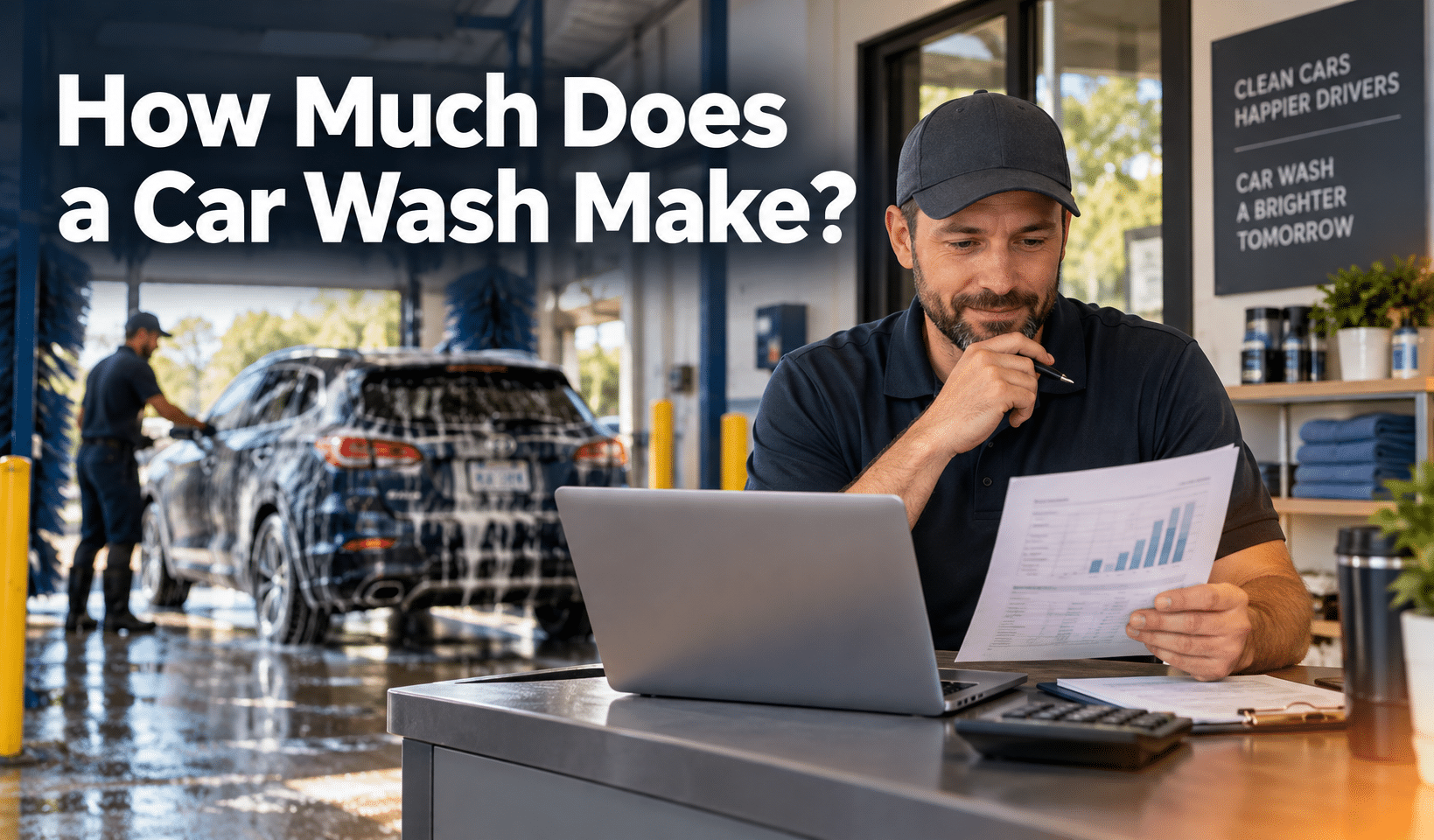
How much does a car wash make? It depends on the type. A small self service site may bring in about $41,000 a year, while a busy express tunnel can pass $2 million.
Revenue is not profit, because rent, labor, chemicals, and loan payments come out first. Below, you will find income ranges for each car wash type, typical profit margins, daily and monthly estimates, the role of memberships, and the costs that decide what an owner keeps.
Key Takeaways:
- Yearly revenue spans $41,000 at a self service site to $2 million or more at a high volume express tunnel.
- Revenue, operating profit, and owner take home are three separate numbers, and most published figures blur them.
- Express tunnels post the strongest margins, and unlimited memberships supply a big share of their revenue.
- Labor, chemicals, utilities, and rent follow predictable percentages, so you can estimate a site’s profit before it opens.
- Startup cost and payback time decide whether a high revenue figure is worth chasing.
Quick Answer: What a Car Wash Makes by Type
Revenue lands between $41,000 and more than $2 million a year, depending on the wash format. Margins span 15% to 60%, topping out at self-service sites and bottoming out at full-service ones. Published figures disagree, so the table below gives ranges.
| Car wash type | Annual revenue | Profit margin | Membership potential |
|---|---|---|---|
| Self-service | $41,000 to $80,000 per location | 40% to 60% | Limited |
| In-bay automatic | $80,000 to $250,000 per bay | 25% to 50% | Moderate |
| Express exterior tunnel | $700,000 to $3 million per site | 35% to 50% EBITDA | Very high |
| Full-service and flex-service | $250,000 to $900,000 per site | 15% to 30% | Partial |
| Mobile | $75,000 to $250,000 per business | 30% to 50% | Varies |
Sources define margin in different ways (EBITDA, operating, or net), which limits comparisons between rows. The figures draw on Sharpsheets’ 2024 franchise data, HyTian Car Wash’s 2026 benchmarks, Neo Advisory’s 2026 sector overview, and MMCG Invest’s July 2026 industry analysis. Each is one outfit’s estimate, so read the ranges as ballparks.
A flat market will not lift every site. IBISWorld puts 2026 U.S. car wash and auto detailing revenue at $17.0 billion, down 0.4% a year since 2021, while MMCG Invest estimates $19.2 billion and projects flat to slightly lower revenue through 2031. Scope explains the gap, since estimates differ on whether detailing counts.
Demand for professional washing stays strong: the International Carwash Association reported that 79% of drivers washed most often at a professional location in 2023, and its Q4 2024 Pulse survey found 73%. Results hinge on how well a site converts those drivers into customers.
Revenue Versus Profit Versus Owner Income
Revenue is the total customers pay, operating profit is what remains after running costs, and owner income is what the owner keeps after loan payments and a fair wage for the work. Published car wash numbers frequently blend the three, so two articles can answer the same question with very different figures.
Revenue
Revenue tallies all income from wash sales, memberships, vacuum fees, and add-ons before any bill gets paid. Easy to find, it tells little about what an owner earns.
Operating Profit
Operating profit is revenue less labor, chemicals, utilities, rent, insurance, and marketing. EBITDA comes out higher, since depreciation, interest, and taxes fall below that line.
MMCG Invest places the industry-average operating margin at 14.1%. Sharpsheets’ franchise data lists operating margins from 14% to 26%, and seasoned express operations record four-wall EBITDA margins of 35% to 50%.
Owner Income
Owner income starts from operating profit, then subtracts debt service and the cost of the labor the owner performs or hires out.
Picture a site grossing $1,000,000 at a 35% EBITDA margin: operating profit comes to $350,000. After $150,000 in annual loan payments and a $60,000 manager salary, the owner keeps $140,000. These numbers are illustrative, not benchmarks.
Owner-Operator Versus Absentee Owner
Working the site yourself saves the manager salary at the cost of your own time. An absentee owner hires that manager and pockets less each year, so one car wash yields different personal income under each arrangement.
That answers the common question about owner pay. A self-service operation grossing $41,000 to $80,000 at a 40% to 60% margin keeps an estimated $16,000 to $48,000 before debt.
An express tunnel grossing $1.5 million to $3 million at a 35% to 50% margin keeps $525,000 to $1.5 million at the site level, and debt service still comes out of that sum.
Car Wash Income by Type
Throughput, ticket price, and staffing needs set each format’s income. Five formats follow, ordered from lowest revenue to highest.
Self-Service Car Wash
Self-service locations bring in $41,000 to $80,000 a year, and Neo Advisory and Sharpsheets data put their margins at 40% to 60%. Drivers spend 10 to 15 minutes washing their own vehicles, which limits how many cars a bay can serve. Minimal staffing preserves the margin.
Owners with spare land and operators in rural or suburban markets with few automatic options get the best fit. The format is also ceding share to automated washes and offers little membership potential, Neo Advisory adds.
In-Bay Automatic Car Wash
Each in-bay automatic bay generates $80,000 to $250,000 yearly at margins of 25% to 50%, depending on which source you trust.
The car sits still while the equipment travels around it, and HyTian Car Wash lists a $10 to $15 ticket. A bay can run unattended for long stretches, which is why gas stations and convenience stores install them.
One widely repeated estimate, $139,000 in revenue and $86,531 in profit, comes from industry statistics published circa 2017 and a $6.34 average sale, so it no longer reflects current pricing.
Express Exterior Tunnel Car Wash
Express exterior tunnels generate $700,000 to $3 million a year per site and deliver EBITDA margins between 35% and 50% at maturity. Older articles label them exterior conveyor washes.
Vehicles ride a conveyor through the tunnel with customers inside, and HyTian says a busy location handles 200 or more cars a day.
Mature revenue reaches $1.5 million to $3 million in MMCG Invest’s analysis, with break-even for a leveraged new build at 120 to 180 cars daily.
Mister Car Wash illustrates the scale: it reported $1.05 billion in 2025 revenue across 548 locations, or $1.9 million per location on average.
Equipment performs most of the work, which holds labor to 17% to 25% of revenue. No other format matches express tunnels on memberships, covered further down.
Full-Service And Flex-Service Car Wash
Full-service washes book $500,000 to $900,000 in annual revenue, while heavy labor squeezes margins to 15% to 30%. After the exterior pass, staff vacuum, clean the interior, dry, and detail by hand.
Older articles sometimes label the $500,000 to $900,000 range as profit; Sharpsheets classifies it as revenue.
Flex-serve sites combine an express exterior wash with optional interior service and report $250,000 to $400,000 yearly, according to HyTian.
New builds cost $500,000 to $5 million, and Neo Advisory calls the format labor-intensive.
Mobile Car Wash And Detailing
Mobile washing pulls in $75,000 to $250,000 annually at 30% to 50% margins, per Sharpsheets. A van, water supply, and cleaning products stand in for land and a building, keeping startup cost well under that of a fixed site. One crew can reach only so many vehicles in a day, which caps income, and detailing packages lift the ticket per vehicle.
Franchise operators with several vans fare better: 2024 disclosures show median revenue of $664,000 at Spiffy and $308,000 at Fleet Clean USA.
How Much Does a Car Wash Make Per Day, Per Month, And Per Year?
Multiply cars washed daily by the average ticket for daily revenue, then by days open for the annual total. Divide that total by 12 for a monthly figure.
| Example | Cars per day | Average ticket | Revenue per day | Revenue per month | Revenue per year |
|---|---|---|---|---|---|
| In-bay automatic, one bay | 60 | $10 | $600 | $18,250 | $219,000 |
| Express exterior tunnel | 300 | $15 | $4,500 | $136,875 | $1,642,500 |
The examples rely on round assumptions and a 365-day year. Neither is a measured average.
Self-Service And Full-Service Estimates
At $41,000 to $80,000 a year, a self-service wash collects an estimated $3,400 to $6,700 monthly, or $110 to $220 daily. A full-service site at $500,000 to $900,000 a year works out to $41,700 to $75,000 monthly and $1,400 to $2,500 daily.
Why Daily Numbers Swing
Weather is the strongest short-run demand variable in MMCG Invest’s view, so a storm can empty a lot that was full the day before. Planning with monthly and seasonal averages keeps one slow day from driving decisions.
How Memberships Change What a Car Wash Makes
At established express tunnels, unlimited memberships account for 40% to 75% of revenue, converting weather-dependent sales into predictable monthly income.
That range comes from Neo Advisory, and Mister Car Wash demonstrates it: the Unlimited Wash Club made up 79% of wash sales in the fourth quarter of 2025 and 76% in the first quarter of 2026, with approximately 2.5 million members.
Why Recurring Revenue Matters
Subscribers pay monthly in sunshine or storms. Plan prices differ by market and tier, so the example below assumes a $35 average. HyTian reports winter dips of 30% to 40% in pay-per-wash traffic at many sites, while membership income holds steady and covers fixed costs.
Membership Revenue Example
Take a location with 2,000 members at an average of $35: that is $70,000 a month, or $840,000 a year, before any non-member pulls in. The total clears the low end of the express tunnel range above, and Neo Advisory treats 2,000 active members as one marker separating stronger sites from weaker ones.
Retention And Churn
Retention drives the math. The International Carwash Association’s Q2 2026 Pulse report found 91% of subscribers planning to renew, yet stated intent outpaces actual behavior.
Monthly churn benchmarks at 7% to 8%, and top operators reach 5% to 6%, Neo Advisory reports. Holding churn at the low end lets a member base compound month after month. In-bay automatics can sell memberships as well, though at lower volume.
Car Wash Profit Margins And Operating Costs
Across the industry, operating margin averages 14.1%, whereas established express tunnels reach four-wall EBITDA of 35% to 50%. Sharpsheets’ 2024 review of 235 franchise businesses reports operating margins ranging from 14% to 26%. Self-service and mobile formats can exceed those levels on a much smaller revenue base.
Operating Costs as a Percentage of Revenue
Sharpsheets divides expenses into steady percentages of revenue. The table applies each range’s midpoint to a wash grossing $100,000 a month.
| Expense | Share of revenue | Example on $100,000 |
|---|---|---|
| Labor | 20% to 30% | $25,000 |
| Chemicals, water, and electricity | 10% to 20% | $15,000 |
| Rent and utilities | 5% to 10% | $8,000 |
| Administrative costs | 5% to 10% | $7,000 |
| Supplies and equipment upkeep | 2% to 5% | $3,000 |
| Marketing | 1% to 5% | $3,000 |
| Insurance | 1% to 3% | $2,000 |
| Training and miscellaneous | 2% to 6% | $4,000 |
| Total | $67,000 | |
| Operating profit | $33,000 |
That leaves a 33% operating margin ahead of loan payments, taxes, and depreciation. Sharpsheets also puts chemical cost at $0.64 per car.
What Raises or Lowers Margins
Uptime, chemical efficiency, staffing model, and membership retention explain the gap between the 14.1% industry average and the 35% to 50% that top express sites reach. A wash that goes dark during a rush forfeits revenue for good, and metered chemical dosing trims waste on each vehicle.
What Affects Car Wash Income
Beyond the wash type, four levers move income: location, weather, pricing, and marketing.
Location And Traffic
Traffic count, visibility, and easy entry determine how many drivers turn in. Express buyers should insist on 25,000 or more vehicles a day, Neo Advisory advises. International Carwash Association research, compiled by Kleen-Rite, found that 77% of customers discovered their go-to wash by driving past it. Weak visibility calls for bold roadside signage aimed at the ideal customer.
Seasons, Weather, And Natural Disasters
Rain slows a wash, while spring pollen and winter road salt bring drivers back. MMCG Invest names winter salt the most reliable wash trigger in the country. Hurricanes and earthquakes can shut a location for weeks.
Colder climates can see pay-per-wash traffic fall 30% to 40% in winter, so a cash reserve and a weather-based forecast prevent borrowing through lean months. Choosing a site outside disaster-prone areas lowers that exposure.
Pricing And Packages
Tiered pricing and add-ons lift the average ticket without adding cars. MMCG Invest attributes growth since 2023 mostly to price, through subscription tier increases and premium packages such as ceramic coatings, with volume playing a smaller part.
Vehicle size also moves the price, since a large SUV like the GMC Yukon Denali XL consumes more water, product, and time than a compact car. Basic, standard, and premium packages let customers pick their own spend.
Marketing
Marketing retains repeat customers and recruits new ones. Local search listings, reviews, social media, roadside signs, and membership promotions each earn their keep, and flyers or partnerships with neighboring businesses stretch reach cheaply.
Startup Costs And Payback Period
Opening costs start at $150,000 for a self-service site and climb to $4 million to $8 million for a new express tunnel. Land, construction, and equipment take the largest share, with permits, licenses, and starting supplies behind them.
| Car wash type | New-build capital cost |
|---|---|
| Self-service | $150,000 to $1 million |
| In-bay automatic | $150,000 to $3.5 million |
| Full-service | $500,000 to $5 million |
| Express exterior tunnel | $5 million to $8 million |
Neo Advisory supplies those ranges, and MMCG Invest places an all-in express build at $4 million to $8 million, with land as the biggest swing factor. Automatic equipment by itself costs $15,000 to more than $350,000, according to HyTian.
Divide total investment by annual operating profit to get the payback period. Neo Advisory cites 3 to 5 years for well-sited express tunnels, though plain division shows how sensitive that answer is: a $5 million build earning $700,000 a year (a $2 million site at a 35% margin) needs 7 years before financing costs.
A $150,000 self-service site earning $40,000 annually pays itself off in under four years. Both examples are illustrative, and loan interest plus slow seasons stretch the timeline.
How to Track Car Wash Income With a POS System
A point of sale system reveals what a car wash earns by logging each sale and sorting results by day, service, and location. Four numbers expose problems early: washes per day, average ticket, membership count, and revenue by service.
KORONA POS is designed for retail, not car wash operations, so wash tunnels, bays, and membership billing belong in software built for them. Owners who run a wash next to a convenience store can still use KORONA POS to track the store side of the business.
Because the system is cloud-based, sales data stays available from any location. Reporting and analytics then highlight which products and hours earn the most, so owners can see how much the store adds to the wash’s income.
Speak with a product specialist and learn how KORONA POS can power your business.
Frequently Asked Questions
How Profitable is a Car Wash Business?
Profitability varies by format. The industry averages a 14.1% operating margin, and well-run express tunnels clear 35% to 50% EBITDA. Annual revenue ranges from $41,000 at a small self-service location to over $2 million at a busy tunnel, and site quality, climate, and membership volume decide where a given wash lands.
How Much Capital is Needed to Start a Car Wash?
Budgets begin at $150,000 for self-service and reach $5 million to $8 million for an express tunnel, per Neo Advisory. An automatic system’s equipment alone costs $15,000 to more than $350,000. Land and construction drive the totals at the top end.
How Much Does a Car Wash Make Per Day?
Self-service locations gross $110 to $220 daily. Sixty in-bay cars at $10 yield $600, while 300 express cars at $15 bring in $4,500. Cars washed times average ticket works for any site.
How Much Does a Car Wash Make Per Month?
A self-service operation grosses $3,400 to $6,700 monthly, and the express tunnel in the earlier example reaches $136,875. Full-service sites collect $41,700 to $75,000 monthly. Profit then follows each format’s margin.
What is The Profit Margin of a Car Wash?
Margins span 15% to 60% by format: self-service 40% to 60%, mobile 30% to 50%, in-bay automatic 25% to 50%, and full-service 15% to 30%. Express tunnels at maturity reach 35% to 50% EBITDA. Definitions differ between sources, so compare cautiously.
How Long Does it Take For a Car Wash to Pay For Itself?
Express tunnels in strong locations pay back in 3 to 5 years, per Neo Advisory, while a small self-service wash costing $150,000 and netting $40,000 annually recovers that outlay within four years. The calculation is total outlay over yearly operating profit, and slow seasons or loan interest add time.
What Are The Downsides of Owning a Car Wash?
Weather swings, equipment breakdowns, staffing headaches, and nearby competitors top the list. Rain and cold suppress traffic, a stalled conveyor or bay halts income, and rival washes chase the same drivers. Money in reserve and a loyal member base cushion all four.