

Helcim Payment Processing Calculator
Enter a typical month of card sales to estimate your Helcim fees and see where the money goes.
Your Store
Total card sales in a typical month. Helcim sets your pricing tier from a three-month average.
Used to estimate how many transactions you process each month.
Sales typed in by hand or taken online. Helcim applies a higher margin to these.
Helcim adds a 0.10% plus $0.10 network fee to each American Express transaction.
Tap to Pay on iPhone adds $0.10 to each transaction.
A starting estimate. Your processing statement shows the real figure. Helcim’s own calculator implies about 1.4% for Visa, Mastercard, and Discover at a $300 ticket, and smaller tickets usually run higher.
Helcim charges $15 for each chargeback you lose.
Hardware And Data
Estimated Monthly Cost With Helcim
Enter a monthly card volume and an average sale to see your estimate.
$0
- Effective rate
- 0%
- Cost per transaction
- $0
- Annual processing cost
- $0
Cost Breakdown
Hardware And Data, Year One
Estimates for planning only. Rates were checked in October 2026 against Helcim’s pricing page and Helcim’s American Express rates page. Helcim restricts some product categories, including remote vape and tobacco sales, so confirm eligibility before you apply.
Helcim Payment Processing charges the card networks' wholesale rate plus a small margin that Helcim publishes openly.
There is no monthly account fee and no contract. Before you sign up, two questions matter: will the pricing beat a flat rate, and will Helcim approve your products?
The sections below explain how the fees work, what costs sit outside the margin, and what Helcim offers retail stores.
You will also see where it falls short, which business types it restricts, how it compares with Square, how it pairs with a POS system, and answers to common questions.
Key Takeaways:
- Helcim charges the wholesale card cost plus a published margin that starts at 0.40% and $0.08 on in person sales.
- Helcim has no monthly or cancellation fees, but hardware, Tap to Pay, Amex sales, and lost chargebacks cost extra.
- Square's flat rate runs higher than Helcim on in person sales at moderate volume, and low-dollar sales shrink the gap.
- Helcim bars online vape orders, remote tobacco sales, paraphernalia, and cannabis businesses based in the US, so liquor and CBD stores need to verify approval first.
What is Helcim Payment Processing?
Helcim payment processing is a card-acceptance service from Helcim, a Calgary-based payments company that opens merchant accounts for businesses in the United States and Canada.
Merchants accept credit cards, debit cards, and bank payments through one account, priced on an interchange-plus model with no monthly account fee.
The account handles Visa, Mastercard, American Express, Discover, and US PIN debit, per the card brands listed on Helcim's interchange page.
Who Uses Helcim
Small and midsize businesses make up Helcim's customer base. Its industry pages span retail stores, restaurants, healthcare practices, home services, and professional firms, a mix that places a retailer alongside many other kinds of merchants.
Processor First, POS Second
Helcim began as a payment processor, and a Merchant Maverick review dates its serious push into point-of-sale software to 2021. Retailers get a clearer view by weighing the processing account and the POS tools as two separate decisions.
How Helcim Pricing Works
Helcim bills interchange plus a published margin on all card transactions, and that margin shrinks automatically as monthly card volume grows.
Interchange-Plus Pricing Explained
Interchange-plus pricing splits each card fee into two parts: the wholesale cost set by the card networks, and the processor's own margin.
All processors pay the same wholesale cost for a given card; the margin is the sole piece that differs between providers.
The wholesale portion, which KORONA breaks down in its explainer on interchange fees, depends on the card type, the card brand, how the card is entered, the merchant category, and fraud risk.
A chip, tap, or PIN sale costs less than a keyed or online sale, since the card is physically present. Card networks usually update their schedules in April and October.
Flat-rate processors apply one blended rate to all cards: a low-cost debit card pays the same as a premium rewards card. Under interchange-plus, the debit card carries a lower fee, and Helcim notes that the biggest gains go to debit-heavy businesses.
Volume Tiers For In-Person And Online Sales
Helcim's margin falls across five tiers, from interchange plus 0.40% and $0.08 on in-person sales at the entry level to interchange plus 0.15% and $0.06 between $1 million and $5 million in monthly volume. The table lists each tier, as published on Helcim's pricing page.
| Monthly card volume | In-person margin | Keyed and online margin |
|---|---|---|
| $0 to $50,000 | Interchange + 0.40% + $0.08 | Interchange + 0.50% + $0.25 |
| $50,000 to $100,000 | Interchange + 0.35% + $0.07 | Interchange + 0.45% + $0.20 |
| $100,000 to $500,000 | Interchange + 0.25% + $0.07 | Interchange + 0.35% + $0.20 |
| $500,000 to $1 million | Interchange + 0.20% + $0.06 | Interchange + 0.25% + $0.15 |
| $1 million to $5 million | Interchange + 0.15% + $0.06 | Interchange + 0.15% + $0.15 |
Helcim sets the tier from the average of the last three months of card volume and applies it automatically; a slow month leaves the rate untouched.
Merchants above $5 million per month receive custom pricing. Keyed and online margins sit higher: card-not-present sales carry more fraud risk.
A Worked Retail Example
A Documented Example: The $500 Transactions
On $30,000 in monthly card-present sales across 500 transactions, Helcim's margin comes to $160 before interchange.
The arithmetic: 0.40% of $30,000 is $120, and 500 sales at $0.08 each add $40. Those figures assume an average ticket of $60 and the entry tier, as volume stays under $50,000.
Square's Free plan, by comparison, runs 2.6% plus $0.15 per in-person sale, according to Square's fees page.
On the same volume, that is $780 plus $75, or $855 in total. KORONA's breakdown of Square transaction fees covers the other plan tiers and keyed rates behind that figure.
Helcim's total equals $160 plus interchange and network fees. Helcim comes out ahead whenever those wholesale costs stay below $695, or 2.32% of volume.
Helcim reports that typical in-person merchants pay close to or under 2%, against an effective 2.85% for Square in this example. Treat the example as an illustration; actual cost depends on card mix.
Costs Beyond The Processing Margin
Helcim charges no monthly account, signup, PCI, statement, or cancellation fees, but hardware, Tap to Pay, recurring billing, chargebacks, and ACH returns carry their own costs.
The margin alone is not the all-in rate: interchange and network fees arrive with each sale.
The $0 PCI line means Helcim bills nothing for the annual self-assessment, and the retailer still owns the broader PCI compliance responsibilities for its store.
Hardware And Add-On Fees
The charges below come from Helcim's pricing page, and KORONA's guide to credit card machine costs adds the wider market view of terminal pricing:
- Helcim Smart Terminal: $349 per unit plus shipping, or $32 per month on a one-year plan.
- Helcim Card Reader: $199 per unit plus shipping.
- Tap to Pay on iPhone: $0.10 added per transaction.
- 4G wireless data: $7 per month, optional, for locations without Wi-Fi.
- Recurring payments: 0.4% added per transaction.
Helcim states that it does not lease equipment, a policy that spares merchants the lease contracts some other providers attach to terminals. Those contracts are where early termination fees usually appear; Helcim imposes no cancellation fee at all.
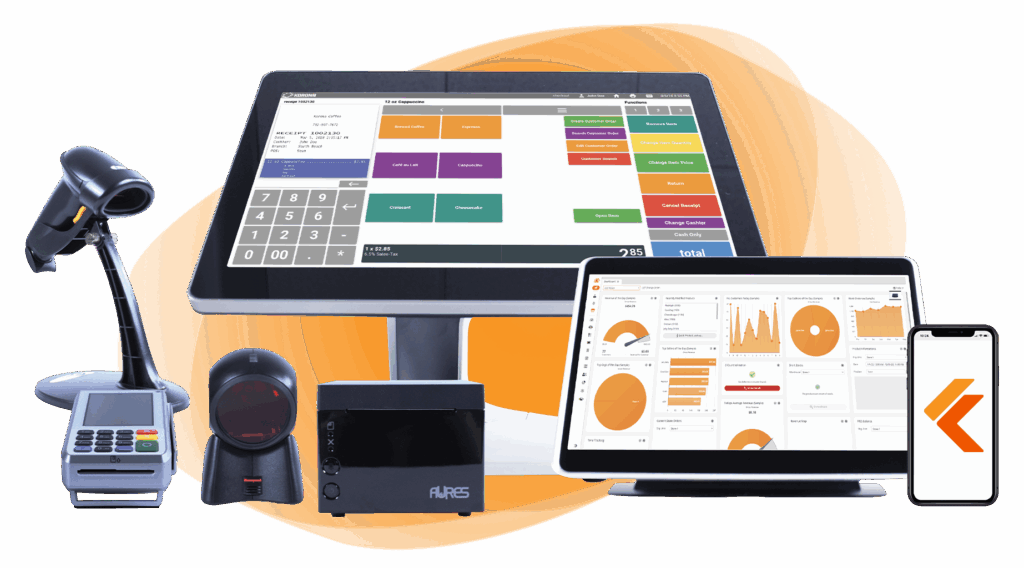
Build Your Own POS
Whether you run a retail store, café, or admissions booth, we have the point of sale hardware designed for your specific needs. Start building your ideal POS system now.
Chargebacks, ACH, And Refunds
A chargeback costs $0 when the case is resolved in the merchant's favor and $15 when it is lost.
ACH and EFT-PAD bank payments cost 0.5% plus $0.25 per transaction, capped at $6, with an extra 0.05% on amounts above $25,000.
A bank payment rejected by the customer's bank carries a $5 fee. Stores new to bank transfers can read KORONA's primer on how to accept ACH payments.
Refunds carry no added fee at Helcim; the processing fees from the original sale stay spent. Voiding the sale the same day, before the batch closes, avoids those fees and suits mistakes caught at the counter.
Effective Rate Versus Margin
Effective Rate Calculator
Grab one monthly merchant statement. Two numbers off it tell you what you are really paying to accept cards.
The effective rate is total fees divided by total card volume, the number to budget around. Helcim says most merchants land near or below 2% on in-person sales and below 2.5% on keyed and online sales.
Its own calculator, set to a $300 average ticket and $40,000 in monthly volume, shows 1.79% plus $0.08 in person for Visa, Mastercard, and Discover, 1.00% plus $0.08 for PIN debit, and 2.31% plus $0.25 for keyed and online sales.
American Express runs higher at 2.59% plus $0.08 in person and 2.99% plus $0.25 keyed and online, and Helcim's Amex rates page lists a 0.10% plus $0.10 acquirer network fee on all Amex transactions.
Ticket size changes the result; retailers can rerun the calculator with their own average sale.
Card mix and the share of keyed sales shift the figure as well, and a fair attempt to compare processing rates across providers begins with a recent statement.
Where the law allows surcharging, eligible merchants can turn to Helcim's Fee Saver tool.
Helcim's rate card lists 0% for the merchant on credit card transactions and 3.0% for customers in person and, in the majority of online cases, online as well.
What Helcim Offers Retail Stores
Retailers get card terminals, a point-of-sale app, inventory tracking, online checkout, invoicing, and accounting integrations under one Helcim merchant account.
Counter And Mobile Hardware
Two physical devices and one software option make up the lineup. The Smart Terminal is a stand-alone unit with a built-in POS, a printer, and 4G connectivity.
The Card Reader pairs with iOS, Android, macOS, and Windows devices. Tap to Pay on iPhone turns a phone into a contactless reader, a format that KORONA's overview of contactless and mobile payments covers in detail.
Current pricing for all three appears in the cost section above.
Online And Remote Payment Tools
Stores that sell beyond the counter can use a virtual terminal for phone and mail orders, payment links, online invoicing, a no-code online checkout, recurring billing, and a customer vault that stores cards securely.
Helcim accepts HSA and FSA cards too, a useful detail for health and wellness retailers.
Deposits And Reconciliation
Free next-business-day deposits on credit and debit sales are available, restricted to merchants whose banks use the RTP or FedNow networks.
Per Helcim's deposit guide, batches must stay at $25,000 or less and close by 7:00 PM Mountain Time, and standard card deposits take one to two business days.
Merchants choose between gross deposits, where total sales land in the bank account and fees post as a separate line item, and net deposits, where fees are deducted first. Gross deposits keep daily sales totals clean for matching against POS reports.
Integrations And Developer Tools
Integrations include QuickBooks Online, Xero, and WooCommerce. Developers can build on the Helcim API, HelcimPay.js, and a Payment Extension, and Helcim's developer docs document a Payments Hardware API for pairing terminals with third-party systems.
Where Helcim Falls Short For Retailers
Helcim's main limits for retailers are a short hardware lineup, thinner savings on low-dollar sales, no multi-location inventory, and next-day deposits that depend on the bank.
Hardware Range
The lineup stops at two physical devices, the Card Reader and the Smart Terminal, and a TechRepublic review flags limited hardware options for larger or more complex POS environments.
NerdWallet's Helcim review adds that no full countertop POS system is available, whereas competitors such as Square and Clover sell two-screen countertop registers.
GOOD TO KNOW!
Multi-lane stores need to test whether the terminal lineup fits their counter setup before committing, and KORONA's advice on choosing a payment terminal helps with that decision.
Small-Ticket Stores
Interchange-plus pricing loses much of its edge when the average sale is small. Interchange includes fixed per-transaction pieces, and those pieces take a bigger share of a $10 sale than a $60 sale.
Merchant Maverick's Helcim POS review says businesses under $5,000 in monthly sales, or with average tickets of $15 to $25, gain little from Helcim's fee model.
Inventory Depth
According to Helcim's inventory page, the free inventory manager supports item variants, bulk imports, and stock syncing across the POS, invoices, and online store.
Merchant Maverick notes that the tool lacks multi-location inventory and provides just basic employee management; multi-store retailers will want to check the fit.
KORONA's guide to retail inventory management explains the methods behind that kind of control.
Inventory management a headache?
KORONA POS makes stock control easy. Automate tasks, generate custom reports, and learn how you can start improving your business.
Deposit Speed
Helcim has no same-day deposit option, and next-day funding is limited to eligible banks, as NerdWallet's evaluation points out. Stores with batches above $25,000 or tight cash flow can plan around Helcim's regular settlement window.
Business Types Helcim Restricts
Helcim restricts or prohibits several specialty-retail categories, among them remote vape and tobacco sales, drug paraphernalia, and US cannabis businesses, under an Acceptable Use Policy last updated September 30, 2026.
The policy's category lists are examples and not exhaustive; each store needs to ask Helcim about its own eligibility directly.
Any store in a restricted or prohibited category might need to explore high-risk merchant accounts as an alternative.
Prohibited Categories That Affect Specialty Retail
The Acceptable Use Policy bars the following categories relevant to KORONA's verticals:
- Tobacco and vape: online, mail order, and telephone order e-cigarette and vape sales, plus tobacco and nicotine product sales other than physical store sales.
- Drugs and paraphernalia: drug paraphernalia, unlicensed medical and recreational cannabis products, US-based marijuana-related businesses, and compounds sold for intoxicating effect (alcohol excepted).
- Stored value: gift cards, preloaded payment cards, prepaid phone cards, SIM cards, and prepaid phones appear under the policy's non-fiat currency and stored value category.
PRO TIP!
The tobacco line leaves physical store sales outside the prohibition. Stores that sell prepaid or stored-value products as part of their business ought to ask Helcim how that category applies to them.
Restricted Categories And Added Review
Restricted businesses face extra scrutiny, document requests, and risk assessments, and Helcim can modify or revoke an approval at any time.
The restricted list includes herbal cigarettes and tobacco production equipment (card-present sales only), online pharmacies and supplement retailers, furniture stores, pawn shops, jewelry and watch sellers, and collectibles dealers.
Beyond the category lists, the policy names general risk factors: a new business without history, an industry with high chargebacks, high expected processing volume, and delayed delivery between payment and fulfillment.
Account stability deserves a look as well. Merchant Maverick's coverage reports users whose accounts were canceled after Helcim treated their businesses as high risk, and NerdWallet notes that Helcim's terms let it close an account at any time without notice.
Categories The Policy Does Not Name
The policy mentions alcohol solely as an exception and does not list liquor stores as prohibited or restricted.
CBD and hemp products do not appear by name either, and hemp retailers weighing alternatives can compare options in KORONA's roundup of CBD payment processing solutions.
Because the lists are non-exhaustive, silence in the policy is not an approval, and underwriting decides each case.
How to Confirm Eligibility
Contact Helcim's trust and safety team at trustandsafety@helcim.com or 1-877-643-5246 before applying, and read Helcim's restrictions guide for how approvals work.
Stores selling regulated products can open that first conversation by describing their product mix, sales channels, and licenses. CBD retailers can read up on the requirements for a license to sell CBD before the call.
Helcim vs. Square And Other Processors
Helcim comes out cheaper than Square on most card-present sales, thanks to a small, published margin, whereas Square charges a flat 2.6% plus $0.15 per in-person sale on its Free plan. Clover and Stax round out the comparison with a second flat-rate model and a subscription model.
Helcim vs. Square, Clover, And Stax Side by Side
| Category | Helcim | Square (Free plan) | Clover (Retail plans) | Stax |
|---|---|---|---|---|
| Pricing model | Interchange-plus | Flat rate | Flat rate | Subscription plus interchange at cost |
| In-person rate | Interchange + 0.40% + $0.08 at entry tier | 2.6% + $0.15 | 2.6% + $0.10 (Starter); 2.3% + $0.10 (Retail Growth) | Interchange + $0.08 |
| Keyed rate | Interchange + 0.50% + $0.25 at entry tier | 3.5% + $0.15 | 3.5% + $0.10 | Interchange + $0.15 |
| Monthly fees | $0 | $0 | Software plan fee; bundles priced monthly over 36 months | $99 to $199+, set by annual volume |
| Contracts | None, with no cancellation fee | None; plans can be changed or canceled at any point | Bundle pricing runs 36 months; the hardware promotion requires a 3-year contract | None; no cancellation fees |
| Volume pricing | Automatic tiers up to $5 million monthly | Custom pricing may be available above $250,000 annually | Not published on the plan page | Subscription steps up at $150,000 and $250,000 in annual volume; custom quotes for larger accounts |
Run through the $30,000 example, Clover's Retail Growth rate totals $740 ($690 for 2.3% plus $50 for 500 sales at $0.10), before plan and hardware payments.
Helcim stays ahead of that figure as long as wholesale costs stay below $580, or 1.93% of volume.
Stax's published markup comes to at least $239 ($199 plus $40), against Helcim's $160; because both pass interchange through at cost, that $79 gap holds whatever the card mix.
Square's paid Plus and Premium plans lower the in-person rate to 2.5% and 2.4%, as the same Square page shows.
The subscription and hardware costs behind those plans are itemized in KORONA's Square POS pricing article.
Clover's page notes that its prices are available only online, so buyers can compare a direct online quote with any reseller offer.
When Flat-Rate Pricing Still Wins
Flat-rate pricing wins for new stores with low volume and small tickets, where a blended rate stays predictable and setup stays simple.
NerdWallet's analysis frames Helcim's advantage as strongest above $50,000 in monthly card volume, the point where volume discounts begin. Below that line, put recent statements side by side before switching.
How Other Processor Models Compare
Three pricing models dominate the market. Flat-rate processors charge one blended rate. Tiered processors sort transactions into qualified, mid-qualified, and non-qualified buckets, each with its own rate.
Interchange-plus processors pass wholesale costs through and add a stated margin. A subscription variant, used by Stax, swaps the percentage margin for a monthly fee plus a flat charge per transaction.
PRO TIP!
Interchange-plus earns a reputation as the clearest of the three, and Helcim shows interchange and its own margin separately on every statement.
Pairing Helcim With a Processor-Agnostic POS
A POS system runs the store, and a payment processor moves the money. Keeping the two decisions separate lets a retailer change one without replacing the other.
POS System Versus Payment Processor
The POS handles checkout, inventory, staff, and reporting. The processor authorizes cards, settles funds, and bills fees, a split that KORONA explains in its guide to POS vs. payment processor differences.
Helcim sits on the processor side, even though it includes its own POS app.
Why Processor-Agnostic Matters
KORONA POS is processor-agnostic software and not a payment processor; merchants choose their own processor and keep the freedom to change it.
That flexibility helps stores that outgrow a rate or fall outside a processor's acceptable use policy. The opposite situation exists, too: a store happy with its current processor can move to a POS without changing card processing.
Helcim publishes a developer API, HelcimPay.js, a Payment Extension, and a Payments Hardware API for third-party systems, and POS vendors can use those tools to build support for it.
Support for any given POS depends on that vendor, and a quick question before purchase settles it.
Questions to Ask Before Pairing a Processor With a POS
- Does the POS vendor support this processor today, and through which integration method?
- Which terminals work with the POS, and who handles support when one fails?
- Do processing fees appear in POS reports, or just on the processor statement?
- Can the store switch processors later without replacing the POS?
- Does the processor's acceptable use policy cover the store's full product mix?
How Payment Processing Fits Into Running a Retail Store
Payment processing affects store management through three numbers: the effective processing rate, deposit timing, and chargeback losses.
Processing Fees as a Margin Line
Processing fees come straight out of gross margin, a good reason to review them monthly. A store with a 25% gross margin that pays a 2% effective rate gives up 8% of its gross profit to card fees (2 divided by 25).
Cutting that rate by half a point returns a quarter of that cost. The math is an illustration, and a store's own statement supplies the true figures.
Reconciliation And Deposit Timing
Daily reconciliation compares POS sales totals with processor deposits. Helcim's gross deposit option eases the match by showing sales and fees as separate lines, and next-day funding for eligible banks shortens the wait.
Stores on standard timing will see a lag of a day or two, and stores on net deposits reconcile against sales minus fees.
Chargebacks And Cash Flow
A lost credit card chargeback costs the sale amount plus a $15 fee at Helcim, and clear receipts, signed records, and consistent ID checks offer cheap protection for cash flow.
Retailers selling age-restricted goods have extra reason to document verification at the register.
A broader look at staffing, inventory, and KPIs sits in KORONA's retail store management guide, a natural companion to the payment decisions covered here.
Helcim Payment Processing: Frequently Asked Questions
Does Helcim Charge a Monthly Fee?
No. The account carries no monthly fee, minimum, software charge, statement fee, PCI fee, or cancellation fee. Costs come from interchange plus Helcim's margin on each sale, and optional 4G data runs $7 per month on Helcim hardware.
How Much Does Helcim Charge Per In-Person Transaction?
In-person sales on the entry tier (volume up to $50,000 a month) carry Helcim's 0.40% plus $0.08 margin on top of wholesale interchange. The margin drops to 0.15% plus $0.06 past $1 million monthly, and network fees apply at all tiers.
is Helcim Cheaper Than Square?
Yes, for card-present sales at moderate to high volume. Helcim says typical in-person merchants hover at 2% or lower, against 2.6% plus $0.15 on Square's Free plan. Tiny tickets shrink the gap; run the numbers on your own statements.
Can a Liquor, Vape, or CBD Store Use Helcim?
It depends on what the store sells and how. Helcim's policy prohibits remote vape orders and tobacco sold away from a physical store, along with paraphernalia and marijuana businesses in the US, while liquor stores and CBD go unnamed. Ask Helcim before applying.
Does Helcim Require a Contract?
No. Helcim runs without contracts, termination penalties, or equipment leases. Signup takes minutes online, but each application gets screened against Helcim's acceptable use policy, and Helcim can ask for business documents along the way. Regulated retailers benefit from checking eligibility before signing up.