833.200.0213 

How To Count a Till: A Step-by-Step Guide for Retail Cashiers

Photo of author

Author

Martial A.

Reviewed by

Michael C.

Featured image showing a cashier counting a till.

Till count and variance calculator

1. What the drawer should hold

$
$
$
$

Expected cash: $0.00

2. Count the drawer

DenominationCountSubtotal
Bills
$100 bills$0.00
$50 bills$0.00
$20 bills$0.00
$10 bills$0.00
$5 bills$0.00
$1 bills$0.00
Coins
Quarters ($0.25)$0.00
Dimes ($0.10)$0.00
Nickels ($0.05)$0.00
Pennies ($0.01)$0.00

Counted total: $0.00

3. Your variance

Expected cash$0.00
Counted total$0.00
Variance $0.00 Balanced

Expected cash is your opening float plus recorded cash sales, minus paid-outs and cash drops. Variance is the counted total minus expected cash: a positive number is over, a negative number is short. All figures are calculated in whole cents.

Counting a till means you tally the cash in a drawer, then compare the total against what your register recorded. Most guides stop at that definition. What follows is how to count a till in practice: the tools to have ready, the formula for your expected cash figure, the seven steps in order, and the math behind an over/short number. You will also find what to do when a drawer will not balance, how to set a variance threshold, and whether you can legally dock a cashier's pay for a shortage.

Key Takeaways:

  • Your expected cash is a formula, not your sales figure: opening float plus recorded cash sales, minus pay-outs and safe drops.
  • Tally the drawer before the expected total is revealed, since a known target invites a count that agrees with it.
  • Log each denomination as you go, since a line-by-line sheet turns a $4.25 gap into something you can trace.
  • Docking a cashier's pay for a shortage is unlawful under federal law wherever it drops wages below the applicable minimum, and several states restrict it further.

Till Count Checklist: The Seven Steps at a Glance

Till Count Checklist

The seven steps, at a glance, in order.

1
Close the open sale and stop ringing transactions on that drawer.
2
Take the insert somewhere private, out of customer view.
3
Separate the opening float from the shift's takings.
4
Count blind, ahead of seeing the expected total.
5
Work from the largest bill down to the smallest coin, recording each denomination as you go.
6
Add up the sheet, then reveal what the system says should be there.
7
Compare the two numbers, record the variance, and secure the deposit.

A till count takes seven steps, in this order:

  1. Close the open sale and stop ringing transactions on that drawer.
  2. Take the insert somewhere private, out of customer view.
  3. Separate the opening float from the shift's takings.
  4. Count blind, ahead of seeing the expected total.
  5. Work from the largest bill down to the smallest coin, recording each denomination as you go.
  6. Add up the sheet, then reveal what the system says should be there.
  7. Compare the two numbers, record the variance, and secure the deposit.

Each step is broken out below, along with the arithmetic that turns a pile of bills into a defensible over/short number.

What Is a Till?

A till is the cash drawer inside a cash register, divided into slots for bill denominations and compartments for coins. The term covers both the physical insert and the money inside it, and "cash drawer" and "shop till" mean the same thing in everyday use. The drawer itself varies with the register it sits in, and the different types of cash registers run from standalone electronic units to full point of sale terminals.

Tills sit among the basic retail store equipment any cash-accepting business needs. Their organization carries more weight than it sounds: bills sorted by denomination and facing one direction let a cashier make change quickly and let the next person verify a count without re-sorting the drawer first.

Most operations assign one till to one cashier, bartender, or barista per shift. The money gets counted when that person signs in, counted again when they sign out, and matched against what the register says should be there.

Why Counting the Till Matters in Retail

Counting the till exists to answer one question: does the money in the drawer match the money the register recorded? Everything else follows from that answer.

Three things break when nobody asks it.

Your Books Stop Reflecting Reality

Sales figures pulled from a point of sale describe what was rung up, not what was collected. Only a physical count confirms the two agree, which is what makes your sales reports something an accountant can rely on. Whichever of the retail accounting methods your books follow, each line in them rests on a count somebody actually performed.

Losses Become Invisible

Cash walks out of retail businesses in small amounts over long periods, and a store without shift-level counts has no mechanism to notice. Losses of that kind fall under shrink in retail, where cash is the hardest category to trace once the day is closed.

A documented count at each handoff builds a chain of custody, so a discrepancy narrows to a defined stretch of the day and a named person instead of vanishing into a monthly total.

Change-Making Degrades

A drawer nobody audits drifts toward the wrong denomination mix. Cashiers end up short on singles and quarters mid-rush, and someone gets sent to the bank during peak hours.

What You Need To Count a Till: Tools and Supplies

Gather six things before you open the drawer, because stopping mid-count to find a pen is how counting errors happen.

  • A written float amount, broken out by denomination. Not just "$200" but how that $200 is built: how many fives, how many rolls of quarters.
  • The expected cash total, from an X report, a shift report, or a blind-count function in your point of sale.
  • A count sheet, printed or digital, with a line for each denomination.
  • A flat, clear surface in a secure area, out of customer sight and away from the register.
  • A drop envelope or bank bag, plus a deposit slip if you bank daily.
  • A bill counter, once volume makes hand-counting the bottleneck. Low-volume stores rarely need one.

Two additions worth the cost in cash-heavy stores: a coin counter, and a second person to verify. Stores buying equipment from scratch will find the drawer packaged alongside the register and receipt printer in most POS hardware bundles.

Build Your Own POS

Whether you run a retail store, café, or admissions booth, we have the point of sale hardware designed for your specific needs. Start building your ideal POS system now.

X Report vs Z Report: How To Find Your Expected Cash Total

An X report reads your totals without clearing them. A Z report closes the period and resets the register to zero. Use X for mid-shift checks and cashier swaps; use Z once, at close of business.

The distinction earns its keep because the report you run determines whether you can run it again. Pull an X report to check a drawer at a shift change, hand the register to the next cashier, and the day's running totals stay intact. Pull a Z report by mistake at 2 p.m. and you have finalized half a day of sales as a complete business day.

The Expected Cash Formula

Your expected cash total is not the same as your cash sales total. Four inputs go into it:

Expected cash =
+Opening float
+Recorded cash sales
Paid-outs
Cash drops

Expected cash = opening float + recorded cash sales − paid-outs − cash drops

Paid-outs are any cash that left the drawer for a reason other than a sale: a vendor COD, a petty reimbursement, a customer refund in cash. Drops are cash moved to the safe mid-shift. Skip either one and the drawer will read as short by exactly the amount you forgot.

A count without this figure is arithmetic without a reference point. You can tally $963.25 with total accuracy and still have no idea whether the drawer is right.

How To Count a Till: Step by Step

Work these seven steps in the same order on every shift, whether the drawer holds $300 or $3,000.

1. Close the Sale and Release the Drawer

Finish any open transaction and log the cashier out before the count starts. A drawer that takes a sale halfway through a count invalidates each line already recorded, and the recount costs more time than waiting did.

2. Move the Drawer To a Secure Area

Take the insert to a back office, a locked room, or any space out of public view. Counting at the register exposes the full drawer to anyone on the other side of the counter and puts the cashier in a position no employee should be asked to occupy. A well-planned cash wrap layout shortens that walk, since the drawer should never have to cross the sales floor to reach a secure surface.

Two practical rules for that space: no phone, and no conversation. Distraction is a routine cause of miscounts, and both interruptions are avoidable at zero cost.

3. Separate the Float From the Takings

Pull the opening float out first and set it aside in its own envelope. What remains is the shift's cash intake, which is the figure you deposit and the figure your report should match.

Keeping the float physically separate prevents a frequent reconciliation mistake in small retail, which is depositing part of tomorrow's change fund and starting the next day short.

4. Count Blind

Count the money before you look at what the register expects. The practice is called blind closing, and it exists for a specific reason.

A cashier who knows the target can make the count agree with it. The classic pattern involves shortchanging customers through the shift, then removing the accumulated surplus at close so the drawer lands exactly on target.

Blind counting removes that option, since the person counting has no target to aim at. Larger retailers treat it as standard for exactly this reason, and the practice also protects honest cashiers by demonstrating that their counts hold up unprompted.

5. Count Largest To Smallest, Recording As You Go

Start with your highest bill denomination and work down: hundreds, fifties, twenties, tens, fives, ones, then coins from quarters to pennies. Rolled coin gets counted separately from loose.

Write each denomination on the sheet as you finish it. Two reasons this beats mental tallying:

  • You keep your place. An interruption at the tens does not cost you the twenties.
  • You get a diagnostic. A drawer that is short $4.25 with a denomination record is a solvable problem. That same drawer under one grand total gives you nothing to work from.

Count each denomination twice before writing it down. The second pass costs about ten seconds and catches stuck bills, a frequent source of shortages where no money is actually missing.

6. Total the Sheet, Then Pull the Expected Figure

Add your count sheet to a grand total. Only now run the X report, the shift report, or the balance function that reveals the expected number.

Order matters here. A total written down before the expected figure appears is a record. A total entered afterward is an opinion.

7. Compare, Record, and Secure

Note the variance on the count sheet, sign and date it, and have a manager countersign in operations that require dual custody. Seal the takings in the drop bag, return the float to the drawer, and lock the drawer or move it to the safe.

The signed sheet is the point of the whole exercise. A count nobody recorded proves nothing three weeks later when a pattern needs investigating.

How To Calculate Your Cash Drawer Over/Short

Your over/short figure is the difference between what you counted and what the register expected. Positive means over, negative means short.

Here is the calculation with real numbers.

A liquor store cashier works a Saturday shift. The drawer opened with a $200 float. The point of sale recorded $1,412.50 in cash sales. Midway through the shift, a manager dropped $600 to the safe. A beer distributor was paid $45 in cash from the drawer.

Step one: find the expected cash.

Expected Cash in Drawer
Worked calculation of the cash a register should hold at close, one input per row. Start with a $200.00 opening float, add $1,412.50 in recorded cash sales, subtract a $600.00 cash drop to the safe and a $45.00 paid-out to a vendor, giving $967.50 expected in the drawer. Any difference between that figure and the counted cash is the drawer variance.
Input Amount
Opening float $200.00
Recorded cash sales + $1,412.50
Cash drop to safe − $600.00
Paid-out to vendor − $45.00
Expected in drawer $967.50

Step two: compare to the count. The cashier's sheet totals $963.25.

$963.25 − $967.50 = −$4.25

The drawer is short $4.25.

Running the Same Math for an Overage

Nothing changes except the sign. Had that cashier counted $971.10 against the identical $967.50 expected total, the drawer would be over by $3.60.

Overages get treated as errors, not bonuses. Set the surplus aside with the deposit and record it. Money that goes back into the float quietly hides the mistake that produced it, and a recurring overage usually means a customer is being shortchanged.

A Cross-Check Worth Two Minutes

Verify the figure a second way before you accept it. Subtract the float from your count, then compare the result against your cash sales minus drops and paid-outs:

  • Count minus float: $963.25 − $200.00 = $763.25
  • Sales minus drops and paid-outs: $1,412.50 − $600.00 − $45.00 = $767.50
  • Difference: $4.25

Both routes land on an identical shortage. When they disagree, the error sits in your inputs, not your count, and a mis-entered float or an unrecorded drop is usually the culprit.

What To Do When Your Cash Drawer Doesn't Balance

Work the discrepancy methodically before drawing conclusions about anyone. Shortages and overages point toward different failures, so the two get diagnosed separately.

Cash Drawer Is Short: How To Find the Missing Money

Six checks, in order of how often they turn out to be the answer.

  1. Recount by denomination: Stuck bills and miscounted coin rolls explain most small shortages. A folded twenty inside a stack of tens reads as $10 until someone separates them.
  2. Search the drawer and its surroundings: Bills slip under the till insert, behind the drawer, and onto the floor. Pull the insert all the way out and check underneath.
  3. Verify the opening float: A drawer that started at $190 instead of $200 reads as $10 short no matter how well the cashier worked. Compare the opening count sheet to the standard.
  4. Review refunds and voids: A cash refund processed as a card refund, or a void entered after the cash left the drawer, produces a shortage with no missing money. A written refund and exchange policy keeps those entries consistent enough to audit.
  5. Hunt for unrecorded cash movements: Paid-outs, safe drops, and petty cash taken without an entry all read as loss. Every dollar that leaves the drawer needs a matching record.
  6. Check for payment-type errors: A cash sale rung as card inflates expected card totals and deflates expected cash by an equal amount. Look for a card overage that matches your cash shortage.

If none of the six resolves it, document the amount and escalate per your policy. Repeated unexplained shortages tied to one person, one register, or one shift are worth a closer look, though a single event rarely is.

Cash Drawer Is Over: How To Trace the Surplus

An overage almost always means a customer received less change than they were owed. Work back through the denomination recount and the float check, then look in two further places.

Review the transaction log for large cash sales, since a $50 taken as a $20 shows up here. Then cross-reference processed refunds against the log, because a refund entered in the system but never paid out in cash leaves the money sitting in the drawer.

Recurring overages signal a training gap rather than dishonesty. The fix is change-making practice, not discipline. Counting change back to the customer out loud catches the error before it reaches the drawer, and it belongs in every cashier training guide you write.

How To Set an Acceptable Cash Variance Threshold

Derive your threshold from your own data. A borrowed number rarely fits the store that borrowed it. Track each variance for 30 days, then set the line at the point that captures ordinary counting error without absorbing real loss.

Many independent retailers land somewhere between $2 and $5 per shift. The range works for low-volume stores, but a shop processing 400 cash transactions a day and one processing 40 should not share a threshold. Scale it to cash volume; gut feel is a poor guide here. Revisit it seasonally when transaction counts shift.

Two rules keep a threshold honest.

Separate Ordinary Error From a Pattern

A cashier $3 short once a month sits inside normal variance. The same cashier $3 short every shift for six weeks is a $70 problem, and the individual amounts never trip the limit. Track cumulative variance per person, not just per shift.

Define Your Escalation Trigger

Decide in advance what moves a discrepancy from a note to a conversation, and from a conversation to a review: three consecutive shifts outside the limit, or a cumulative monthly figure, or any single event above a set dollar amount. Deciding after the fact tends to produce inconsistent treatment across staff.

Telling cashiers the threshold exists does as much work as the threshold itself. A known limit removes the anxiety that drives people to fudge counts, and it makes clear that rules exist without making every $1 a confrontation.

Can You Deduct a Shortage From a Cashier's Pay?

Usually not, and the constraints are tighter than most operators expect. Federal law and state law both restrict the practice, and the safest read is that an ordinary till shortage is a cost of doing business.

What Federal Law Allows

Under the Fair Labor Standards Act, deductions for cash shortages are unlawful to the extent that they drop an employee below the federal minimum wage of $7.25 an hour or cut into overtime pay owed, per the Department of Labor's Handy Reference Guide.

Deductions for items other than board, lodging, and other recognized facilities normally cannot be taken in an overtime workweek at all. The Department has also stated that an employer cannot sidestep the rule by asking the employee to hand the money back in cash outside of payroll.

One 2026 caveat outweighs the federal number itself. Thirty states and the District of Columbia now set minimums above $7.25, so for most retail workers the operative floor is the state rate, not the federal one. A California cashier earning the 2026 state minimum of $16.90 has far more room above $7.25 on paper, and yet California is where the deduction is hardest to justify, for the reasons below.

Three further points operators tend to miss:

  • Voluntary agreements do not cure the problem. In Mayhue's Super Liquor Stores, Inc. v. Hodgson, the Fifth Circuit held that even an agreed repayment of register shortages is invalid where it pushes wages below the statutory minimum.
  • Tipped employees are excluded outright. Where an employer claims a tip credit, paying the federal cash wage of $2.13 an hour against a credit of up to $5.12, the employee counts as having been paid only the minimum wage, so any shortage deduction is unlawful by definition. Our walkthrough on how to pay tipped employees sets out how the credit works in practice.
  • Theft is treated differently, but the burden sits with the employer. A shortage provably caused by an employee's misappropriation can be deducted, and the employer must prove that specific person was personally and directly responsible. Suspicion is not proof.

Where State Law Goes Further

State law frequently goes further than federal law. California is the strictest example: deductions for cash shortages are barred unless the employer can show dishonesty, a willful act, or gross negligence, and the Division of Labor Standards Enforcement has cautioned that even the exception may not survive review under the state Labor Code.

An employer who deducts and cannot meet the burden may owe the withheld wages back plus waiting-time penalties. Other states require written employee authorization, and some prohibit the deduction regardless of wage level.

Enforcement is real. In 2022 the Wage and Hour Division recovered $166,073 for 732 workers at Sparky's Kwick Stop, an Oklahoma convenience store chain that charged employees for uniforms and register shortages in ways that pushed hourly pay under $7.25.

Why Docking Pay Backfires

The practical case against deduction is separate from the legal one. Docking pay for shortages teaches cashiers to conceal them, which produces false counts and destroys the data you built the count around. Progressive discipline, retraining, and reassignment away from cash handling all address the behavior without corrupting the record.

General information only, not legal advice. Wage deduction rules vary by state and change; confirm current requirements with your state labor department or an employment attorney before setting policy.

Cash Handling Policies That Keep Drawers Balanced

Policy is what makes an accurate count repeatable. Five practices carry most of the weight.

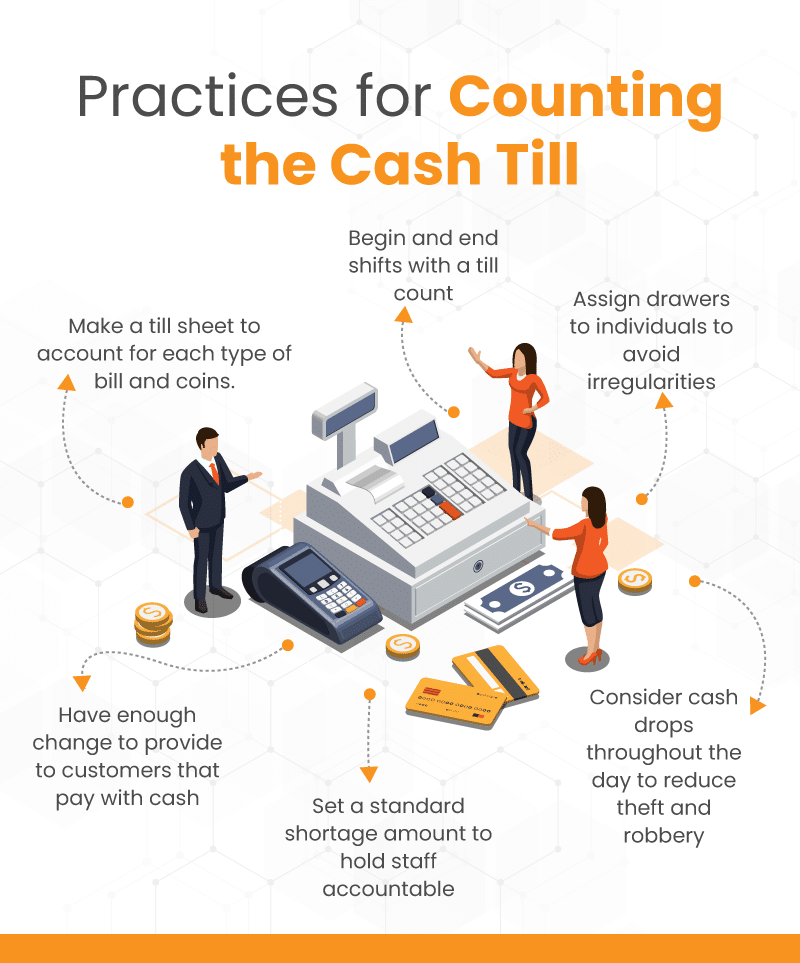
Assign One Drawer To One Person

Give each cashier a dedicated till for the length of their shift. Accountability dissolves the moment two people share a drawer, since a variance can no longer be attributed to anyone.

Picture a coffee shop where five baristas work from one register and the drawer comes up $30 short. Nothing in the record narrows it down.

Cafés hit the problem harder than most, because coffee shop staffing tends to put several people behind one counter through a morning rush. Under assigned drawers, the same $30 points to one person and one window of time. Where staffing genuinely prevents it, log each handoff with both signatures so the custody chain survives.

Count at Both Ends of Every Shift

An opening count is not optional. Counting in confirms the float and links the incoming cashier to the outgoing one, so a shortage discovered at close belongs to a known stretch of hours and not to an entire day.

Skipping the opening count is how stores end up with unassignable variances, and it makes fair treatment of staff impossible.

Keep the Right Change on Hand

Stock the float by denomination, not just by total. A $200 float made up of two hundreds is functionally useless for making change.

Small retailers generally do well between $150 and $200 in mixed small bills and coin, though volume and average ticket should drive the figure. A store with a $6 average ticket burns through singles far faster than one selling $80 cases of wine.

Drop Cash During the Shift

Move accumulated cash to the safe at set intervals in any high-volume store. Drops lower the amount sitting in an open drawer at any moment, which limits exposure to both theft and robbery.

Pick predictable triggers, a dollar threshold or a clock time, and have a manager witness each one. Log each drop, because an unrecorded one reads as a shortage of exactly that amount.

For stores holding serious cash, KORONA POS integrates with BLUbeem by Brink's, which puts a smart safe in the store for sealed drops.

Deposits are credited to the business account the next business day rather than waiting on a bank run, Brink's messengers collect the contents, and the cash is insured against internal and external theft while it sits in the device.

Build a Documented Chain of Custody

Dual counting is among the strongest controls available, and it costs nothing but time. Two people count independently and compare totals, which catches arithmetic errors and protects the cashier from an unfounded accusation.

Make the chain a document rather than a habit. A workable custody record has four elements: a signed count sheet at each handoff, a witness signature on the closing count, a sealed and numbered drop bag, and a log showing who held the drawer between which times. Tie the whole thing back to your wider plan for asset security in retail so cash controls and inventory controls tell one consistent story.

Broader guidance on writing these rules into a store-wide standard lives in our guide to cash handling procedures in retail.

How To Count a Till in High-Volume Stores: Liquor, Smoke Shop and Dispensary

High-volume cash stores need more frequent drops, tighter denomination discipline, and a count that doubles as a compliance record. The generic advice above holds, but three adjustments matter.

Coin Volume Changes the Count

Smoke shops and convenience stores run high transaction counts against low average tickets, which produces far more coin than a general retail store. Hand-counting stops being viable early. A coin sorter and pre-rolled coin cut close time substantially, and stocking rolled quarters in the float saves the cashier from breaking rolls mid-shift.

Anyone already watching turnover through smoke shop inventory management knows the pattern, since the velocity that empties the shelves is what fills the drawer with coin.

Drop Frequency Scales With Velocity

A liquor store on a Friday evening can accumulate a week's worth of a slow store's cash in four hours. Hourly drops during peak periods keep drawer exposure low, and each one needs its own record for the expected-cash formula to hold. Weekend turnover strains liquor store inventory management on the very grounds it strains cash handling, so the two schedules deserve planning together.

Cash-Only Operations Need Audit-Grade Documentation

Dispensaries operating without card acceptance handle volumes that push the count closer to bookkeeping than to housekeeping. Card acceptance stays out of reach for many of them because of the banking obstacles our breakdown of CBD payment processing lays out. For the count itself, treat each drop, each paid-out, and each variance as a record you may have to produce, with named signatures and sequential bag numbers throughout.

How KORONA POS Handles Cash Reconciliation

KORONA POS builds the blind count into the point of sale, so the procedure above runs as a software function and stops depending on a paper process you have to enforce. KORONA POS is processor-agnostic, so none of what follows depends on which payment processor you use.

Balance POS: The Built-In Blind Count

Balance POS closes out a whole register at the end of the business day. The last shift enters what they physically counted, and the function is a blind count, so the cashier never sees the expected amount before committing to a number.

Blind closing arrives as a software behavior instead of a rule you have to police. Cashiers get three attempts to match by default, adjustable through the Maximum Balance Attempts setting in POS Profiles, and any difference remaining after the third attempt carries through to the End of Day Statement, where it stays visible. Balance POS runs Finish Day automatically once it completes.

Balance Cashier: Tracking Variance Per Person

Balance Cashier is the function that matches the assigned-drawer approach argued for earlier. Each cashier balances at the end of their own shift, which produces a variance tied to a named person, not to a terminal.

Two details matter operationally. Balancing a cashier does not run Finish Day, so that still happens once at close of business. And a cashier who has balanced cannot ring further transactions until Finish Day runs, which enforces the release-the-drawer step from the procedure above.

Central Balance: Counting Away From the Register

Central Balance covers the secure-area problem. A cashier presses the function, the system logs them out and prints a slip, and the physical drawer insert travels to a back office or counting room where the count gets entered on a web form against that slip.

Useful for 24-hour operations that cannot take a register offline, and for any store that wants counting done away from the floor.

The printed statement carries the payment methods used, the expected and actual cash amounts, the difference between them, and signature fields for both the cashier and the person verifying, which is the custody record described earlier already in printed form.

End of Day Statement: Expected vs Actual

The End of Day Statement produces the expected-versus-actual comparison the formula earlier in this post describes. Each payment method shows an expected amount, the actual amount the cashier entered, and the gap between them, with cash drops and account transactions already factored into the expected number.

Finishing the day advances an internal z-count and finalizes those sales permanently, so a completed statement cannot be edited after the fact. A z-count period is a business day measured from open to close, so the calendar date does not define it. Useful for stores trading past midnight.

Balance Statements and the Cashier Balance Report

For variance tracking across staff, individual statements sit under Sales > Balance Statements, filterable by cashier, register, date, or z-count. The Cashier Balance Report under Evaluations summarizes that data per person, and it is the report that turns a scatter of $3 shortages into a cumulative pattern you can act on.

Cashier-level permissions restrict who can process discounts, refunds, and voids, and each action ties to the individual who performed it. Those permissions belong to a wider set of retail loss prevention features covering receipt voids, no-sale tenders, and a rule that blocks new transactions while the drawer sits open.

FAQs: Counting a Till and Balancing a Cash Drawer

What Does Counting a Till Mean?

A till count is a physical tally of the drawer, checked against the amount your system says should be sitting in it. Retailers run one when a cashier signs on and again when the shift ends.

How Do You Count a Till?

Blind, in a secure spot, working down from the biggest bill. Set the float aside, log each denomination on a sheet, add it up, and only afterward reveal what your system expected so the gap can be calculated.

How Long Should a Till Count Take?

Between five and fifteen minutes for a typical retail drawer, once a standard process exists. High-volume drawers with heavy coin run longer. A count consistently taking over 20 minutes usually signals too much cash in the drawer or missing equipment.

What Is Blind Closing?

A closing procedure where the target stays hidden from whoever is counting. Nobody can nudge a tally toward a number they already know, and a cashier whose independent count lands correctly has proof of it.

How Much Cash Should a Till Start With?

Between $150 and $200 suits many independent shops, but treat that as a starting point. Ticket size and daily traffic move the number, and how the float breaks down across denominations counts for more than the total.

Can a POS System Count Cash For You?

No. Software works out what the drawer should hold and handles the variance arithmetic, but the currency itself still has to pass through somebody's hands. Only a bill counter or coin sorter speeds up the physical part.

Photo of author

Written By

Martial A.

Martial Amoussou has over 5 years of writing and content creation experience in the POS, retail, and payment processing industry. He has interviewed and consulted with hundreds of business owners across liquor stores, vape/smoke shops, convenience stores, museums, attractions operations, dispensaries, and many more, giving him a ground-level understanding of what operators actually struggle with day to day. Reach Martial here.