

Bottle Deposit States Map
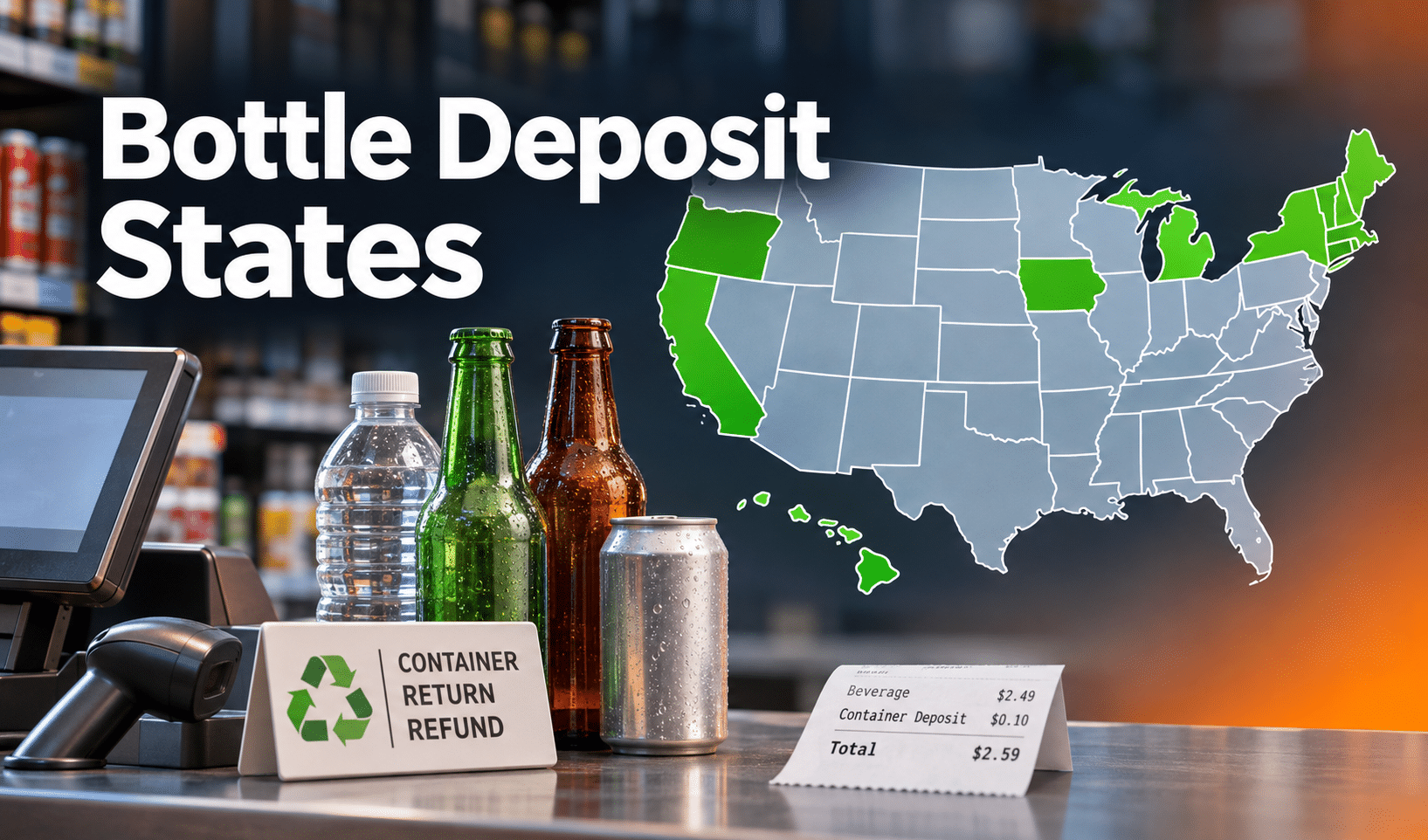
Ten states run bottle deposit programs: California, Connecticut, Hawaii, Iowa, Maine, Massachusetts, Michigan, New York, Oregon, and Vermont. Turn on JavaScript to compare their deposits, redemption rates, and handling fees on an interactive map.
Ten bottle deposit states charge a refundable fee on drink containers: California, Connecticut, Hawaii, Iowa, Maine, Massachusetts, Michigan, New York, Oregon, and Vermont. Amounts run from $0.05 to $0.25 per container, and the rules for stores differ in every state.
Below, you will find the full list with deposit amounts, a breakdown of each program, and what retailers owe in refunds, returns, and record keeping. We also cover recent law changes and show how KORONA POS tracks deposits at the register.
Key Takeaways:
- Ten states, along with Guam, operate bottle deposit programs, from Oregon and California in the West to Maine and Vermont in the Northeast.
- The usual deposit is $0.05 per container. Connecticut, Michigan, and Oregon set it at $0.10, and liquor bottles in Maine and Vermont carry $0.15.
- Retailers across the majority of deposit states have to accept returns of the products they sell. California narrows that duty to shops in zones with no recycling center within reach.
- Deposit money passes through your register without counting as revenue, so give it a line of its own, separate from product sales.
- Expect change. Connecticut doubled its deposit in 2024, and Maine and Vermont overhauled their systems in 2026.
Which States Have Bottle Deposit Programs
Ten states have bottle deposit programs: California, Connecticut, Hawaii, Iowa, Maine, Massachusetts, Michigan, New York, Oregon, and Vermont.
Each one attaches a refundable charge to covered drink containers and repays shoppers who bring the empties back. Guam, a U.S. territory, has a program of its own, and no national deposit law exists.
Oregon passed the first modern deposit law in 1971, and Hawaii came last, in 2002. Delaware once ran a program before repealing it: shoppers stopped paying deposits on December 1, 2010 and had until January 31, 2011 to collect refunds.
Other names for the same laws include bottle bills, container deposit laws, and deposit return systems, all describing one arrangement: a small charge at purchase, repaid on return.
Bottle Deposit Amounts by State
Most bottle deposit states set the deposit at $0.05 per container, three go to $0.10, and a few add higher tiers for wine and liquor.
Connecticut, Michigan, and Oregon apply $0.10 across all covered containers, and California reserves it for sizes of 24 ounces or more. Maine and Vermont attach $0.15 to liquor bottles, and Maine extends that rate to wine.
| State | Deposit per container | Main covered beverages | Where returns go |
|---|---|---|---|
| California | $0.05 under 24 ounces, $0.10 at 24 ounces or more, $0.25 for wine and spirits in boxes, pouches, and cartons | Beer, wine, spirits, and non-alcoholic drinks, with milk excluded | Certified recycling centers, plus stores in unserved zones |
| Connecticut | $0.10 | Beer, malt beverages, malt-based hard seltzer, soda, water, juice, tea, coffee, kombucha, sports and energy drinks | Stores selling the brand, plus registered redemption centers |
| Hawaii | $0.05, plus a $0.01 nonrefundable container fee | Non-alcoholic drinks except dairy, plus beer, wine, and mixed spirits | Certified redemption centers |
| Iowa | $0.05 | Carbonated and alcoholic beverages, including wine and liquor | Participating stores or approved centers |
| Maine | $0.05, and $0.15 on spirits and wine over 50 ml | Almost all drinks, with exceptions such as milk, Maine-made apple cider, and blueberry juice | Dealers and licensed centers |
| Massachusetts | $0.05 | Beer and malt drinks, soda, mineral water | Retail outlets and independent centers |
| Michigan | $0.10 | Beer, malt drinks, soft drinks, carbonated water, mixed wine and spirit drinks | Stores, plus a handful of centers |
| New York | $0.05 | Beer, malt drinks, soft drinks, bottled water, wine coolers | Dealers plus redemption centers |
| Oregon | $0.10 | Waters, soft drinks, other non-alcoholic drinks, beer, hard seltzer, and canned wine. Liquor is excluded | Stores and BottleDrop locations |
| Vermont | $0.05, and $0.15 on liquor over 50 ml | Beer, malt beverages, wine coolers, premixed cocktails, carbonated drinks, liquor | Retailers and redemption centers |
Each container prints its refund value, which reveals the state where the product was sold. Handling fees for stores and drop-off centers differ considerably and appear in the retailer section below.
How Bottle Deposit Programs Work
A bottle deposit program tacks a refundable fee onto a drink’s price and repays it once the shopper returns the empty. The fee pushes people to haul bottles and cans back to a store, not to the trash.
The Deposit Chain From Distributor to Shopper
Money moves from distributor to retailer to shopper, then retraces the route on return. Connecticut’s environmental agency lays out the cycle step by step.
A retailer pays the distributor $0.10 per delivered container, and the shopper pays the retailer $0.10 at checkout.
Once the shopper brings an empty back, the store or center hands over $0.10, and the distributor repays that amount along with a handling fee.
New York’s Department of Environmental Conservation outlines a matching loop and notes that dealers, or the sorting services they contract, sort returned containers for distributors.
Store Take-Back vs Redemption Centers
In the typical program, stores carry the primary duty to accept returns, and redemption centers offer a second route. Michigan, New York, Massachusetts, Connecticut, and Vermont require stores to take back the types of bottles and cans they sell, subject to limited exceptions.
Other programs lean harder on centers: California and Hawaii funnel the bulk of returns to certified sites.
Iowa allows a store to opt out of redeeming when an approved center operates within 10 miles (15 miles in counties of 30,000 people or fewer), provided the store posts a front-door notice naming the nearest one.
Oregon ties store duties to size and location, and its BottleDrop network takes bag drops.
Redemption centers are privately owned, and numerous operators struggle financially.
Stateline reported in 2023 that private centers across deposit states faced money trouble, and the Container Recycling Institute (CRI) says half of California’s centers shut between 2013 and 2022.
Who Keeps Unclaimed Deposits
Where abandoned deposit money ends up depends on the state:
- Michigan: Once the first $1 million feeds an enforcement fund, 75% flows to a state cleanup trust fund and 25% goes back to retailers.
- Massachusetts: The state General Fund receives it.
- Connecticut: The state collects it, and distributors have kept a share since fiscal year 2023.
- California and Hawaii: It stays with the state to support the program.
- Oregon and Iowa: Distributors hold onto it.
- Vermont: The Clean Water Fund receives unclaimed deposits, and the Department of Liquor and Lottery retains the leftover from liquor bottles.
- Maine: Since July 15, 2026, a commingling cooperative owns unredeemed deposits and uses them for program improvements.
State-by-State Breakdown
Bottle Deposit Refund Calculator
At $0.05 per container, $20 takes 400 containers. At $0.10 it takes 200, at $0.15 it takes 134, and at $0.25 it takes 80. Turn on JavaScript to calculate refunds and daily return limits for your state.
Coverage, deposit levels, and return rules differ from program to program. The ten summaries below gather the details a store owner needs.
California
California sets the deposit at $0.05 for containers under 24 ounces, $0.10 for 24 ounces and up, and $0.25 for wine and spirits sold in boxes, pouches, and cartons. Labels call it California Redemption Value, or CRV.
Wine and distilled spirits entered the program on January 1, 2024, and larger fruit and vegetable juice sizes followed. Under CalRecycle’s dealer rules, stores within one mile of a large supermarket have to redeem empties in-store or, since January 1, 2025, join a dealer cooperative, whenever that zone lacks a certified recycling center.
Registered small dealers, those under 5,000 square feet or under $1.5 million in annual revenue excluding fuel, may qualify for an exemption from in-store redemption. CRI reported a 59% redemption rate for 2025.
Connecticut
Since January 1, 2024, Connecticut’s deposit has stood at $0.10 per container. Covered drinks include water, juice, tea, coffee, kombucha, sports drinks, and malt-based hard seltzer, and hard cider dropped out on July 1, 2025.
Shops have to accept the brands they carry throughout normal operating hours, and crushed cans and bottles with legible labels cannot be turned away.
Chain stores meeting state criteria need at least two automated return machines. The share of containers redeemed climbed from 65% in 2024 to 92% in 2025.
Hawaii
Hawaii’s HI-5 program adds a $0.01 nonrefundable container fee on top of its $0.05 deposit.
The Department of Health has kept that fee at $0.01 year after year, and a September 2026 Star-Advertiser report still puts the register charge at $0.06 per container.
PRO TIP!
Labels need the word Hawaii or the letters HI plus the deposit value. Shoppers bring empties to certified redemption centers, which draw handling fees from the program fund. CRI recorded a 52% rate for fiscal year 2024 to 2025.
Iowa
Iowa applies a $0.05 deposit to carbonated and alcoholic beverages, among them beer, wine, liquor, and kombucha. A 2022 law lifted the handling fee to $0.03 per container for participating dealers and approved centers, up from $0.01.
Opt-out routes exist: an approved redemption site within 10 miles (15 miles in counties of 30,000 people or fewer), a mobile redemption system on site, or a licensed food establishment selling time- and temperature-controlled food.
Distributors keep unclaimed deposits. CRI publishes no current rate for Iowa, but its 2022 study put the recovery rate for containers on deposit at 49%.
Maine
Maine runs two tiers: $0.05 on beer, soda, water, and other covered drinks and $0.15 on spirits and wine over 50 milliliters, with miniatures of 50 milliliters or less at $0.05.
Handling fees paid to retailers and drop-off centers have sat at $0.06 per container or higher since September 1, 2023.
A 2023 law, LD 1909, created a commingling cooperative and set October 1, 2026, as the deadline for moving redemption centers from brand-by-brand sorting to material-type sorting. The 2025 return rate was 69%.
Massachusetts
In Massachusetts, a $0.05 deposit covers beer and other malt drinks, soda, and mineral water. Retailers must redeem empties whenever they are open, and distributors reimburse a handling fee of at least $0.0225 per container.
Coverage has stayed narrow, which leaves noncarbonated water, juice, and sports drinks outside the program.
CRI reported 33% for 2025, the lowest among the states with data. Bills to raise the deposit to $0.10 and extend coverage, including H.3464 in the 2025 to 2026 session, have not passed.
Michigan
Michigan sets $0.10 on beer, malt drinks, soda, carbonated water, and mixed wine and spirit drinks.
According to Michigan’s environmental agency, stores must take back containers of the same brand, size, and type they sell, and are allowed to cap refunds at $25 per person per day.
Dumping covered beverage packaging in the trash is illegal. CRI put the state’s redemption rate at 69% in 2025, down 20% since 2019. Violations carry fines and possible loss of a liquor license.
New York
New York’s $0.05 deposit applies to beer and other malt beverages, soda, bottled water, and wine coolers.
Dealers owe refunds on the containers they sell, and distributors pay a $0.035 handling fee.
Retailers may cap returns at 240 containers per customer daily once the required sign is posted, and chains of ten or more outlets have to install reverse vending machines. New Yorkers returned 68% of eligible containers in 2025.
Oregon
Oregon’s deposit stands at $0.10 per container, a level reached on April 1, 2017. Coverage spans non-alcoholic drinks and beer, and canned wine became eligible on July 1, 2025.
Liquor, dairy, plant-based milk, and infant formula sit outside the program. Store duties hinge on size and location, as Oregon’s retailer guidelines spell out, and the BottleDrop network offers bag drops.
State law does not require merchants to charge the deposit, but shoppers are entitled to the $0.10 refund on redeemable packages. At 88%, Oregon posted the second-highest rate in 2025.
Vermont
Vermont puts $0.05 on beer, wine coolers, other malt beverages, premixed cocktails, and carbonated nonalcoholic drinks, and $0.15 on liquor containers over 50 milliliters.
Retailers cannot refuse containers of the kind, size, and brand they sell unless the state approves an exception tied to local redemption centers.
Good to know
A law signed June 17, 2026, raised handling fees to $0.045 for commingled containers and $0.05 for others, and it requires manufacturers and distributors to form a producer responsibility organization by January 1, 2027. Redemption in 2025 came in at 68%.
What Bottle Deposit Programs Mean For Retailers
Operating in a deposit state adds four tasks: charging the deposit, refunding it, processing the empties, and booking the money correctly.
For liquor retailers, those duties join age checks, tax setup, and recordkeeping in the daily routine of liquor store compliance. Each task gets its own section below.
Collecting the Deposit at Sale
A retailer collects the deposit from the shopper at checkout and remits the same amount to the distributor once stock arrives.
Deposits ride along with each delivery, so careful receiving, a basic habit of sound liquor store inventory management, keeps what you owe distributors in line with what you stocked.
Dealers in New York pay deposits to distributors on purchase and collect them from consumers on sale, and Michigan’s consumer protection guidance directs stores to charge the $0.10 deposit on eligible containers.
Printing the deposit on its own receipt line keeps it out of your sales totals. Tax treatment differs by state: California, for example, applies sales tax to the CRV portion whenever the beverage sale is taxable.
Check your own state’s rule with its revenue agency, and consider how pass-through money fits the retail store accounting methods your books follow.
KORONA POS deposit products generate that dedicated receipt line each time a flagged beverage rings up.
Accepting Returns
In a deposit state, a store typically owes a refund on any container matching a kind, size, and brand it sells. Daily minimums shield retailers from bulk dumps:
- Michigan: A retailer can cap refunds at $25 per person per day, though a store cannot reject returns under that figure.
- New York: Under New York’s dealer rules, stores are permitted to limit returns to 240 containers per person per day, or $12.00, once a sign is posted and a 48-hour advance arrangement is offered for larger loads. Food and beverage stores under 10,000 square feet qualify to set a 72-container limit if they offer a daily two-hour window at 240.
- Oregon: Large outlets (5,000 square feet or more) outside redemption center zones accept 144 containers from one customer a day. Smaller shops accept 50, or 24 inside a zone. Returns run from 8 a.m. to 8 p.m.
- Connecticut and Massachusetts: Return hours match regular business hours, and Massachusetts retailers need to accept just 120 containers daily from one person.
Michigan and Oregon both reject a crowded backroom as grounds for turning returns away. Penalties differ: Michigan treats each day of a violation as a separate offense, Massachusetts allows civil penalties of up to $1,000 per violation, and Iowa classifies violations as simple misdemeanors with civil penalties of up to $2,000.
Handling Fees and Storage Costs
Beyond the refunded deposit, distributors pay retailers and redemption centers a handling fee per returned container. State sources give these current figures:
| State | Handling fee per container |
|---|---|
| Connecticut | $0.025 for beer and malt beverages, $0.035 for soft drinks and noncarbonated drinks |
| Iowa | $0.03 for dealers and centers, $0.01 for dealer agents |
| Maine | At least $0.06 |
| Massachusetts | At least $0.0225 |
| New York | $0.035 |
| Vermont | $0.045 for commingled containers, $0.05 for others |
Space is the larger hidden cost. A Central Michigan University article notes that smaller retailers lack automation, so they rearrange layouts or limit how many containers each customer can bring.
Empties pile up in back rooms, basements, and sheds, making disciplined stockroom management part of the deposit routine.
Returns bring a side benefit: retail foot traffic. A TOMRA survey of 7,000 shoppers in seven European countries, covered by Waste360, found that 87% would spend a redeemed deposit in the same store, and 31% would switch stores after long lines or broken machines.
TOMRA sells reverse vending machines and the survey covered European return-to-retail systems, so read the figures as a rough indicator for U.S. stores.
Reverse Vending Machines
Reverse vending machines scan, sort, and compact containers, and they begin the refund accounting the moment an item goes in.
New York has obliged chains of ten or more stores to install them since March 1, 2010, with the number tied to floor space. Connecticut asks chains that satisfy state-defined criteria for at least two machines, a rule that added around 300 redemption sites.
Smaller shops are free to count by hand. Connecticut obliges stores to keep accepting returns when a machine breaks, and Michigan expects hand counts while machines are down.
Machines identify products by barcode. Michigan’s agency notes that returnable containers there carry a code the machine reads to confirm the sale happened in the state, and understanding how barcodes work helps explain why a crushed container sometimes fails the scan.
Retailers must still accept crushed items that are clean and recognizable as Michigan returnables.
Labels and Refund Markings
Redeemable containers bear markings for the state and the amount refundable, and a store refunds only those sold into its own state. Michigan’s statute calls for the refund value and the state name on each container.
California uses CRV, Connecticut uses marks such as CT 10 or CTRV, Hawaii mandates HI or Hawaii with the deposit value in lettering of at least one-eighth inch, and Vermont wants Vermont or VT beside the refund amount.
New York says a container needs a New York refund label to be redeemed.
New labels phase in slowly. After the January 2024 increase, Connecticut let beverages with older labels showing the previous $0.05 amount sell through, so shoppers pay and receive $0.10, whatever the printed mark says.
California gave wine, spirits, and large juice containers until July 1, 2026 to add the CRV label, yet the deposit itself applied from January 1, 2024.
Fraud and Out-of-State Returns
Cashing in empties bought in another state is illegal in deposit states. Michigan’s environmental agency says that carrying in out-of-state containers to collect a deposit breaks the law, and the state enacted its Beverage Container Redemption Antifraud Act in 2008. The Seinfeld episode “The Bottle Deposit” built a plot on the gap between Michigan’s $0.10 and New York’s $0.05.
Connecticut is the current hot spot. A 2024 law made it illegal to return containers not purchased in the state, and a 2026 law, SB 457, bars collecting or charging a refund on containers not bought there.
CRI reports containers crossing state borders, and it flags concerns about how workable the new law is in modern supply chains.
Large volumes, cans missing your state’s mark, and repeat visits by one person all merit a second glance.
Recording Deposits in KORONA POS
Within the KORONA POS features, deposit handling relies on a Deposit Product that attaches to the beverage as a sub-product.
The support manual demonstrates the setup with a 24-ounce Coke bottle and a $0.15 deposit item. Set the amount to your own state’s rate when you build yours.
Setting Up a Deposit Product
- Go to Inventory, then Products, click New, and create the deposit item.
- In the Additional Information box, check “Deposit Product” and save.
- Open the main beverage product, find the Sub-Product box, and attach the deposit item.
- To tie the deposit to a supplier, go to Inventory, then Suppliers, edit the supplier, and select the deposit product in the Order box.
Using Deposit Mode at the Register
Place the button function Switch Deposit Mode on your POS screen, or use Activate Deposit Refundmode and Deactivate Deposit Refundmode as two buttons.
With refund mode active, ring up the same product and the receipt shows a negative line for the deposit. The register skips the product charge in that mode and only credits the deposit.
A small indicator in the top corner beside the cashier’s name is the sole on-screen sign of the current mode, which is why the manual suggests two buttons in place of one toggle. The Deposit Product setup guide holds the complete walkthrough.
Recent Changes and Pending Bills
Connecticut delivered the biggest recent shift, doubling its deposit to $0.10 on January 1, 2024, and dropping hard cider from the program on July 1, 2025. CRI data show redemption climbing from 44% in 2023 to 92% in 2025.
Elsewhere, programs changed in these ways:
- California: Distilled spirits and wine joined on January 1, 2024, and the state is funding new redemption sites.
- Oregon: Canned wine became eligible on July 1, 2025, and SB 992 reshaped store return rules.
- Iowa: A 2022 law boosted handling fees and let retailers opt out once a qualifying center operates within the set distance.
- Maine: A commingling cooperative took over unredeemed deposits on July 15, 2026.
- Vermont: A law signed June 17, 2026, lifted handling fees and calls for a producer responsibility organization by January 1, 2027.
- New York: The 2026 Bigger Better Bottle Bill, which would lift the deposit to $0.10 and widen coverage, stalled.
- Massachusetts: Proposals to increase the deposit and broaden coverage have not passed.
CRI’s August 2026 release keeps the tally of deposit states at ten. Proposals to launch programs have surfaced in Maryland, Washington, Texas, New Jersey, South Carolina, and Rhode Island, where a needs assessment is due December 1, 2026. None of them has become law.
How Well Bottle Deposit Programs Work
Containers on deposit are recycled at 64%, compared with 26% for those sold without one, per CRI’s 2021 data. The 2025 redemption rates in CRI’s August 2026 release reveal a 59-point spread from top to bottom:
| State | 2025 redemption rate |
|---|---|
| Connecticut | 92% |
| Oregon | 88% |
| Maine | 69% |
| Michigan | 69% |
| New York | 68% |
| Vermont | 68% |
| California | 59% |
| Hawaii | 52% (fiscal year 2024 to 2025) |
| Massachusetts | 33% |
Connecticut combined a higher deposit with broader coverage and more machines, and CRI cautions that over-redemption claims and out-of-state containers could be inflating its figure.
Massachusetts held onto a $0.05 deposit and slim coverage, and CRI says it and Michigan have fallen behind on updates.
Critics make fair points. A $0.05 deposit buys less than it did in the 1970s, and certain redemption centers cannot cover costs at current handling fees.
Opponents add that bottle bills act like a tax and saddle merchants with storage and labor burdens. Supporters answer that shoppers recover the whole deposit and that deposit states recycle at higher rates.
Conclusion
Ten states run bottle deposit programs, and amounts, coverage, and return rules vary widely, so owners need the details for their own state.
Build deposit products so the money stays out of your sales figures, confirm your state’s limits and hours, and revisit them each year, since a number of programs changed in 2026.
Liquor retailers comparing registers could start with our roundup of the best POS for liquor stores, then test each option’s deposit handling.
Speak with a product specialist and learn how KORONA POS can power your business.
Frequently Asked Questions
How Many States Have Bottle Deposit Programs?
Ten states, plus the territory of Guam, have bottle deposit programs. Five sit in the Northeast, two in the Midwest, and three in the West. Congress has not passed a federal law, so the list reflects state action alone.
Which States Have a $0.10 Bottle Deposit?
Three states set a $0.10 deposit on all eligible containers: Oregon, Michigan, and Connecticut. California applies that amount only to containers at or above 24 ounces. The rest hold at $0.05 on standard containers, with the exception of $0.15 on liquor in Maine and Vermont.
Which States Lack Bottle Deposit Programs?
The other 40 states have none. Lawmakers in Texas, Washington, Maryland, Rhode Island, South Carolina, and New Jersey have floated proposals, and none has passed.
What Does CRV Stand For on Bottles?
CRV is short for California Redemption Value, the label that flags a container as carrying a California deposit. The same mark sometimes appears as CA Cash Refund.
How Many Bottles Make $20 in Refunds?
Reaching $20 takes 400 containers at $0.05, 200 at $0.10, or 134 at $0.15. Daily caps in certain states may stretch a large haul across multiple visits or call for an advance arrangement.
Can a Store Refuse to Take Back Bottles?
As a rule, no, at least for containers that match products the store stocks. Legitimate grounds for refusal include foreign material inside a container, an Iowa opt-out based on proximity to an approved center, daily caps like Michigan’s $25 limit, and California’s exemption for stores outside unserved zones.
Who Keeps Unclaimed Deposit Money?
The answer changes by state. Michigan divides it between a cleanup fund and retailers, Massachusetts deposits it in the General Fund, and California and Hawaii put it toward program costs. Oregon and Iowa let distributors retain it, Vermont mostly funds clean water projects with it, and Maine hands it to a cooperative.
Can Shoppers Redeem Out-of-State Containers?
No. Michigan’s regulators call the practice illegal, and Connecticut law bans returning containers bought elsewhere. A store pays out only on containers first sold within its own state.