


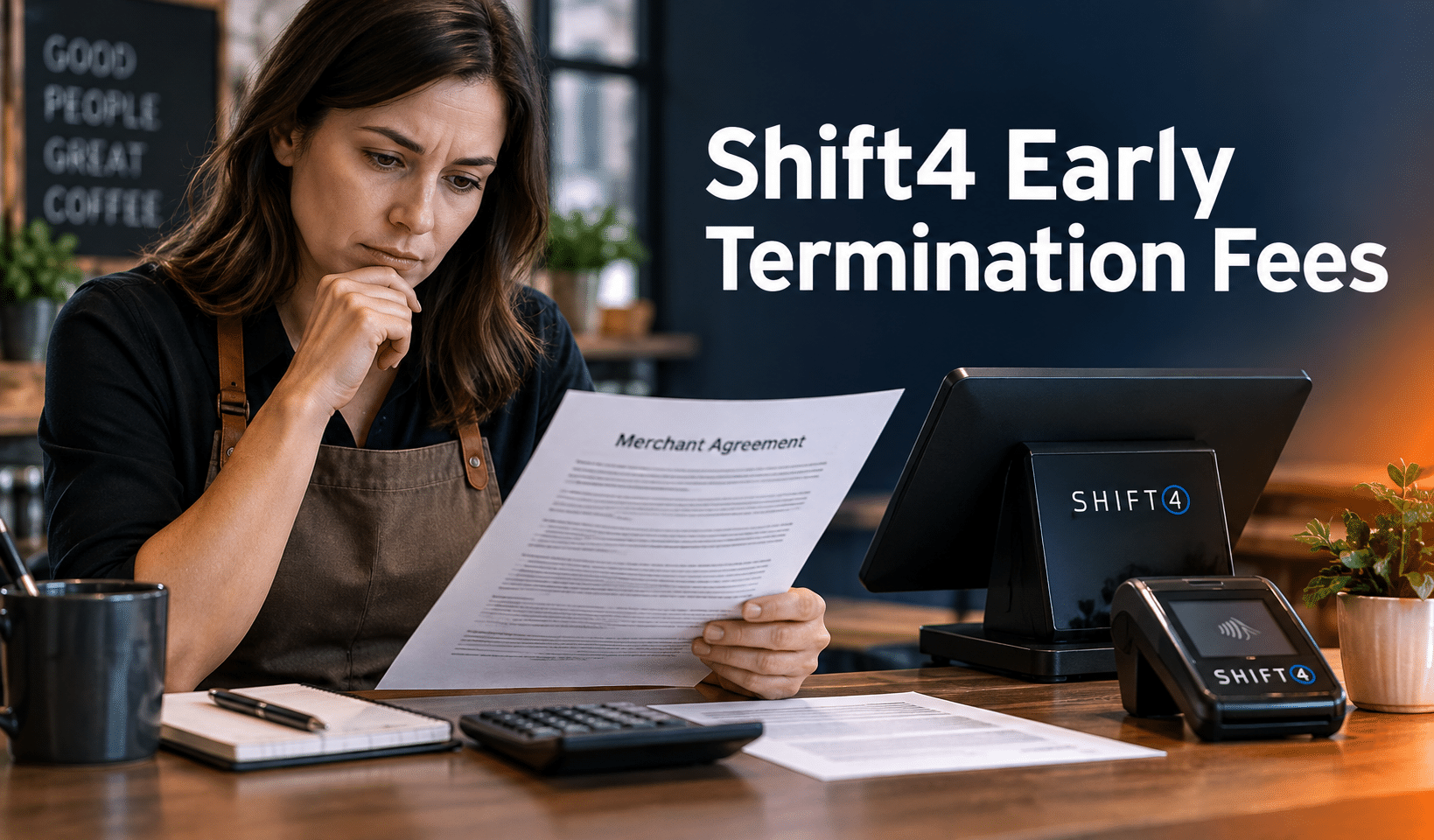
Shift4 Early Termination Fee Calculator
Estimate the liquidated damages a Shift4 processing agreement can charge when a contract ends early. Enter your account details, then compare the result with the written calculation from Shift4.
Uses the Base Monthly Termination Fee table in Shift4’s Merchant Processing Agreement form dated July 1, 2026.
Use the figure entered on the merchant application, in dollars per month.
Count each terminal ID on the account.
Uses the average-fee clause quoted by Retail Systems and Merchant Cost Consulting. Confirm that your signed form contains it.
Average over the prior 12 months, excluding interchange and other pass-through costs.
Enter 0 to 36. Initial terms run 36 months (30 months for contracts signed before December 1, 2025, unless the application says otherwise), and renewals run 12 months.
Help me work out months remaining
Assumes the term started at signing. Your contract may start the clock on a different effective date, so confirm it with Shift4.
Optional Details
Shift4 reserves the right to use the prior three months instead of the application estimate when the two differ materially.
The SkyTab and Pay-at-the-Table agreements charge $75 per terminal for each such period.
Your estimate appears here after you enter the account details and select Calculate Estimate.
Shift4 Early Termination Fees can reach tens of thousands of dollars. One merchant reported a $45,000 charge after trying to cancel a SkyTab POS system.
Shift4's current processing agreement sets the fee by volume tier, terminal count, and months left in the contract.
Below, you will find the formula, the equipment and inactivity charges that can stack on top, real merchant cases, and the 30-day trial deadline.
You will also see recent fee changes, a checklist for leaving, and how an independent POS keeps a processor change separate from a system change.
Key Takeaways:
- Shift4's processing agreement now sets the fee as a per-terminal monthly amount, tied to a processing volume tier, multiplied by how many terminals the account has and the time left on the term.
- Additional bills may arrive alongside it: termination fees under the POS or device contract, inactivity fees, and hardware costs.
- The 30-day trial clock starts on the effective date, which is the install date, the first transaction above $5, or 60 days after shipping, whichever applies. Get that date confirmed in writing.
- After the initial term, the processing agreement renews annually unless the owner sends notice 90 days ahead. Before canceling, collect the contract, the fee calculation, and the renewal date, and arrange a replacement processor.
- A processor-agnostic POS lets a retailer swap processors without swapping systems.
What is a Shift4 Early Termination Fee?
A Shift4 early termination fee is a charge billed to a business that ends a Shift4 agreement before the contract term runs out. Shift4's published Merchant Processing Agreement sets a 36-month initial term that renews for successive one-year terms. That length applies unless the application states a different term or the contract was signed before December 1, 2025, in which case the initial term runs 30 months.
An owner who wants out at the end of a term has to give written notice at least 90 days ahead. Shift4 is far from alone in building contracts that way, and KORONA's guide to POS early termination fees shows how similar clauses work across providers.
Which Shift4 Documents Can Carry a Fee
Many Shift4 customers sign more than one contract. The Merchant Processing Agreement governs card acceptance and holds the liquidated damages clause that functions as the early termination fee.
A separate POS service contract (the SkyTab POS System Service Agreement, covering a system Shift4 renamed Shift4 Dine on May 12, 2026) and device addenda such as Pay-at-the-Table bring their own costs for hardware, inactivity, and termination-related fees. The terms differ from one document to the next and all of them deserve a careful read; a refresher on gateway versus processor roles helps identify which contract a given fee belongs to.
Why Processors Use Early Termination Fees
Processors tie longer commitments to free or discounted terminals, and the fee recoups that subsidy when a customer leaves early.
The SkyTab agreement says as much: the customer receives hardware and software at favorable pricing in exchange for a term commitment.
An earlier Merchant Maverick review framed Shift4's free terminal offer as a three-year contract carrying an early termination fee.
Customer reviews point to disclosure problems. A Capterra reviewer reports that the contract length and fee sit on a separate terms and conditions page rather than in the agreement itself, and a G2 reviewer states that a sales rep described the account as contract-free before a fee applied at cancellation.
KORONA's Shift4 vs Square comparison gives a current look at that hardware-for-term trade, including the 36-month term and the rule that included hardware returns to Shift4 on cancellation.
How Shift4 Calculates Early Termination Fees
The processing agreement now in force multiplies a per-terminal monthly amount, set by the account's volume tier, by the terminal count and by the months still on the clock. Contracts signed on older forms used a different formula; the form on file governs.
The Merchant Processing Agreement Formula
The clause in the form dated July 1, 2026 applies when the contract ends during its term for any reason other than an uncured breach by Shift4.
The owner then owes liquidated damages equal to a base monthly termination fee, pulled from a table keyed to the estimated monthly processing volume on the application, multiplied by the number of terminal IDs and then by the months remaining in the term.
Shift4 reserves the right to substitute the average of the prior three months when actual volume diverges materially from the application estimate.
The base monthly termination fee per device follows eight volume tiers:
- Under $10,000 per month: $100
- $10,000 to $25,000: $250
- $25,000 to $50,000: $300
- $50,000 to $75,000: $350
- $75,000 to $100,000: $400
- $100,000 to $125,000: $450
- $125,000 to $250,000: $500
- Over $250,000: $750
Three inputs drive the total:
- Volume tier: set from the estimated monthly volume on the application, not from fees actually paid; a fee increase leaves the base untouched.
- Terminal count: the amount multiplies by the number of terminal IDs.
- Months remaining: the count drops by one as months pass, and the total shrinks as the term winds down.
Earlier forms worked differently. A clause quoted in a 2024 Reforming Retail article, republished by Retail Systems, set liquidated damages at the average monthly fees payable to Shift4 over the prior 12 months, excluding interchange fees and other pass-through costs, multiplied by the time left in the term.
Merchant Cost Consulting outlines a matching structure and places it in Section 8.5.4, titled Equipment Fee; Early Termination Fees.
Under that older language, an owner who cancels with a year left still pays what Shift4 would have earned from the account over those twelve months, and Shift4's own fee increases lift the base. Because contract versions change, the signed copy controls the outcome.
In mid-November 2025, Shift4 notified customers that updated Merchant Processing Terms would take effect December 14, 2025, with continued use counting as acceptance. Confirm which version governs the account.
POS and Equipment Agreement Charges
Shift4's POS and device contracts layer additional costs over the processing agreement. Two documents posted on Shift4's site illustrate how.
- SkyTab POS System Service Agreement (form dated March 2025):
- Processing: using the hardware requires exclusive use of Shift4 processing, and Shift4 bills an inactivity fee of $75 per terminal for every 30-day stretch in which processing stops.
- Termination: ending the contract after the Effective Date for reasons other than an uncured Shift4 default counts as a material breach, and Shift4 has the right to debit the fees derived from the termination within 30 days.
- Equipment: unreturned hardware, or hardware that comes back damaged beyond normal wear, is billed at Shift4's full cost.
- Annual fee and debits: a $199 Annual Program Fee per terminal ID, capped at two per merchant ID, a $25 fee per rejected debit, and an ACH authorization that survives termination as long as fees remain owed.
- Fee amount: the public terms state no dollar formula for the termination fees; request Shift4's calculation in writing.
- Pay-at-the-Table Device Service Agreement (form dated August 2024):
- Term: a one-year initial term, automatic one-year renewals, and 30 days' notice to stop a renewal.
- Fees: an identical $75 per terminal inactivity fee and a $99 Annual Program Fee.
- Termination: an owner who terminates before the install date must return the hardware within 15 days, and matching material breach and 30-day debit language governs a termination after installation.
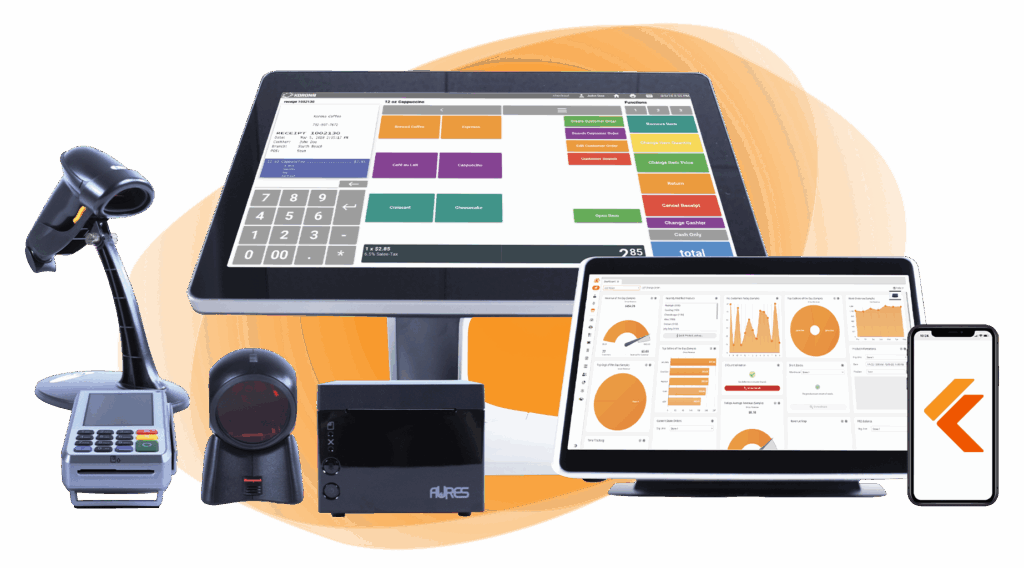
Build Your Own POS
Whether you run a retail store, café, or admissions booth, we have the point of sale hardware designed for your specific needs. Start building your ideal POS system now.
Worked Example
The figures below are hypothetical and show only how the current formula scales. Actual contracts differ in tier, terminal count, term, and add-on charges.
- Under $10,000 tier, 1 terminal, 12 months remaining: $100 × 1 × 12 = $1,200
- $25,000 to $50,000 tier, 2 terminals, 24 months remaining: $300 × 2 × 24 = $14,400
- $125,000 to $250,000 tier, 3 terminals, 30 months remaining: $500 × 3 × 30 = $45,000
- Over $250,000 tier, 4 terminals, 36 months remaining: $750 × 4 × 36 = $108,000
The third line matches the size of the reported cancellation fee in the case below, but the basis for that figure was not published, so the example illustrates scale alone. That $14,400 account would owe $7,200 with 12 months left.
Hardware, inactivity, and other charges would add to these totals. An account on the older average-fee language, with $900 in average monthly fees and 24 months remaining, would owe $900 × 24 = $21,600.
Real Merchant Cases and Typical Costs
Reported Shift4 termination charges in the sources found run from $525 to $45,000, depending on volume, contract type, and time left on the term. The formula itself allows higher totals, as the worked example shows.
The $45,000 Cancellation Fee
Reforming Retail's December 30, 2025 post describes a business with about $1.5M in card volume that inherited a SkyTab POS when it took over a lease.
According to the post, the owner signed a Shift4 agreement, found the system unsuitable, and contacted Shift4 regarding the return of the equipment before the trial period ended.
Shift4 answered with a $45,000 cancellation fee. A lawyer then sent a letter arguing that the 30-day trial clause entitled the business to cancel without penalty.
The post characterizes the fee as anticipated profit over the term, whereas the published clauses covered above use a volume-tier or average-fee formula. None of the sources found report how the dispute ended.
Smaller Charges From Review Sites
Capterra reviews show the lower end of the range. One reviewer cites $525 in early termination fees alongside added monthly fees and a contract the reviewer says was added with no notice. Another says the contract length and fee were disclosed solely on a separate terms page.
A G2 reviewer recalls a sales rep calling the account contract-free before a fee hit at cancellation.
These are unverified customer accounts, Shift4's Capterra profile carries positive reviews too, and Shift4 frequently answers Capterra reviewers by inviting them to contact its reviews team.
The 30-Day Trial Period and Effective Date Rules
The SkyTab POS System Service Agreement lets a customer cancel penalty-free within 30 calendar days of the Effective Date; missing the deadline leaves the contract in force.
The trial is not entirely free. All charges under the processing agreement and the service agreement continue during it, the owner pays shipping in both directions plus wiring completed, and equipment added later does not earn a new trial.
How the Effective Date is Defined
Effective Rate Calculator
Enter your totals from last month's statement.
Above 3%? Your pricing model or markup may be worth renegotiating.
The contract defines that date in three steps. First comes the date Shift4 installs the system at the business location. If no installation date is recorded, the hardware counts as installed once the business processes one transaction above $5.
If there is neither an installation date nor processing activity, the hardware counts as installed 60 days after the shipping date. The contract additionally requires installation within 60 days of shipment, after which the date is deemed to have occurred.
Why Inherited Systems Complicate the Date
A system already in place when a new owner takes over carries no installation date tied to that owner.
In the reported case, the lawyer's letter argued that the $5 rule applied. Under that reading, the first processed transaction, no earlier than November 1, 2025, started the clock and the business could cancel through at least December 1, 2025.
According to the letter, the business executed its application on November 1 and requested cancellation effective November 30. It further states that a Shift4 phone representative called cancellation impossible, and an email followed with no stated reason.
Steps Inside the Trial Window
Owners inside the trial window typically put the cancellation on paper, keep copies of all messages, and ask Shift4 to document the start date.
Because the agreement authorizes a debit upon receipt of the cancellation notice and puts return shipping on the customer, expect charges and compare them against the contract's terms.
Notice methods vary by version; follow the delivery method the owner's own paperwork specifies. The information here is general and not legal advice.
Fees That Raise the Cost of Staying or Leaving
Stay or Switch Break-Even Calculator
Compare paying an early exit fee to switch now with waiting for the contract term to end. Enter your numbers, or send the estimate from the termination fee calculator.
Your comparison appears here after you enter the details and select Compare Options.
Several Shift4 fee changes between March 2025 and August 2026 raised the monthly and annual cost of staying, which shifts the math on whether to leave.
Fee Changes Merchants Report
Merchant Cost Consulting tracks the changes below in its history of Shift4 rate increases and updates.
- March 1, 2025: a rate increase of 0.05% plus $0.03 per transaction.
- July 1, 2025: a new Month End Billing Fee of 2 basis points on total sales volume.
- September 1, 2025: a rate increase of 0.07% plus $0.05 per transaction, a $20 monthly BMS Portal Fee, and a $50 monthly Premium Monthly Support and Service Fee per merchant ID.
- December 2025 statements: a Regulatory Assurance Fee of $325 per device, capped at three devices ($975).
- March 2026: the Month End Billing Fee rose to 0.05% from 0.02%.
- August 2026: Shift4 consolidated its annual fees into one Annual Service and Maintenance Fee, announced in June 2026 and applied to select accounts. It replaces the Annual Program Fee and the Regulatory Assurance Fee. That source has seen notices from $1,500 to $2,000 a year and notes that the amount varies by account.
Annual fee schedules differ by document. The SkyTab agreement shows a $199 Annual Program Fee and the Pay-at-the-Table agreement shows $99. Compare statements against whichever one applies. Merchant Cost Consulting adds that Shift4 publishes $250 per device and that one client paid $99.
Both agreements let Shift4 change fees on 30 days' written notice and, after the first year, to raise aggregate fees by the greater of the consumer price index plus 1% or 4%.
How Fee Increases Change the Math
Under the current formula, the exit price follows the tier, the number of terminals, and the time remaining. Fee hikes, therefore, make staying more expensive while the exit price holds steady, and that price shrinks monthly as the term winds down. On older average-fee contracts, higher fees lift the termination amount as well.
Owners should weigh the projected fee increases over the remaining months against the termination total, and the processing agreement's 90-day non-renewal notice sets the deadline for stopping a renewal. Those who stay have room to trim costs, and KORONA's list of ways to lower merchant fees offers places to start.
What Merchants Report Doing Before They Cancel
Reforming Retail's follow-up post lists three steps that other merchants reportedly took against Shift4 termination fees: hire a lawyer, block debits at the bank, and let Shift4 pursue its own claim. The practical checklist below adds the document and timing steps that post skips.
Request the Paperwork
Ask in writing for the signed contracts with their form dates, the term end date, the volume tier and terminal count on the account, and Shift4's termination calculation. Include hardware or lease obligations. A written request leaves a paper trail.
Get a Lawyer to Read the Agreements
That follow-up advises hiring a lawyer and concedes the cost. An attorney's review covers the signed documents, the trial period and start-date language, and the available options.
The contracts add procedural limits: disputes go to binding individual arbitration with a class action waiver, a written notice of dispute must go by certified mail or signature courier before arbitration starts, and claims must be filed within one year of the date they could first be filed.
Reforming Retail separately claims that Shift4 would struggle to enforce its fees, which is the site's opinion; outcomes depend on the signed documents and applicable law.
Line Up a Replacement Processor First
Losing the ability to take cards costs more per day than any fee. Open the new account and test it before a cancellation notice goes out.
The test should confirm how the new processor connects to the POS, and KORONA's walkthrough on integrating payments with a POS spells out the steps.
Handle Bank Debit Blocks With Care
Per the follow-up, some owners ask their bank to block Shift4 debits, free at some banks and around $50 at others, which forces Shift4 to pursue its own legal route.
Shift4's contracts include ACH authorizations that survive termination and allow termination fees to be debited within 30 days, so a block could trigger a dispute of its own. Raise the idea with an attorney before acting.
Questions to Ask Before Signing Any Processor Agreement
- How long is the initial term, how does renewal work, and how much written notice does non-renewal require?
- What formula sets the termination fee, which volume tier applies, and how many terminals count?
- Does a free or discounted terminal extend the commitment?
- Who owns the hardware, and what does returning it cost?
- Can the processor raise fees, and with how much notice?
- How is the trial period defined, and what starts the clock?
- Which documents make up the full agreement (processing, POS, device), and what are the termination terms in the individual documents?
- Are the salesperson's promises written into the contract?
Why Bundled POS and Processing Contracts Raise the Cost of Leaving
Bundling a POS with processing makes leaving costlier, since ending the processing relationship can force a POS replacement, a hardware return, and staff retraining all at once.
What Bundling Adds to an Exit
The SkyTab agreement ties the system to Shift4 processing. Using the hardware requires exclusive use of Shift4's processing services, Shift4 charges $75 per terminal for any 30-day span with no Shift4 processing, and Shift4 reserves the right to stop the software from working.
Reforming Retail's 2024 article, republished by Retail Systems, profiles a restaurant doing about $18M a year that signed a 2023 Shift4 processing agreement because the sole alternative was leaving a POS product Shift4 had acquired. According to the account, the owner was promised a flat rate and later found its rates had risen three times.
Merchant Cost Consulting credits Shift4 with strong technology for food and beverage merchants.
Retailers may still end up with the company through an inherited system, as in the $45,000 case, or a sales agent's pitch.
Owners comparing platforms will find processor lock-in and reseller contract terms side by side in KORONA's Clover vs Shift4 breakdown.
How a Processor-Agnostic POS Changes the Picture
KORONA POS is processor-agnostic software for specialty retail, including liquor stores, smoke and vape shops, convenience stores, and CBD retailers.
Because the software is tied to no one payment processor, a retailer can move to a different processor without replacing the POS itself.
Terminal and gateway compatibility require confirmation with the new processor, and an existing processing contract deserves close scrutiny, but the expense of leaving shrinks to the processor contract alone.
Retailers who want the reverse, a new POS on the processor they already use, will find KORONA's guide to choosing a POS without changing processors.
Speak with a product specialist and learn how KORONA POS can power your business.
Shift4 Early Termination Fees: What to Know Before Canceling
In short, the current fee multiplies a per-terminal tier amount by the terminal count and the months still owed, and hardware and inactivity charges tend to follow.
Two dates deserve attention first: the end of the 30-day trial and the 90-day non-renewal cutoff. Before canceling, get the contract, term, renewal date, and fee calculation documented.
Frequently Asked Questions
How Long Are Shift4 Contracts?
Current Merchant Processing Agreement forms start at 36 months and then renew year by year, and stopping a renewal takes written notice 90 days before expiration. Contracts signed before December 1, 2025 begin at 30 months, and an application may specify its own term. The March 2025 SkyTab form names 30 months; Pay-at-the-Table names one year.
Can Shift4 Charge a Termination Fee Without Any Processing Activity?
Yes, per the published terms. The damages formula draws on the application's tier, the terminal total, and the contract's remaining life; fees paid play no part.
Shift4 reserves the right to swap in the prior three months' average volume if activity deviates significantly from the estimate. Idle terminals trigger a $75 inactivity charge per 30-day period under the SkyTab and Pay-at-the-Table forms.
Can Merchants Negotiate the Shift4 Termination Fee?
Leverage peaks before signature. Merchant Cost Consulting recommends asking Shift4 to strike the liquidated damages provision up front and expects amendment to be unlikely later.
Once signed, the reported case leaned on a lawyer's review and the trial-period argument, and owners should ask Shift4 which tier and terminal count it applied to the account.
Which Terms Apply When a Merchant Inherits a Shift4 System?
Where no install date exists, the SkyTab form treats the first transaction over $5 as the install date, and, if no processing happens either, it assumes installation occurred 60 days following shipment.
A new owner should record the signing and first transaction dates, request written confirmation of the Effective Date, and have an attorney read the paperwork before signing anything.
Does the Fee Still Apply After Auto-Renewal?
The fee is triggered by ending the contract during a term, and a renewal period counts as a term. Giving notice 90 or more days before expiration sidesteps it.
Missing that cutoff starts another one-year period, and leaving during it could reapply the formula to the remaining months. The 2025 SkyTab form sets a shorter 30-day notice; compare the notice clauses across documents.
What Happens to Equipment After Cancellation?
Once cancellation paperwork is done, Shift4 supplies shipping labels, and the SkyTab form gives 60 days from termination to send hardware back.
Hardware that never comes back, or returns worn beyond ordinary use, is invoiced at what it cost Shift4, and Shift4 keeps a security interest in it. Pay-at-the-Table has a shorter window: 15 days after a termination that precedes installation.